Downtime Cost of Unplanned Robot Reprogramming Events
Most plants drastically undercount the true cost of robot reprogramming downtime.

The manufacturing sector loses roughly $253 billion a year to downtime, and most of it isn't random. Process drift, product changeovers, and quality escapes that build for shifts before anyone pulls the plug account for the bulk of it. Robot reprogramming events belong in that category, and they get undercounted worse than almost anything else on the plant floor, because the accounting starts the clock in the wrong place. A teach pendant reprogramming event takes the robot fully offline: no partial workaround, no running half a cell while the other half gets touched up. The operator switches to manual mode, the line stops, and it stays stopped until the program is rewritten and verified.
Automotive plants lose an estimated 18 to 27% of production efficiency annually to unscheduled downtime, teach pendant delays, and path-drift quality failures combined. Reprogramming is its own category, distinct from mechanical breakdown. It's its own line item, and most plants still file it under the wrong category.
The production loss layer: what the clock costs
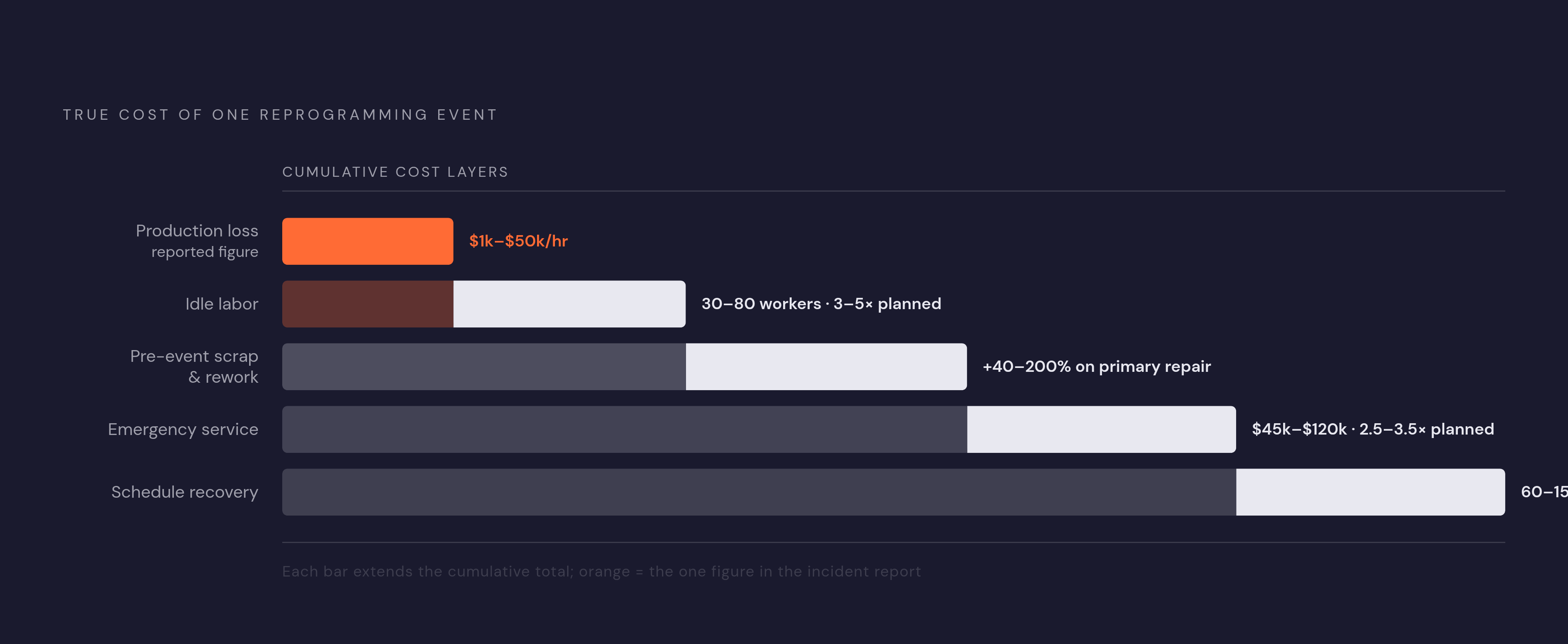
Start with the number everyone already tracks: the hourly rate. Estimates put the cost of a single downtime hour anywhere from $1,000 to $10,000, and at scale that climbs past $600,000 depending on the plant and sector. Automotive is where this turns serious fastest. Downtime there runs closer to $50,000 a minute, and a bad event, one that drags across a shift or more, can approach $3 million before anyone even touches idle labor or scrap.
The Aberdeen Group has put the average manufacturing downtime hour at about $260,000; a separate ServiceMax survey landed close to $250,000. Two independent estimates that close together deserve to be taken seriously. When ABB and Sapio Research surveyed 3,600 senior manufacturing decision-makers, 83% said unplanned downtime costs at least $10,000 per hour, and 76% put the ceiling as high as $500,000. Nobody in that survey called the cost small, and the plants that still budget for downtime like it's a rounding error are the ones getting the number wrong.
The idle labor layer: workers and supervisors on the clock while the line is stopped
The production-loss figure is the one that lands on the incident report. It's also, consistently, the smallest of the layers, and treating it as the whole cost is the first mistake most plants make. Idle labor is usually where the real total starts to separate from the reported one.
During a reprogramming event, operators, material handlers, quality inspectors, and shift supervisors stay on the clock, drawing full wages, producing nothing. On a mid-size line that can mean dozens of people standing around a stopped robot cell. Nobody sends them home mid-shift and calls them back an hour later; labor cost accrues in full whether the line is moving or not. Industry analysis puts the reactive-maintenance premium at 3 to 5 times the cost of planned maintenance, and an unplanned reprogramming event is reactive by definition. There was no work order for it. Nobody scheduled the idle time. It happened, and payroll doesn't ask why.
The scrap and rework layer: how path drift accumulates defects before the stoppage is even declared
Reprogramming events rarely start with an alarm. They start with a robot arm drifting a millimeter or two off its programmed path, a drift too small to trip a fault code but large enough to start putting parts out of tolerance. Path deviation comes first, then a spike in quality rejects, and only after that does someone actually call the line stoppage. By the time it gets logged, the damage has been accumulating for shifts.
That means most of the scrap and rework tied to a reprogramming event happened before the event officially began. Standard incident accounting misses almost all of it, since the clock starts at the stoppage, not at the first bad part. iFactory notes that uncontrolled failure modes frequently damage adjacent tooling, dies, and in-process product, adding another 40 to 200% on top of the primary repair bill. A drifting weld gun doesn't just produce bad welds; it chews up the fixture it's welding into, and that damage gets discovered on a different shift, by a different team, weeks before anyone connects it back to the original drift.
The emergency service and specialist labor layer: what it costs to bring in outside help
A planned maintenance call, with a technician who already knows the cell, runs $1,200 to $3,000, and that's the baseline. A planned maintenance call, with a technician who already knows the cell, runs $1,200 to $3,000, and that's the baseline.
Emergency service calls tied to reprogramming incidents run $45,000 to $120,000, an order of magnitude above routine maintenance. That premium pays for mobilization fees, after-hours rates, and the plain fact that a specialist willing to drop everything on short notice charges accordingly. Emergency repairs generally run 2.5 to 3.5 times the cost of the same scope done on a planned basis, and the gap is entirely about timing, not technique. Teach pendant reprogramming takes a narrow, specific skill set, and when in-house staff can't execute it, the plant has to find someone who can, fast, with zero negotiating leverage. That is not a position any plant manager wants to be in twice.
The schedule recovery layer: the cost of catching up after the event ends
The event ending doesn't end the cost. Getting the schedule back on track carries its own substantial cost on top of the direct downtime loss. The financial tail of a reprogramming event is often longer, and more expensive, than the event itself.
Recovery means overtime shifts, weekend production runs, and expedited changeovers, each carrying its own markup. In automotive and other OEM supply chains, the exposure extends to late delivery penalties, airfreight charges to substitute for a missed ground shipment, and damage to customer satisfaction scorecards that shows up on no invoice anywhere. In B2B buying, research consistently finds that most buyers, in one figure as high as 68%, have already picked a front-runner supplier before the first sales call happens. A track record of late deliveries is what keeps a supplier from being that front-runner next time. That's a cost with no line item, and it's also the one plants are worst at pricing in.
Calculating the full cost of a single reprogramming event
Adding it up clarifies the shape of the problem. Production loss, the number that gets reported, sits at one end. The number that's actually true, once idle labor, pre-event scrap, emergency service, and recovery costs get folded in, is considerably higher, and most of that gap goes untracked in standard plant reporting.
Walk through a mid-volume automotive plant. Production loss alone, for that sector, runs from a substantial sum to several times as much per significant event. Idle labor for 30 to 80 workers on full shift pay adds on top of that. Then add scrap accumulated across shifts before the stoppage was ever declared, cost that standard accounting never attributes back to the event. Add $45,000 to $120,000 in emergency service. Add 60 to 150% of the direct downtime loss for recovery. None of these are hypothetical add-ons. They're documented cost categories that simply don't get totaled together in most plant reporting, which is the whole problem.
The pattern holds at the fleet level, too. The operational cost of running an industrial robot makes up as much as 40% of its total cost of ownership, and downtime specifically accounts for 6.6% to 27.5% of that operational spend. Reprogramming events are a concentrated driver inside that band. Over five years, the total cost of owning an industrial robot runs 2.5 to 3.5 times the price of the hardware itself, and downtime, reprogramming downtime chief among it, decides where in that range a given deployment actually lands.
The frequency multiplier: how often reprogramming events occur
None of this matters much if it happens once a decade. It doesn't happen once a decade. The typical robot fleet runs 5 to 15% unplanned downtime, and most of it is preventable, which is a very different claim than saying it's rare.
Component failure, motors, belts, sensors, power supplies, accounts for about 65% of unplanned downtime industry-wide. Reprogramming events sit outside that category entirely, driven by process drift and changeover volume rather than a part wearing out. For high-mix manufacturers running frequent SKU changes or custom parts, reprogramming frequency scales more or less linearly with product variation. Every new part number is a potential trigger, and that's the detail fleet-reliability numbers hide.
Industrial robots run an average mean time between failures of around 62,000 hours, roughly seven years of continuous operation, and on its own that sounds like a machine that almost never breaks. MTBF measures mechanical failure, though, and says nothing about programming drift or changeover-driven reprogramming, which runs on a much shorter cycle, sometimes weeks, sometimes days on a high-mix line. A robot can be mechanically flawless and still be a reprogramming liability every time a new part comes down the line. Anyone reading MTBF as a proxy for total downtime risk is measuring the wrong thing.
What changes when manufacturers quantify reprogramming downtime accurately
Once the hidden layers get counted instead of ignored, the math around prevention flips. Offline programming tools cost $15,000 to $40,000 upfront, steep next to a $3,000 to $5,000 reactive fix, until idle labor, scrap, emergency service, and recovery costs are added to the other side of the comparison. At that point the offline tool is the cheap option, not the expensive one, and treating it as a discretionary upgrade is the second mistake most plants make.
Predictive maintenance systems built on early failure detection report 30 to 50% reductions in unplanned downtime and 20 to 40% longer useful equipment life, though those gains only read as real savings once the baseline cost gets measured honestly. Manufacturers who've cut unplanned stops by 40 to 60% generally did it the same way: they replaced threshold alarms, which fire only after something's already broken, with systems that catch failure signatures 48 to 96 hours ahead of a forced stop. That shift turns a reactive reprogramming event into a planned one, and it's where the roughly fifteen-fold gap between planned and emergency work actually gets captured, not theorized about.
Industry data on predictive maintenance points to meaningful downtime reduction and savings on maintenance spend. Plants that have adopted this approach consistently report that the savings materialize in the first year of running it. The plants that get ahead of reprogramming events aren't running better robots than everyone else. They finally sat down and counted what the old events actually cost, and stopped pretending the incident report told the whole story.
Sources
- A factory robot arm priced at $65,000 carries a verified real-world bill of up to $195,000, and a single hour of unplanned downtime at scale can rival that entire deployment cost in one shift
- onrobot.com
- Unplanned Downtime Costs $253B Annually: Prevention Guide
- Robotics Maintenance Costs: Operating Efficiency Data
- AI Robotics in Automotive Manufacturing
- robotomated.com
- downtime cost