Robot Programming Time Comparison by Teach Method
Choose the wrong teach method and robot downtime can cost your shop tens of thousands.
Robot programming time is not a fixed cost. It swings by a factor of ten or more depending on which teach method a shop picks, yet most engineers still price it like a flat hourly rate, treating a job that could eat a robot's whole shift the same as one that leaves it running untouched. Four methods share the shop floor today: teach pendant, lead-through (also called kinesthetic teaching), offline programming, and the newer AI-driven natural language systems. Pendant and lead-through stop the robot cold to program it. Offline programming and AI-assisted generation let the robot keep making parts while the new job gets built somewhere else, on a laptop, in simulation, far from the cell floor. That split, robot time spent against engineer time spent, is the variable that actually decides which method wins, and most shops still get the trade backwards: they buy the fancy simulation seat for a job a pendant would've knocked out in an afternoon, or they keep hand-teaching hundred-point paths on a robot that should've gone offline years ago.
Teach pendant programming: the default method and its real time cost
A teach pendant is the handheld unit that ships with nearly every industrial robot on the market, touchscreen now in most cases, and it runs on brute repetition. The operator jogs the arm to a position, records that point, moves to the next one, records again, and keeps going until the whole path exists as a string of individually taught coordinates. It's slow by design and stays the default anyway, because it needs no extra software, no digital twin, no simulation license. Just the controller the robot already came with in the box.
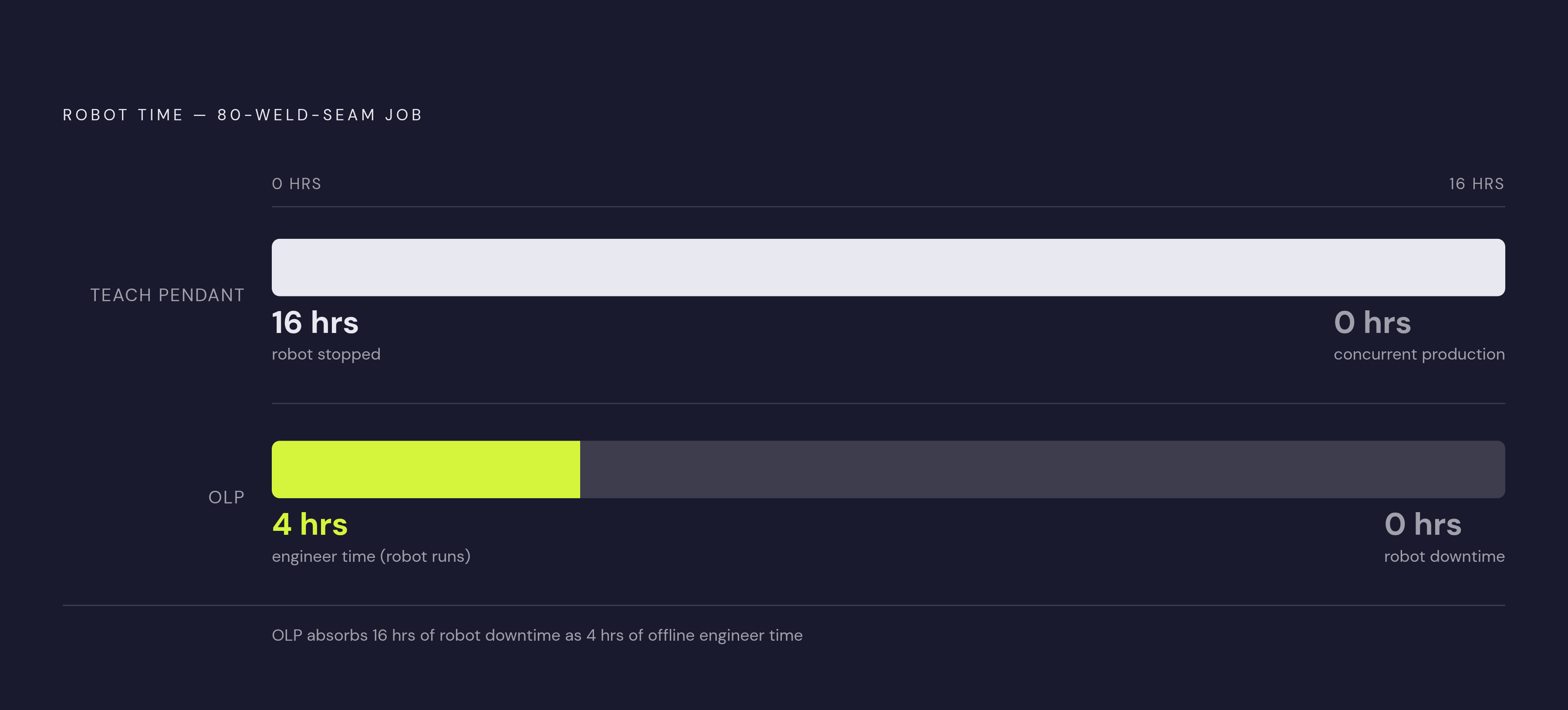
That simplicity carries a cost, and it appears on the shop floor in an ugly, specific way. A fabricator running three welding robots can lose 40% of each robot's shift to programming and setup, and none of that 40% turns out a single part, because pendant teaching happens with the robot standing dead still. Take an 80-weld-seam part with joints at varied angles: taught point by point on a pendant, that job eats two full shifts, roughly 16 hours of robot downtime, before the first production weld gets laid down. Sixteen hours is a welding cell that might cost six figures sitting idle, earning nothing for anyone.
Lead-through programming: speed through physical demonstration, with constraints
Lead-through programming swaps typing for touch. The operator grabs the arm and physically walks it through the motion, and the controller logs joint values continuously along the way instead of waiting for someone to stop and hit "record" at each point. Demonstration beats manual data entry as a way to communicate a path, since the operator draws the trajectory with their own hand rather than specifying coordinate after coordinate. The advantage is greatest on freeform work like gluing, sealant application, or polishing, where the path curves continuously and pendant-style point capture would take forever to approximate.
Lead-through only works if the operator can stand next to the arm and push it around safely, and that limits the method almost entirely to collaborative robots, the smaller, lower-power arms built for contact with a human body. Nobody should be muscling a six-axis industrial arm through a weld path by hand at full payload speed, so lead-through is functionally off the table for most heavy industrial installs.
Lead-through is still an online method, and that matters more than the demonstration speed does. The robot sits stopped from production exactly the way it does during pendant teaching, so the real gain is programming speed inside a downtime window that was going to exist anyway, not downtime elimination. It's programming speed inside a downtime window that was going to exist anyway.
Kinesthetic Teaching Versus Joystick and Gesture Alternatives: User Study Findings
Demonstration-based teaching has its own academic literature, separate from shop-floor time studies, and one of the more direct comparisons comes from a paper out of CIIRC CTU, authored by Vanc, Behrens, Hlaváč, and Stepanova. Eight participants ran through three manipulation tasks, comparing kinesthetic teaching against joystick control and hand-gesture input, using path length as a stand-in for how clean and efficient each demonstration turned out.
The numbers split clearly, and kinesthetic teaching wins the headline comparison. Mean demonstration path length came in at 1.7 meters for kinesthetic teaching, 2.3 meters for joystick, and 2.5 meters for gesture, with kinesthetic producing the shortest, smoothest trajectories across all three tasks tested.
Once task type enters the picture, though, the ranking flips. Joystick teleoperation beat kinesthetic teaching on simple peg-picking, a task with no orientation sensitivity to punish an imprecise move. Kinesthetic pulled back ahead on tasks that were orientation-sensitive or involved sustained contact, where a hand naturally encodes force and angle information a joystick can't capture as directly. Gesture-based control outperformed what the researchers expected going in, and it stands as a workable contact-free option wherever touching the arm isn't practical or allowed.
That result sits in tension with other findings in the demonstration-teaching literature, where indirect input methods have shown competitive motion quality against kinesthetic guiding depending on task design. The CIIRC CTU paper points in the other direction. Read together, the two studies say task type does most of the work in deciding which method wins. No fixed hierarchy of demonstration methods sits above the task itself, and anyone claiming otherwise is selling a method, not reporting a result.
Offline programming: front-loading time to protect production
Offline programming, OLP for short, moves the work off the robot. Engineers build a digital twin of the cell, kinematics, tooling, fixtures, the workpiece itself, then write, test, and refine the robot program inside that simulation. The physical robot never has to stop, because the program gets built and validated elsewhere and only gets loaded onto the arm once it's actually ready to run.
Go back to the 80-weld-seam part. Taught on a pendant, that job costs 16 hours of robot downtime. Built in OLP, the same program takes about four hours of engineering time, and the robot keeps producing parts the whole time it's being written. That's a fourfold improvement on the downtime side of the ledger for this one benchmark, and the four hours of engineering time is a cost the production line never has to feel.
Industry reporting backs the direction of that number: online programming for complex welding sequences can stretch the process far beyond what OLP requires, with a meaningful cut in production downtime attached to the offline approach. A 2026 buyer's guide puts the broader claim at a 60 to 80 percent reduction in programming time for offline methods against manual approaches, which lines up with the fabricator example.
AI and natural language programming: compressing time at the program-generation layer
AI-driven programming doesn't replace OLP so much as remove the engineer from the slowest part of it. Instead of a person hand-building paths inside simulation software, an LLM or a vision-based system generates the program straight from a task description, a 3D scan of the part, or a plain-language instruction, cutting out the skilled-engineering bottleneck OLP still depends on.
A handful of production-ready examples already show what this looks like on a shop floor. Universal Robots' AI Accelerator is a kit that adds AI-powered cobot capabilities, launched in late 2024 and designed to accept task descriptions as inputs. Elephant Robotics' myCobot Pro 450 works with large language models including DeepSeek and ChatGPT, along with embodied intelligence models such as LeRobot, and it can run off spoken voice commands instead of code. ROS-LLM, an open-source system published in Nature Machine Intelligence, lets someone with no robotics background control a robot through natural language and teach it new skills through demonstration and feedback.
The biggest claimed time compression comes from AI-assisted systems that turn a 3D scan directly into a weld path, no design-file import, no manual point placement. On standard geometries, these systems are reported to cut first-piece programming time substantially against manual OLP, with the largest gains showing up in high-mix job shops that swap parts several times a day. Separately, industry observers have made a related point about cobots specifically: even though cobots are already easier to program than traditional industrial arms, adapting them quickly to new jobs in fast-changing production remains a genuine challenge. That's exactly the managerial pain point AI-driven no-code tools are being built to solve.
Matching method to context: the decision variables that determine which time profile wins
None of these four methods is simply "the fastest." Each trades a different kind of time, and the right choice comes down to which kind of time a given operation can least afford to lose. Robot downtime and engineering hours are not the same currency, and shops that price them as if they were make bad calls, full stop.
Pendant and lead-through spend robot production time. OLP and AI-assisted generation spend engineer time instead. A high-throughput welding cell running three shifts, where uptime is worth real money every hour, should weight the engineering-hour cost more favorably even when the raw hour count on paper looks bigger. Get this backwards and you end up buying an OLP license for a job a pendant would've handled by lunch.
Part complexity sets a hard ceiling on pendant teaching. A path with a few dozen points is manageable by hand. Past that line, a path with a very large number of points makes offline or AI-assisted generation the strongly preferred choice, because manual pendant teaching becomes increasingly impractical at that density. Anyone still hand-teaching a hundred-plus-point path on a pendant is burning robot hours that OLP would have recovered in an afternoon.
Changeover frequency changes the whole calculation. In a high-mix shop switching part numbers several times a week, the parallel-path advantage of OLP compounds with every new job added to the queue, while the pendant's per-job downtime cost keeps stacking against production in the other direction.
For the demonstration-based methods specifically, task type decides more than anything else, and the CIIRC CTU results back that up directly. Orientation-sensitive or contact-heavy work favors kinesthetic lead-through. A simple top-down grasp does just as well with a joystick, and there's no reason to pay the safety overhead of hands-on teaching for a task that doesn't need it. Where physical contact with the arm isn't an option, for safety reasons or because the workspace doesn't allow it, gesture-based or headset-guided teaching opens a path lead-through can't offer.
Operator skill matters too, and the four methods sit on very different points of that scale. Pendant programming needs a trained technician who knows the controller's interface cold. Lead-through works fine for an operator with no programming background. AI-driven methods push that entry barrier lower still, though someone with technical judgment still has to review the generated code before it runs in a safety-critical cell. That review step doesn't disappear just because the program wrote itself, and any shop that skips it is trading an afternoon of saved time for a risk it hasn't priced.
A skills shortage is a quieter cost that drives all of this: experienced pendant operators are hard to find or expensive to keep, which forces shops toward methods that need less specialized training. Adoption of OLP among newly installed welding robots runs around 48%, and that number reflects more than a pure time calculation. When experienced pendant operators are hard to find or expensive to keep on staff, the engineering-hour cost of OLP starts looking a lot more attractive than a stopwatch comparison alone would suggest.
AI-assisted programming fits best in high-mix job shops running standard, repeatable geometries with frequent changeovers, where the scan-to-path compression pays off every time a new part comes through. It fits worst in certified or safety-critical work, where the human review step ahead of deployment can't get shortened no matter how clean the generated code looks on screen.
A shop running simple, low-point tasks on stable production doesn't need to change a thing, and pendant teaching still costs nothing extra there. A cobot running freeform paths under operator demonstration should default to lead-through, with AR-based tools worth a look if physical access to the arm is limited. A cell running complex programs where robot uptime carries real financial weight, especially with frequent changeovers, should absorb OLP's license cost and calibration overhead as the price of keeping production moving. A high-mix operation running standard geometries with too few skilled programmers on staff has the clearest case of all for layering AI-assisted path generation on top of OLP, provided someone keeps a close eye on the safety review the whole way through.