Continual Learning for Robots Handling New SKUs
Robots must learn new products without forgetting old ones to keep warehouses running.

E-commerce broke the old assumption that a warehouse robot could be built once and left alone. Order profiles used to run heavy on pallet-scale, single-SKU shipments; now a single order might contain a phone case, a bag of dog food, and a box of light bulbs, each needing different handling and headed to a different truck. Picking and placing is among the most widely deployed warehouse robot functions, which means the function most exposed to catalogue churn is also the one carrying the most operational weight.
Fixed automation, bolted to the floor and programmed for one repetitive task, cannot answer this problem at all. It was never meant to. Mobile robots with reprogrammable software look like the fix, but reprogramming still takes time, still takes skilled labor, and still leaves a gap between what a robot was trained to do and what a new SKU actually demands. That gap shows up as fragile goods that go straight to a human station, odd geometries that jam a gripper, and packaging the vision system has never seen. Conventional robotic arms apply the same grip force no matter what they're holding, which is exactly why fragile or irregular items have stayed in human hands for as long as warehouse robotics has existed as an industry. Continual learning is the technical answer to this tension: the ability for a robot to absorb a new SKU without quietly losing what it already knew how to do. Most vendors selling into this space would rather talk about pick rates than admit how often that forgetting happens, and pressing on that omission is where an operations leader's diligence actually earns its keep.
What catastrophic forgetting actually means for a picking robot
Catastrophic forgetting happens when a deep learning model updates its internal weights to handle something new, and in the process overwrites the weights that made it good at something old. A robot retrained overnight on a new product launch can wake up the next morning measurably worse at picking the staple items it handled fine the day before. The gain and the loss happen in the same update. That's not a minor engineering footnote. It's a structural property of how neural networks learn, and no vendor roadmap makes it disappear.
Researchers call the underlying tension the stability-plasticity dilemma. A learning system needs enough plasticity to pick up new SKUs fast, but enough stability that old competence doesn't erode in the process. Those two goals pull against each other by design, and no amount of compute alone resolves the conflict. It takes a specific architectural or training strategy, built for the tradeoff rather than around it.
Warehouses don't get to schedule a retraining window the way a software team schedules a maintenance outage. Fulfillment timelines carry no slack for a robot to underperform across its whole catalogue while it learns one new item.
The standard reinforcement learning setup, where a robot attempts a task, gets a reward signal for success, and iterates over thousands of trials, works fine when the task set is static. Introduce a new task, though, and previous behaviors are at risk unless something specifically protects them. The LIBERO benchmark, announced at NeurIPS in 2023, gave researchers a standardized way to measure exactly this. It reports Negative Backward Transfer (NBT), which tracks how much performance on old tasks drops after new learning, alongside AVG, the overall success rate across a full task sequence. Any operations leader looking at a vendor's benchmark numbers should ask whether NBT is reported at all, and treat silence on that number as an answer in itself. A system that learns a new SKU fast but forgets three old ones in the process is not a win. It's a liability that hasn't shown up on the floor yet, and vendors who lead with pick-rate gains and leave NBT out of the conversation are hoping nobody asks.
The main technical approaches researchers are using to close this gap
Three broad families of technique are doing most of the work in the research literature right now, and they are not interchangeable.
Parameter-composition methods split what a model knows in general from what it knows about one specific task. New SKUs update only the task-specific slice of the network, leaving the shared, task-agnostic parameters untouched. Knowledge-Compositional Reinforcement Learning (KCRL) is one example of this approach, with researchers exploring gains on sequential manipulation tasks alongside methods for managing conflicts between tasks.
Streaming, or single-pass, methods take a different route. Instead of cycling through a large curated dataset repeatedly, the model processes each example once. Some streaming methods use gradient-based techniques to adapt to new examples while preserving generalization to previously seen data, which allows for real-time evaluation rather than a batch retraining cycle. This maps onto how new SKU data actually arrives in a warehouse: one product at a time, in a trickle, not as a neatly packaged dataset delivered on a schedule.
Foundation model approaches, generally described as Vision-Language-Action (VLA) models, take the most ambitious swing. One model takes in a camera feed and a language instruction, and outputs joint commands and gripper control directly. Teaching the model to handle a new SKU becomes, in principle, a matter of giving it a language description rather than running a full retraining cycle. The 2023-2024 wave of these models includes RT-2, OpenVLA, Octo, and π0. The economic shift implied here is real: instead of building a robot for task X, an operator deploys a general-purpose model and instructs it toward task X.
None of these three approaches rules out the others, and treating them as competitors misses how production systems actually get built. Betting the whole roadmap on any single one of them is a mistake; the strongest deployments increasingly stack parameter-efficient fine-tuning on top of a VLA backbone, using each technique where it's strongest. The LIBERO benchmark itself spans four separate evaluation environments, worth keeping as a checklist when a vendor claims strong results without specifying which environment the claim applies to.
Where VLA models are reliable today and where they still fall short
VLA models in production today reliably pick up labeled objects from known positions, place them in known target zones, and follow simple language instructions. They generalize modestly to objects similar to what they've seen, though not to genuinely unfamiliar ones. That's a meaningful capability set. It's also a bounded one, and the boundary matters more than the capability when a facility is deciding what to trust the robot with unsupervised.
Full zero-shot generalization, where a robot correctly picks something it has never seen and was never told about, remains an open research problem, not a solved one. Any vendor pitch that implies otherwise is describing a lab demo, not a production guarantee, and that distinction is worth holding onto through every sales call.
The labeling dependency is where deployments actually run into trouble. A new SKU that shows up without clean product data, with an inconsistent barcode, no reference image in the system, dimensions that don't match anything in the catalog, sits outside the reliable operating envelope of the model regardless of how sophisticated the underlying architecture is. AI-driven sensors and cameras can now adjust grip force in real time, which extends the range of SKU types that can move through automated stations. But that capability only holds up if the perception model has actually seen enough variation during training to recognize what it's looking at. That's a data problem before it's a hardware problem, and vendors who pitch it as a hardware win are selling the easier half of the story.
Benchmarks like LIBERO also track forward transfer, how well a model handles tasks it has not yet encountered. Results in the published literature point to modest transfer: real but limited, a more honest picture than the broad generalization language in some vendor marketing. The gap between benchmark performance on curated lab objects and production performance on the actual diversity of a real warehouse catalog is where most deployments hit their first unpleasant surprise.
How the robot-powered data flywheel changes the economics of learning new SKUs
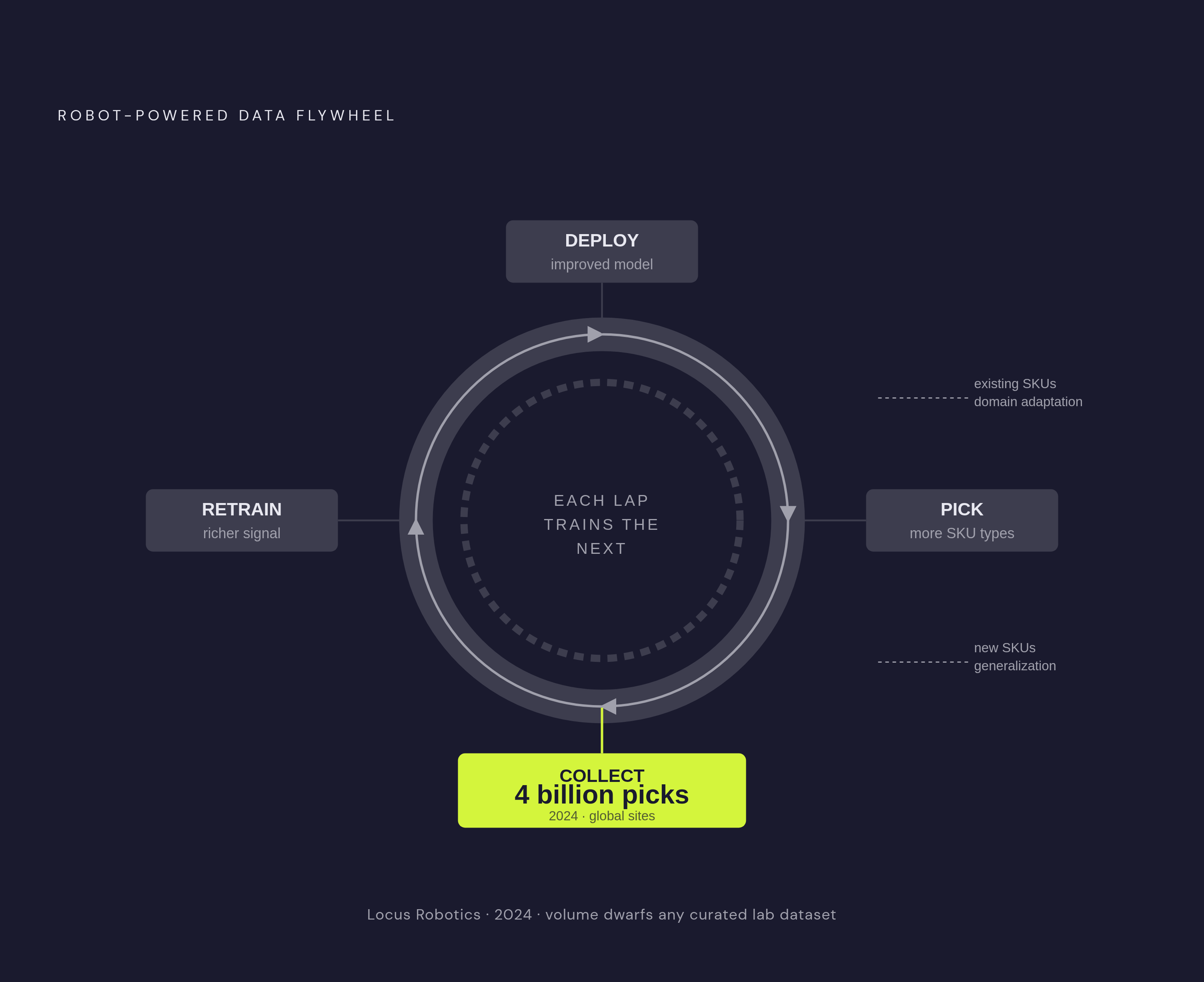
Continual learning methods are only as good as the data feeding them, and collecting labeled manipulation data for every new SKU by hand does not scale. That bottleneck is exactly what the Robot-Powered Data Flywheel (RPDF) concept, introduced in a November 2025 arXiv paper by Jennifer Grannen and colleagues, is built to address. Robots doing useful work in a live facility generate large-scale real-world data as a byproduct of that work, and that data feeds back into model improvement, which then makes the next round of picking better.
The cycle runs: deploy, pick, collect, retrain, deploy again with a better model, pick more SKU types, collect richer data than before. Each operational cycle produces the training signal for the one after it. Both domain-specific adaptation (getting better at SKUs already being handled) and domain-adjacent generalization (getting somewhat better at SKUs not yet seen) improve as a result.
The operational implication is blunt: a warehouse running a higher volume of picks generates better continual-learning data than one running fewer, all else equal. Scale becomes an advantage at the software and learning layer, not just at the throughput layer where it's traditionally measured, and that reframing is the part most buyers still miss when they compare vendors purely on cost per pick. Locus Robotics reported more than 4 billion picks across its global customer sites in 2024. At that volume, the training signal available for model improvement outstrips anything a curated lab dataset could offer. That gap is the clearest illustration available of why deployment scale matters specifically for continual learning, not just for unit economics, and it's a genuine advantage that smaller deployments structurally cannot match no matter how good their models are on paper.
What orchestration software must do to make continual learning work in a live facility
None of this works in isolation. The warehouse execution system (WES) has to route new SKUs to the robot in a controlled way while the model is still learning them, and it has to reroute those SKUs back to a human operator the moment confidence scores drop below an acceptable threshold. Without that safety valve, a robot's early learning curve on a new item becomes a stream of picking errors on the floor rather than a contained, manageable phase.
Agentic AI at the WMS layer is starting to handle novel situations on its own. Agentic systems are being described that allocate missions based on live variables like floor congestion, worker availability, and robot battery levels, rather than static rules set in advance. That kind of dynamic allocation is what makes controlled SKU rollout possible at all.
Orchestration software also needs to surface per-SKU accuracy in real time, not just an aggregate picks-per-hour number. Without that granularity, degraded performance on a recently onboarded item stays invisible right up until it turns into a customer-facing error. Conectiv's Kevin Sullivan, speaking on the Locus Robotics "Warehouse Automation Matters" podcast, described using onboarding data (SKU lists, order profiles, delivery patterns) to design workflows before robots ever arrive on site. That kind of pre-deployment data discipline is exactly what a continual-learning pipeline needs as its starting input. LocusHub, launched by Locus Robotics in 2024, provides real-time reporting on fleet and warehouse performance along with predictive labor forecasting, the kind of granular data layer that makes per-SKU learning monitoring possible in the first place.
Integration with WMS and ERP platforms isn't optional here. A robot that learns a new SKU well but has no way to propagate that updated handling parameter back to the warehouse management layer has just built itself a knowledge silo, and a silo that improves in isolation isn't actually improving the facility. Flexibility itself is becoming a measurable KPI: scale3PL's Adam Lawicki, also on the Locus Robotics podcast, quantifies adaptability in concrete operational terms. That same metric applies directly to SKU onboarding speed when continual learning is functioning as intended.
How current deployments are handling new SKU onboarding in practice
Brightpick's Autopicker 2.0, launched in June 2025, paired an upgraded Intuition software stack, incorporating what the company calls Physical AI and picking-in-motion, with a fully redesigned hardware platform. It is designed to sustain pick rates comparable to a warehouse worker while running continuously without the fatigue-related slowdown a human shift eventually shows. Picking-in-motion is a harder target for continual learning than stationary picking, since the perception model has to correctly classify a SKU while the robot itself is moving, not just while it sits still and looks at a fixed scene.
ABB Robotics, also in June 2025, launched a compact mobile robot alongside messaging framed around what it called the "era of Autonomous Versatile Robotics." The emphasis on versatility over raw speed signals where ABB sees the competitive line being drawn: handling a wider range of SKU types matters more than shaving seconds off a single pick cycle.
Amazon, in October 2025, introduced AI-powered smart glasses alongside related automated systems. The smart glasses matter less for the delivery use case than for what they imply structurally: putting a perception layer directly on human workers creates a path for real-world SKU data to flow back into training pipelines even in workflows still run by people. Call it a data flywheel in hybrid human-robot form, rather than a purely robotic one.
The Robotics-as-a-Service (RaaS) model, which bundles robots, software, monitoring, and maintenance under a predictable recurring cost, changes who owns the continual-learning burden. Under RaaS, the vendor retains responsibility for pushing model updates, so the operations leader isn't managing retraining cycles internally at all. The catalog expands, the vendor ships an update, the facility keeps running. Exotec noted in August 2026 that RaaS typically costs more than an outright purchase over several years, but for operations with high SKU churn, the bundled commitment to keep models current can justify that premium on its own; paying for that guarantee usually beats the alternative of building the retraining capability in-house, and operations leaders who default to outright purchase on cost alone are optimizing for the wrong line item.
Volume spikes are their own test of all this. Locus Robotics' PeakFLEX program deployed nearly 2,000 additional bots during the 2024 peak season, a scenario where continual learning has to hold up not just across new SKUs arriving gradually, but under a throughput spike where unfamiliar items show up at a much higher rate than the model has been tuned for.
What the market build-out means for how quickly this capability will be expected as standard
Mordor Intelligence projected the global warehouse robotics market to grow from $7.93 billion in 2024 to $17.91 billion by 2029, a compound annual growth rate of 17.70%, in a 2025 report. That much capital flowing into the space means competitive differentiation will rest increasingly on software and learning capability rather than on hardware specs alone, since hardware commoditizes faster than the software layered on top of it. Betting on hardware differentiation alone, at this point in the market, is betting on the wrong layer.
ABI Research projects roughly 4 million robots deployed across more than 50,000 new warehouses over the next six years, with at least a quarter of all warehouse space dedicated to online fulfillment. At that density of deployment, the cost of inadequate continual learning doesn't stay contained to one facility. It compounds across every site running the same underperforming approach.
The shift from large, homogeneous pallet orders to small, multi-SKU orders is a structural change in what warehouses are being asked to fulfill, not a temporary spike tied to one shopping season. Robots that can't keep pace with that mix on an ongoing basis simply won't remain competitive against ones that can. Locus Robotics described a shift in January 2026 from orchestration built around visibility toward orchestration built around foresight, predictive adjustment and automatic capacity shifting that only work if the underlying model is current, not stale from a retraining cycle that ran last quarter. Reshoring and nearshoring trends, noted by Kardex in an update from June 2025, are also pushing automation investment into higher-labor-cost regions, where the return-on-investment case depends specifically on robots handling a broad SKU range without expensive manual fallback.
Within the typical three-to-five-year planning horizon for a warehouse automation investment, continual SKU learning is on track to move from a differentiating feature to a baseline expectation. A platform bought today that can't do this well locks a facility into a retraining bottleneck right during the years when catalog growth is fastest, and that lock-in is the real cost, not the sticker price on the contract.
What operations leaders should ask vendors before committing to a platform
Ask whether the system reports Negative Backward Transfer for new SKU onboarding events, or only an aggregate success rate. A vendor who can't answer this isn't measuring the thing that actually matters, and a confident answer about pick-rate improvements alone should be treated as a dodge.
Ask where the training data for new SKUs comes from, and how long it takes to update the model once a new product line shows up. Days or weeks of retraining lag is a real liability against a catalog that changes weekly.
Ask whether the platform captures picking data from your own facility and feeds it back into model improvement, or whether the model only ever updates against the vendor's centralized dataset somewhere else. That distinction determines whether the platform gets smarter specifically for your SKU mix or just stays generic while your invoice goes up.
Ask whether the WES can flag per-SKU confidence degradation in real time and automatically hand items back to a human operator before pick errors start piling up, and ask exactly what that handoff looks like on the floor. Finally, ask which of the LIBERO evaluation environments any cited benchmark result actually comes from, since a strong number in one environment says very little about performance in another. None of these questions is exotic. They separate a platform that grows with a catalog from one that quietly falls behind it, and the vendors worth signing with are the ones that don't flinch at being asked.