Safety Revalidation Costs After Robot Reprogramming
Reprogramming a robot restarts the full safety revalidation cycle, not just testing.
What revalidation means and when it is legally required
Revalidation is not a smoke test to confirm a new program runs without faulting out. It's the formal re-confirmation that a modified robot system still meets the safety requirements it was originally certified under, and that distinction is where most manufacturers get the budgeting wrong. A robot's program is part of its safety case, whether anyone treats it that way or not. Changing the program changes the hazard profile: reach envelopes shift, cycle timing changes, and the interaction between the robot and any nearby worker becomes a different interaction than the one that was assessed.
Once the hazard profile changes, the risk assessment obligation reopens, full stop. That assessment runs against ISO 12100:2010, which has been a binding, normative reference since the 2011 edition of the robot safety standards and stays one under the 2025 edition, alongside ISO 13849-1. ISO 12100 sits above the machine-specific standards as a type-A document, governing them rather than competing with them.
Under ISO 10218-2:2025, the obligation for cell-level risk assessment and safeguarding falls on the system integrator. Whoever configures the cell, and whoever changes it later, owns the job of proving it's still safe. This means the robot builder's certification only covers the machine as shipped. It says nothing about the cell that machine gets bolted into, and nothing about the program running on it six months from now.
The current standards stack manufacturers must satisfy
Compliance in 2026 runs through three layers, each one leaning on the one below it. ISO 12100 supplies the risk management method. ISO 10218-1 and 10218-2, both revised in 2025, supply the specific requirements for the robot and the cell around it. ANSI/A3 R15.06-2025 adopts that international framework for the US market.
R15.06-2025 published in September 2025, thirteen years after the prior version, and copies start at $655. A standard doesn't sit unrevised for thirteen years and then come back thin. Six areas changed substantially: closer harmonization with international norms, consolidation of collaborative-robot requirements that used to be scattered across ISO/TS 15066, and the folding-in of end-effector and loading/unloading guidance from ISO/TR 20218-1 and 20218-2, with their guidance merged into ISO 10218:2025. It also updates safety-function requirements, adds cybersecurity as its own category, and spells out safety obligations for the people actually running these cells day to day.
Part 2 of R15.06-2025 runs roughly three times the length of its predecessor. That length covers risk assessment for contact between moving parts and operators, cybersecurity, local and remote control schemes, single-point-of-control rules, normal stop categories, safety-function performance requirements, and documentation of safety-function information. A standard doesn't triple by accident. It triples because the industry it governs got more complicated faster than the paperwork could track.
The five cost categories that appear on every revalidation invoice
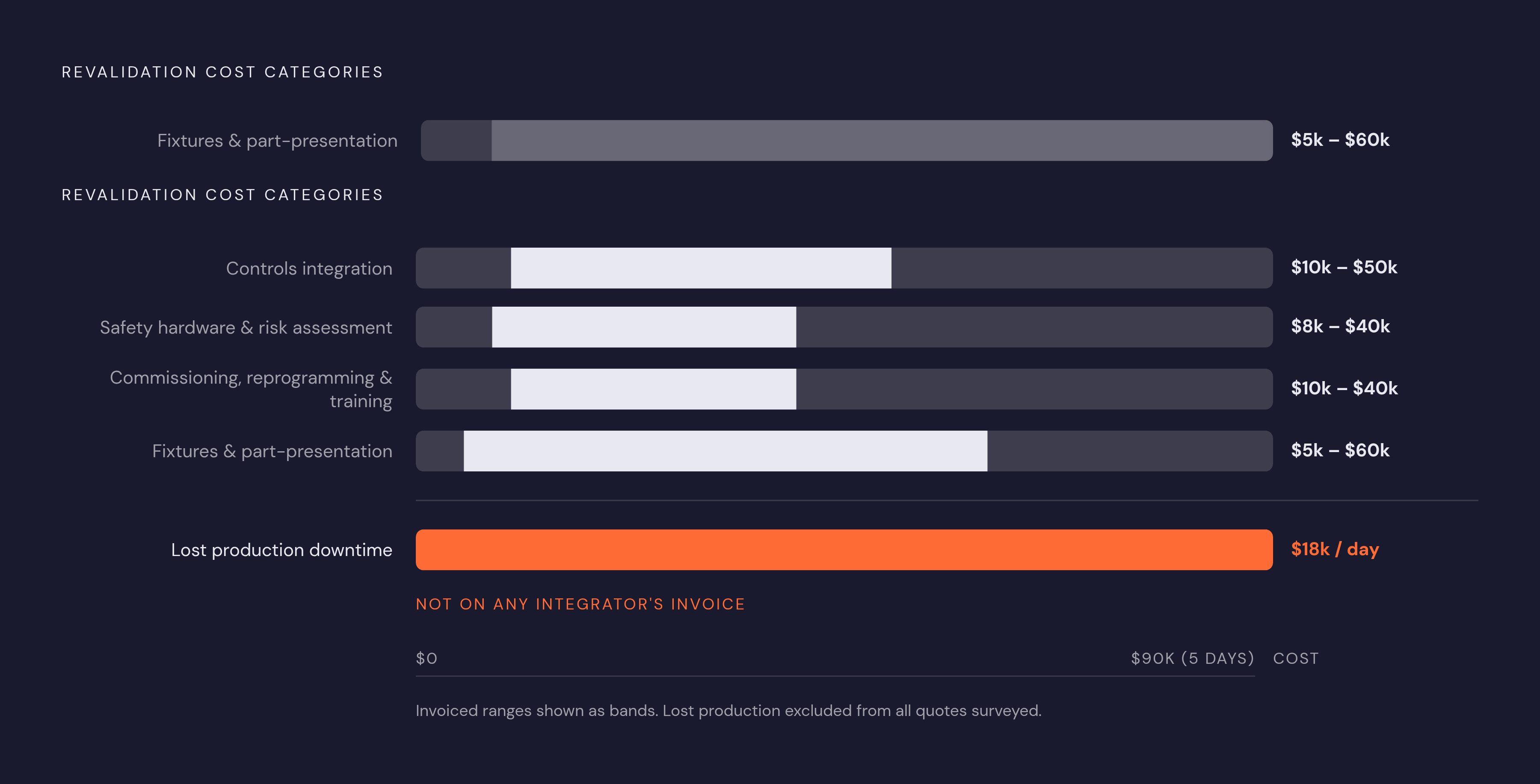
Revalidation cost breaks into four distinct buckets, and the manufacturers who get blindsided are almost always the ones who only budgeted for one or two of them.
Safety hardware and the formal risk assessment run $8,000 to $40,000. That covers fencing, light curtains, area scanners, e-stops, safety-rated PLCs, and the labor to document the assessment against ISO 10218 and ANSI R15.06. This cost sits with the integrator under the 2025 standard, not the robot manufacturer, and cells where operators enter often for pallet changes or product swaps land at the top of that range.
Fixtures, guides, and part-presentation hardware run $5,000 to $60,000. That spread is wide because existing tooling either survives the reprogramming or has to be rebuilt from the ground up, and the outcome dictates the cost. Reprogramming projects get scoped as software work, so this category gets missed constantly. The physical hardware the software depends on is missing from the plan, and that gap blocks commissioning.
Controls integration, meaning PLC logic, HMI updates, vision-system recalibration, and network ties to MES or ERP platforms, runs $10,000 to $50,000. Any program change that touches I/O logic, adds a sensor, or shifts handshake timing with upstream or downstream equipment reopens this whole line item, even when the robot's motion path barely moved.
Commissioning, reprogramming labor, and operator training run $10,000 to $40,000, on top of whatever production gets lost during ramp-up. Training here isn't paperwork you can skip. Training and competency records sit among the core documents auditors and insurers expect to see, and skipping that step opens a compliance gap that becomes visible the moment something goes wrong on the floor.
How lost production time becomes the largest line item
None of those four categories is where the real money disappears. That happens on the floor, during the revalidation window itself, and a deployment in FMCG packaging shows how.
The robots in that case got bolted to the floor before the full integration was validated, a sequencing call that seemed fine until revalidation surfaced two integration failures that only showed up once the cell went live. A case packer's conveyor interfered with a palletizer's pick zone by 140 millimeters, small enough to miss in the design software, large enough to force mechanical rework, reprogramming, and a full revalidation cycle on a live production floor. Separately, the safety scanner zones overlapped an existing AGV path, and that triggered the same sequence: rework, reprogramming, revalidation, repeat. Each failure triggered revalidation downtime costing $18,000 per day in lost output.
The mechanism is mechanical. Revalidation can't run while the line is producing, so the cell sits offline, in a controlled state, for each test phase, and one reprogramming event often stacks several of those phases back to back. When a problem surfaces mid-cycle instead of getting caught beforehand, the test cycle doesn't pause, it restarts, and every phase that already passed gets repeated once the mechanical fix goes in.
That's the piece missing from most business cases. The $10,000 to $40,000 commissioning and training figure covers labor. It says nothing about the production that line would have made during that downtime, and that number never appears on an integrator's invoice. It lands on the manufacturer's books, usually after the budget's already signed.
Why the "every reprogramming triggers a full revalidation" problem is getting worse
Industrial automation was built around stability. Fixed programs ran in fixed environments for years, so a full revalidation was a rare project cost, something you budgeted once and rarely touched again.
That era is closing, and it's closing fast enough that the old budgeting habit is now actively dangerous. The global robotics market grew 34 percent year over year in 2026, the fastest growth the industry has posted in a decade, and a meaningful share of that growth comes from a shift away from fixed automation toward flexible, reprogrammable systems. Vision-Language-Action models are a big reason why. Absent from production floors eighteen months before that market figure was reported, systems built on that class of model now back 40 percent of new deployments, and they're built specifically to get retasked often rather than locked into one motion program for the life of the cell.
Semiconductor fabs are already living this. Retasking a robot arm there now takes hours instead of the weeks traditional reprogramming used to demand, and that speed is opening applications in wafer handling, PCB inspection, and component placement that weren't economical before. But speed on the programming side does nothing to the regulatory math on the safety side. Each retask, however fast, is still a reprogramming event, and every reprogramming event reopens the same risk assessment obligation under ISO 12100 and ISO 10218 covered above. The tooling got faster. The compliance burden per change did not shrink to match it, and that gap is where the real exposure sits from here forward.
What continuous validation architecture looks like as a mitigation
The FMCG numbers above hand this field something rare: a computable return on a specific fix. Upfront simulation would have caught both integration failures, the 140-millimeter conveyor conflict and the AGV path overlap, before either one triggered $18,000-per-day downtime on a live floor, and that's an arithmetic case for simulation, not a philosophical one.
Digital twin modeling is the practical version of that arithmetic. Build the cell in simulation before any live revalidation phase starts, and mechanical interference, zone conflicts, and I/O logic errors appear in software, where a mistake costs computation time instead of a shutdown line. The failure still happens. It just happens somewhere that doesn't cost $18,000 to fix.
Continuous validation also runs on traceability, which matters more as reprogramming frequency climbs. Every robot skill needs an identity that traces back to its model version, its training data, the demonstration source it learned from, the hardware it's approved to run on, its tooling configuration, its safety limits, its test results, and its full deployment history. Without that record, nobody can confirm which version is running on a given robot at a given moment, or whether that robot's actual behavior still sits inside the boundaries someone signed off on.
That level of discipline isn't a nice-to-have bolted onto flexible robotics after the fact. Each retask deserves the same rigor as any safety-relevant software release: version control, documented change history, active boundary monitoring. Once a robot gets retasked weekly or daily instead of once a year, anything less than version control, documented change history, and active boundary monitoring becomes a liability.
Building revalidation cost into the reprogramming business case from the start
Most reprogramming failures trace back to a scoping mistake made before a single line of code changed. Projects get planned as software projects, with revalidation penciled in as a quick sign-off at the end, when it's actually a multi-category cost center with its own budget, its own timeline, and its own downtime exposure, one that can dwarf the programming cost that triggered it.
A business case built to survive contact with the floor needs its costs itemized rather than buried under one "commissioning" line. Safety hardware and risk assessment belong at $8,000 to $40,000, priced against actual cell complexity and how often operators need physical access. Controls integration needs mapping against exactly which upstream and downstream systems the program change touches, because that mapping puts the bill near $10,000 or near $50,000. Documentation updates need names attached: which compliance documents need revision, and who signs off on each one. And someone needs to confirm, in writing, that the integrator is certifying against ISO 10218-1/2:2025 and ANSI/A3 R15.06-2025, not a legacy edition that misses current cybersecurity or collaborative-robot requirements.
None of that erases the cost. It moves the cost from the middle of a live production run, where it appears as $18,000 surprises and idle conveyors, to the planning stage, where it's a number someone can approve or push back on before the robot ever touches the floor.
Sources
- 6 Major Upgrades to US Robot Safety
- State of Robotics 2026
- ISO 10218-1:2025—Robots And Robotic Devices Safety - The ANSI Blog
- Robot Safety Documentation: The Complete 2026 Guide | There's A Robot For That
- ISO 10218-1:2025 - Robotics — Safety requirements — Part 1: Industrial robots
- 2026 Robot Safety Standards Update: What Manufacturers and Integrators Need to Know | A3
- A3 releases full three-part national safety standard for industrial robots - The Robot Report
- thebotscout.com