Total Cost of Ownership for Collaborative vs. Industrial Robots
Hidden costs in integration, safety, and maintenance dwarf the sticker price on robots.
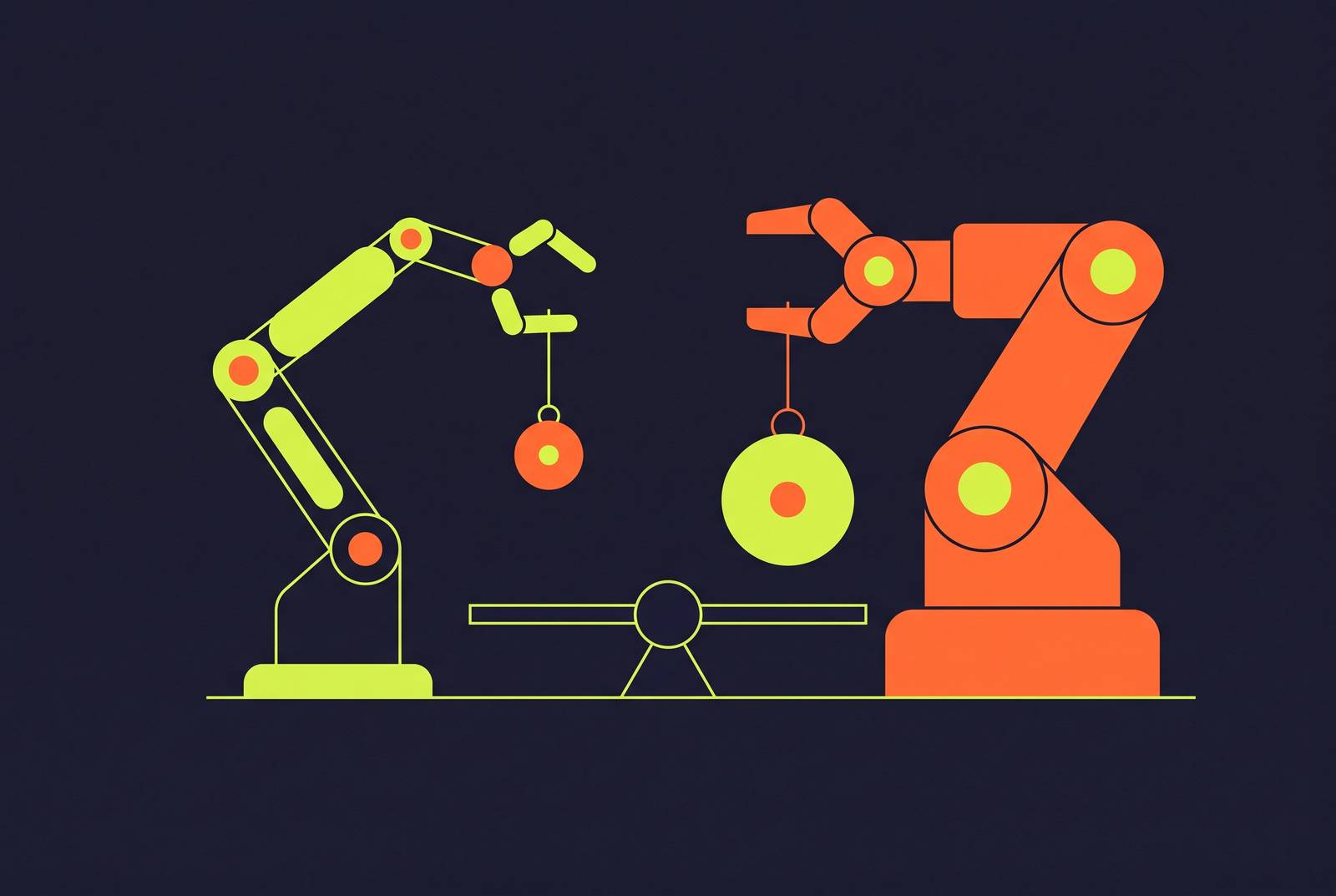
The sticker price on a robot arm tells you almost nothing about what it costs to run. What decides whether a cobot or an industrial robot pays off is the full stack behind that number: integration, safety infrastructure, maintenance, software licensing, and what happens to the machine once the application changes. This piece walks through that stack layer by layer, so the comparison holds up cell-to-cell, not arm-to-arm.
The IFR's World Robotics 2025 report counted 542,000 industrial robots installed globally in 2024, with cobots making up 64,542 of those units, or 11.9% of new installations. Total cost of ownership stopped being a side debate for procurement teams a while back. It's the whole ballgame now, and most buyers still shop the wrong number.
What you pay for an arm: cobot and industrial robot purchase prices in 2026
Vendors quote the arm price because it's the most flattering number on the table. Whether an automation project pays for itself depends on more than the number, and treating it as the deciding factor is the single most common mistake buyers make.
EVS International's 2026 figures put standard cobot arms at $25,000 to $60,000. Entry-level light-duty units from Chinese manufacturers start closer to $15,000 to $20,000. On the branded end, Universal Robots' UR3e through UR20 lineup spans $25,000 to $72,000, and FANUC's CRX series runs $28,000 to $68,000. Welding arms and explosion-proof configurations can push past $85,000 for the arm alone.
Industrial robots track a similar range at the low end, then climb hard. A six-axis, small-payload arm runs $25,000 to $60,000, roughly the same bracket as a cobot. Moving into mid-payload territory, costs climb substantially beyond the entry-level bracket, with complete fenced cells for larger arms reaching $150,000 to $500,000. Branded mid-range arms from major manufacturers typically fall within that broader range, with specific models varying by payload and reach configuration.
Buyers see a $50,000 cobot and a $50,000 industrial arm sitting in the same bracket and assume the projects are comparable. They aren't, because the divergence starts the moment you stop looking at the arm and start looking at everything required to make it actually run a part. The divergence starts the moment you stop looking at the arm and start looking at everything required to make it actually run a part.
The integration cost gap: what it takes to make each type operational
MillBrief's analysis finds that a fenced industrial cell typically costs 2 to 4 times the arm price once tooling, a safety PLC, and integration engineering get added, and complex welding cells can reach 4 to 6 times that. EVS International reports that facility work alone, power upgrades, compressed air lines, floor prep, fencing, tacks on another $10,000 to $50,000. Integration engineering, wiring, fixture design, and programming time are the line item that gets underestimated on almost every industrial project, and it's usually the reason a quoted budget blows past its number by month three.
Cobots carry a structural, not cosmetic, difference in profile. EVS International reports that total installed cost, gripper, integration, programming, operator training included, runs $40,000 to $150,000 for standard applications. Teach pendants and drag-and-teach interfaces cut the engineering hours needed to get a cobot running, compared to the specialized programming languages an industrial arm demands. Facilities running multiple applications off one cobot still need interchangeable tool sets, and that cost adds up fast if the arm moves cells often.
None of this holds uniformly, and pretending it does is how buyers get burned. A complex cobot welding cell can climb toward $150,000 to $200,000 or more, at which point the gap against a simple industrial installation narrows considerably. Integration cost is application-specific. Compare cell to cell. Comparing arm to arm will mislead you every time.
Safety infrastructure: the cost that industrial robots carry and cobots largely avoid
Non-collaborative industrial arms move fast and hit hard. The law requires physical separation from people wherever the two might share space: fencing, interlocked gates, laser scanners, often a dedicated safety PLC. That's a standards requirement, not a design preference, and skipping it isn't a call a plant manager gets to make.
That infrastructure costs real money, and the dollar figure swings hard with cell size. Standard Bots reports facility work, power upgrades, compressed air, floor prep, running as high as $50,000 in many installations. Adding the fencing, the safety PLC, the extra floor space, and the longer integration timeline that comes bundled with all of it, EVS International finds a traditional fenced cell can cost significantly more than an equivalent cobot deployment doing the same job.
Cobots sidestep most of this by engineering, not by marketing copy. Force-torque sensing stops the arm the instant it contacts something with more force than a set threshold allows, and speed-and-separation monitoring slows or halts it the moment a person enters its workspace. That's why a cobot can share a workspace with a person without the caging an industrial arm needs, and it's the single biggest structural cost advantage a cobot carries into any bid.
The standard shifted in 2025, and anyone documenting compliance in 2026 needs to know it. ISO 10218-2:2025 formally absorbed ISO/TS 15066, folding the bulk of collaborative robot safety requirements into the updated ISO 10218 series, Parts 1 and 2. The consolidation means compliance documentation will increasingly reference the updated ISO 10218 series rather than the earlier technical specification. Where people and machines have to share floor space, the safety bill on an industrial robot can erase whatever price edge the arm looked like it had back at quote time.
Ongoing costs: maintenance, software subscriptions, and the emerging AI licensing layer
EVS International reports cobot maintenance running $2,000 to $8,000 a year, depending on utilization, environment, and the service contract in place. Cobots carry fewer wear components than industrial arms, and many manufacturers throw in software updates at no extra charge. Well-managed maintenance programs and favorable operating environments can push real-world costs toward the low end of that range.
Industrial robots run higher, and the gap compounds, because annual support costs commonly track as a percentage of a purchase price that already sits far above a cobot's. Replacement parts, technician labor for proprietary controllers, and specialized servicing all push industrial maintenance costs above cobot equivalents as a rule, not an exception.
The wildcard in 2026 is software. Hardware turned into a commodity years ago, and JustOborn's reporting, citing TechCrunch Robotics, describes the cost, and the value, migrating up to the software layer running on top of it. Recurring cloud connectivity fees, license renewals, and AI model updates add a real, ongoing line to the operating budget that didn't exist in older TCO models, and it's the one buyers most often leave off the spreadsheet. Industry estimates recommend budgeting an extra 15 to 20% a year for software maintenance alone.
That cost hits cobots and industrial robots alike, and it compounds. Run the numbers out to a seven-year operating horizon and EVS International's analysis shows total cost of ownership for industrial robots landing well above initial capex, with maintenance, software, and licensing fees stacking on top of each other to make that multiplier real.
Payback periods and labor savings: where the ROI math lands
Industry data generally shows cobots paying back in 12 to 24 months for single-shift work, faster once a second or third shift gets added. High-utilization jobs, CNC tending, screw driving, continuous pick-and-place, can hit payback under 12 months, but that number assumes the cobot is displacing a meaningful chunk of one full-time position, not just supplementing a line that was already running fine.
Industrial robot lines commonly run 18 to 36 months to ROI, reflecting higher upfront capital and longer integration timelines. Higher upfront capital and longer integration timelines push that number out relative to cobots in most documented cases.
The labor math behind both figures is straightforward. MANTEC reports a single cobot replacing one full-time operator saves $65,000 to $85,000 a year in direct labor costs. Continuous operation without breaks shortens cycle times, and precision gains cut defect rates, so the payback case ends up stronger than a simple labor swap suggests on its own.
Payback speed depends heavily on shift utilization, and most buyers skip past that caveat. A cobot running one shift pays back slower than the identical unit running three, while an industrial robot running flat-out in high-volume production can recover its larger upfront cost within a comparable window. The cobot payback advantage is structural in low-to-medium volume, mixed-product settings. It narrows, or disappears, on dedicated high-throughput lines, which is the environment industrial robots were built for.
Redeployability and flexibility: the costs and savings that standard TCO models miss
A fenced industrial cell gets built around one task, one payload, one cycle time. When the application changes, someone is dismantling safety infrastructure, re-engineering fixtures, and eating extended downtime to get there. When a product line shifts or a factory floor gets reorganized, all that sunk cost in safety hardware and integration engineering strands the asset right where it sits.
Cobots were built to move. Reprogramming and relocating one between applications can take hours using teach-by-demonstration interfaces, not weeks, and that flexibility carries real TCO value: the same $40,000 to $150,000 system can serve several successive applications across its working life instead of sitting locked to one cell. For a facility running mixed product lines, that flexibility compresses the effective cost per application over time, and it's a factor most standard TCO spreadsheets never capture.
Robotics-as-a-Service offers a third path, keeping the asset off the buyer's books entirely rather than solving redeployment after the fact. Cobot RaaS is commonly priced at roughly $8 to $12 per hour of operation. EVS International reports leasing programs with monthly payments starting around $1,500 to $3,000, a similar CapEx-to-OpEx shift that changes how a buyer thinks about redeployment risk from day one. RaaS models are more commonly associated with the cobot market than with large industrial systems.
None of this prices in cleanly ahead of time. The honest way to handle it is as a scenario, not a line item: what would it cost to adapt this installation if the application changes in year three? Most standard TCO models never ask that question, and that gap is why they get the comparison wrong.
Building a like-for-like TCO comparison for your application
Arm price is a starting point and nothing more. A real comparison adds up the arm, the controller, tooling, vision and sensors, integration engineering, safety infrastructure, facility modifications, training, annual maintenance, software and licensing fees, and an estimated redeployment or write-off cost at end of life. Skipping any one of those means the comparison measures the wrong thing.
Cobots win the full comparison in a handful of recurring situations: low-to-medium volume work with mixed products, where flexibility carries real value; shared human-robot workspaces, where safety infrastructure would otherwise dominate the budget; smaller operations where faster payback matters more than squeezing out maximum throughput; and applications likely to get redeployed as product lines shift.
That doesn't make industrial robots the wrong choice, and anyone reading this as a case against fenced cells is reading it wrong. Dedicated high-volume lines running at full capacity remain their territory, for good reason. But the decision has to get made on the full deployed cost. That number was never the one that mattered.
Sources
- How Much Does a Cobot Cost? $15k–$150k (2026)
- How much do robots cost? 2026 price breakdown - Standard Bots
- Robot Automation Costs Review: 2026 ROI & Pricing Guide - Artificial Intelligence World
- How Much Does an Industrial Robot Cost? 2026 Price Ranges | MillBrief
- ifactoryapp.com
- robotomated.com
- Collaborative Robots (Cobots): The Best Guide for 2026
- mantec.org