Robot Cell Commissioning Timelines in Discrete Manufacturing
Early planning and week-one rigor prevent delays that compound during production ramp.
Why the first week of site commissioning sets the tone for everything after
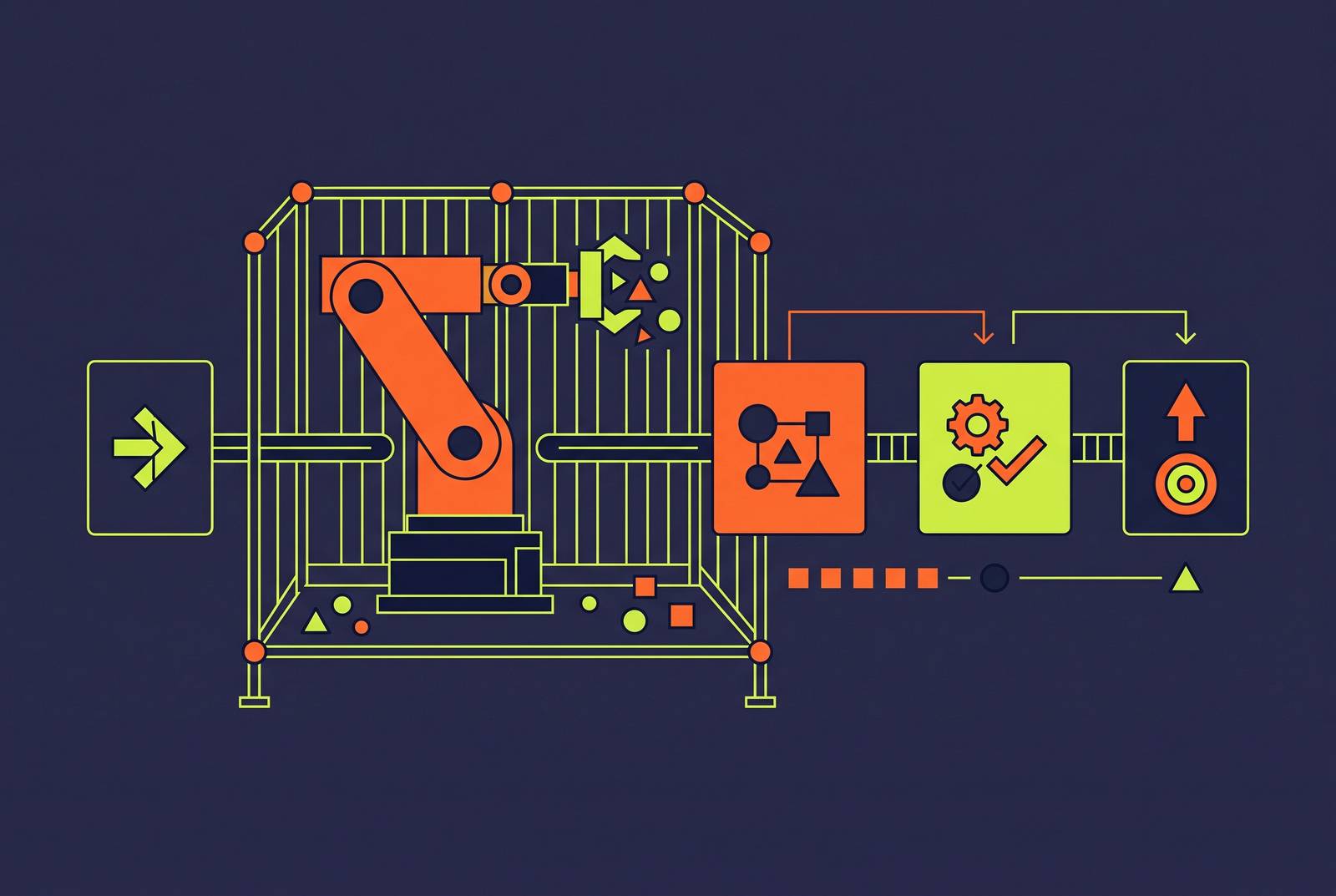
Robot cell commissioning follows a set sequence in discrete manufacturing: Factory Acceptance Test, Site Acceptance Test, then a production ramp-up that sits between installation and full output. Most teams treat these as three gates to pass. They're actually one continuous proof, and treating them separately is where schedules start to slip.
FAT happens at the manufacturer's or integrator's facility, before anything ships, and checks the equipment against the design spec under conditions the shop floor controls. SAT happens after the cell lands on-site and gets wired into the plant's own power, network, and safety systems. Some multi-vendor projects add a third gate, the Factory Integration Test described in IEC 62381:2024, which brings equipment from separate manufacturers together for testing before shipment. That stage earns its cost most on jobs where a DCS or SCADA layer has to talk to custom communication protocols across vendors, and skipping it there just moves the same integration fights downstream into SAT, where they cost more to untangle.
These gates mean little unless approved software backups, drive parameter sets, as-built drawings, a log of open items and how each closed out, and retest evidence for anything that failed the first pass back them up. Skipping that package, a cell can run fine on acceptance day and still be unserviceable six months later, because nobody can say what changed or why.
Week one on-site has one job: prove the installed cell matches the approved design and that the safety systems work in the actual plant, not on paper. That means walking access controls, safeguarding devices, emergency stop functions, utility hookups, stored energy sources, and the process hazards specific to that line. It also means naming, in writing and before anyone touches the panel, who is authorized to change the system's state during commissioning. A temporary bypass with no named owner is how a minor issue turns into an incident report.
Where electrical work is involved, OSHA 29 CFR 1910.333 sets safety-related work practices tied to the specific hazard present, and a commissioning checklist is not a substitute for the employer's electrical safety program. A checklist confirms a step happened. The regulation governs how that step gets done safely, and treating the two as interchangeable is a common gap on sites moving fast.
ISPE and IEC 62381:2024 both address continuous-run requirements at production load before SAT is formally accepted, with IEC 62381:2024 providing guidance that should be agreed and written into the contract and schedule from day one. The specific duration should never get discovered mid-argument over whether the cell counts as complete, because a sustained run at real load surfaces intermittent faults that a two-hour demo simply won't.
Welding cells carry a second, separate risk lane, and it gets missed more often than it should. ISO 10218-2:2025 covers robot integration and commissioning safety but explicitly excludes hazards from handling dangerous loads (molten metal, acids and bases, radiating materials) along with certain extreme environments. Welding fumes, arc radiation, burns, and hot work represent a separate hazard category that needs its own owner and its own evidence trail. ANSI/A3 R15.06-2025 is the current reference document for robot safety, and AWS B2.1/B2.1M:2026 covers welding procedure qualification; both lanes have to close before arc-on work starts. Treating welding safety as a subset of robot safety, rather than a parallel track with its own sign-off, is a mistake that recurs repeatedly in incident data.
Where delays concentrate: software errors, interface boundaries, and the conditions FAT cannot reproduce
Most commissioning delay does not come from broken hardware. It comes from software errors caught too late: a large share of commissioning delays trace back to software, even though traditional commissioning itself accounts for only a fraction of total development time. A cell that runs perfectly in a shop demo can lose days on-site because a drive was left with the wrong parameter set, or a sensor changes state at a moment the PLC sequence never anticipated. Real field wiring, real network traffic, real tooling, and whatever else is running upstream on the actual line turn the shop test into a rough sketch of the real conditions, not a full rehearsal of them.
Multi-vendor line integration is where this compounds hardest. Automotive and discrete manufacturing lines often stack dense PLC, robotics, and MES interfaces on a single line, and every boundary between vendors is another place a fault can hide until commissioning forces it into the open.
What counts as "acceptance testing" has also grown. Plant digitalization and Industry 4.0 requirements push it well past mechanical and electrical checks, into data communications, historian integration, and cybersecurity resilience. Teams still planning around the old, narrower checklist are going to feel that gap during SAT, usually at the worst possible moment.
Drives and motors sit at the boundary between a robot's command and physical movement somewhere else in the cell. A fault can originate in parameter settings, fieldbus mapping, electrical installation, or the handoff sequence between a conveyor and the robot, not necessarily in the robot's own program. The fix is tracing the complete motion chain, from command to physical result, before deciding where the fault actually lives. Guessing at the source wastes more time than the trace does, every time.
Production Engineering Annual Volume 2025 found that identical robots, operating under different conditions, needed maintenance intervals ranging from three weeks to twenty-nine weeks, against a conventional fixed schedule set around 23 weeks regardless of condition. A gap that wide, three weeks against twenty-nine, means underperformance risk is not spread evenly across a fleet of otherwise identical machines, and a calendar-based maintenance plan has no way to see that variance coming. Monitoring built on real production data, started during commissioning rather than after, is what catches that kind of deviation before it turns into unplanned downtime.
How pre-build planning decisions determine how much trouble arrives at site
Commissioning planning has to start while the cell is still on the drawing board, not once it's sitting on a truck. Before fabrication begins, a project needs an approved controls narrative, a finished I/O list, a network map, agreed equipment revisions, and clear, documented ownership for every interface between systems. Skipping any of these does not make the gaps disappear. They surface later, usually mid-SAT, with the plant manager asking why the line still isn't running.
Vague requirements are the real enemy here. "The cell runs correctly" is not a test criterion, it's a hope dressed up as a spec. Turning that into something testable means naming exactly which modes, alarms, permissives, handoffs, and recovery states get demonstrated at the integrator's shop versus which ones can only be proven once the cell sits on-site, and tying each one to an agreed test and a written record.
Factory testing works best as controlled exposure to failure. A good FAT scope covers the ordinary running modes plus the approved fault and recovery scenarios; it tests a missing part, a sensor timeout, a drive fault, and a lost communication path. Finding those failures on the shop floor, before production sits idle waiting on an answer, is the entire point of paying for a FAT.
Folding disciplines like electrical installation, drive commissioning, application and drive selection, programming, and troubleshooting into one shared test plan, rather than testing each in isolation, is what makes tracing the full motion chain possible instead of theoretical.
The defect numbers show the payoff for doing this well. Robotic welding systems with proper operator training and documented preventive maintenance achieve weld defect rates below 1%, against 5 to 8% for manual operations. That gap doesn't appear because someone tightened a robot's program. It appears because commissioning validated the whole system, not just the individual devices sitting inside it.
What virtual commissioning with digital twins changes about the timeline
Virtual commissioning moves a meaningful chunk of the schedule earlier. The 2026 practice numbers are hard to wave off: time savings can be substantial, integration errors can drop by more than half, and production ramp-up runs faster than conventional methods.
Named results back that up. Wipro PARI cut commissioning time by 70% on an automotive machining line. Wistron got a 50% reduction. ATS Industrial Automation saved more than six weeks on a battery assembly line. Manufacturers running Dassault Systèmes' DELMIA Virtual Commissioning have reported reductions up to 60%. Siemens tools have reportedly cut CapEx by 10 to 15% by letting manufacturers simulate a line before buying anything for it, and some discover through simulation that they need fewer robots, or smaller ones, than the original spec called for. Hexagon reports an average 22% ROI from digital twin implementations. The tools doing this work include factory-scale simulation platforms like NVIDIA Omniverse and Siemens Tecnomatix, virtual PLC and CNC commissioning software for validating control logic before it touches real hardware, robotics and AGV simulation for path planning and collision detection, and integration testing tools built for MES and ERP connectivity.
The academic work is catching up to the practice. Procedia CIRP 134 (2025) carries Raza, Bilberg, and de Oliveira Hansen's work on multiple-level virtual commissioning and the integration challenges it still presents. Procedia Computer Science 253 includes Nezzi and colleagues' study of virtual commissioning on a mechatronic plant for insulating material processing. A 2026 Springer contribution from Nowinski, Klingel, and Verl argues for continuous virtual commissioning through open interfaces for industrial robot integration and control, rather than a one-time simulation pass before build.
What none of this replaces is physical reality, and that's the part vendors selling the software tend to leave out of the pitch. Site-specific wiring, utilities, grounding, actual plant network conditions, and real operating loads still have to be verified in person, because a simulation of the plant is not the plant. The 72-hour continuous run required under ISPE and IEC 62381:2024 does not shrink because the control logic was validated in software months earlier. What virtual commissioning actually does is move the discovery of software and interface errors earlier in the calendar, and since that's exactly where the research says most delay originates, the 70% software-error figure stops being a fixed cost of the project. It becomes a cost that gets front-loaded into a phase where fixing it is cheap.
A realistic planning framework for each phase's contents, outputs, and schedule contingency
Before fabrication starts, the pre-build phase has to produce a finished controls narrative, an I/O list, a network map, an interface ownership matrix, defined FAT and SAT scopes, and agreed acceptance criteria for every mode and recovery state the cell will need to demonstrate. This is paperwork, but the rest of the schedule only holds if this paperwork gets done right, and most schedule slip traces back to a shortcut taken here.
Where virtual commissioning is part of the plan, it belongs at this stage too: control logic validation, collision detection, MES and ERP integration testing, and a baseline for predictive maintenance parameters. The 50 to 75% time reduction and the 53% integration-error reduction get captured here, not later, and teams that push virtual commissioning into a later phase lose most of its value.
FAT tests the cell against the agreed spec at the integrator's facility, scoped to whatever can genuinely be reproduced away from the actual site. Punch-list items get written down and tracked, not waved off verbally and forgotten by the time the truck leaves.
Between installation and SAT, the job is closing out the FAT punch list, confirming that software and parameter revisions match what was actually approved, and validating the installed wiring, utilities, grounding, and the plant's own network conditions before the full system gets powered up.
SAT runs the approved site procedure under the plant's own safety controls, and includes the 72-hour continuous run at production load specified by ISPE and IEC 62381:2024 before formal sign-off. It also has to cover data communications, historian integration, and cybersecurity resilience now, as a required part of the test, not an add-on tacked on afterward.
Production ramp-up benchmarks the system against its projected quality and uptime targets before full production volume kicks in. GrayMatter Robotics' deployment model, for instance, is built to resolve most performance risk during this window, ahead of any throughput commitments taking effect.
Schedule contingency should weight toward SAT and multi-vendor interface resolution, since that's where the boundary problems concentrate hardest. Virtual commissioning shrinks that buffer, but it doesn't erase the need for one, and a team that plans as if it does is setting up its own SAT delay.
The handover record is the last deliverable, and arguably the one that matters longest after the ribbon-cutting: what was tested, which software and parameter revisions were in place, what changed once the cell hit the actual site, and who signed off on each result. That record is what makes the cell serviceable a year later, and it's what a certified integrator is on the hook to produce.
Maintenance planning belongs in this same output, not bolted on afterward. Production Engineering Annual Volume 2025 makes the case directly: a fixed maintenance schedule set around 23 weeks, applied regardless of actual operating conditions, produces either wasted maintenance on machines that didn't need it or unexpected failures on machines that needed it sooner. Commissioning is where the monitoring baseline gets set, the one that lets maintenance scheduling track real usage intensity instead of a calendar that has no idea what the machine actually did that week.
Sources
- How certified systems integrators reduce commissioning risk in robotic production cells
- Welding Robot Commissioning Timeline: 6-Week Roadmap - Zhouxiang
- Smart Greenfield Factory Commissioning 2026 | AI, Robotics, and Digital Twin for Rapid Ramp-Up
- ISO 10218-2:2025 Explained: Robot Cell Safety Guide
- link.springer.com
- factory.graymatter-robotics.com