Throughput Gains From Robotic Automation in Food and Beverage Packaging
Robots solve the throughput ceiling manual lines cannot break.
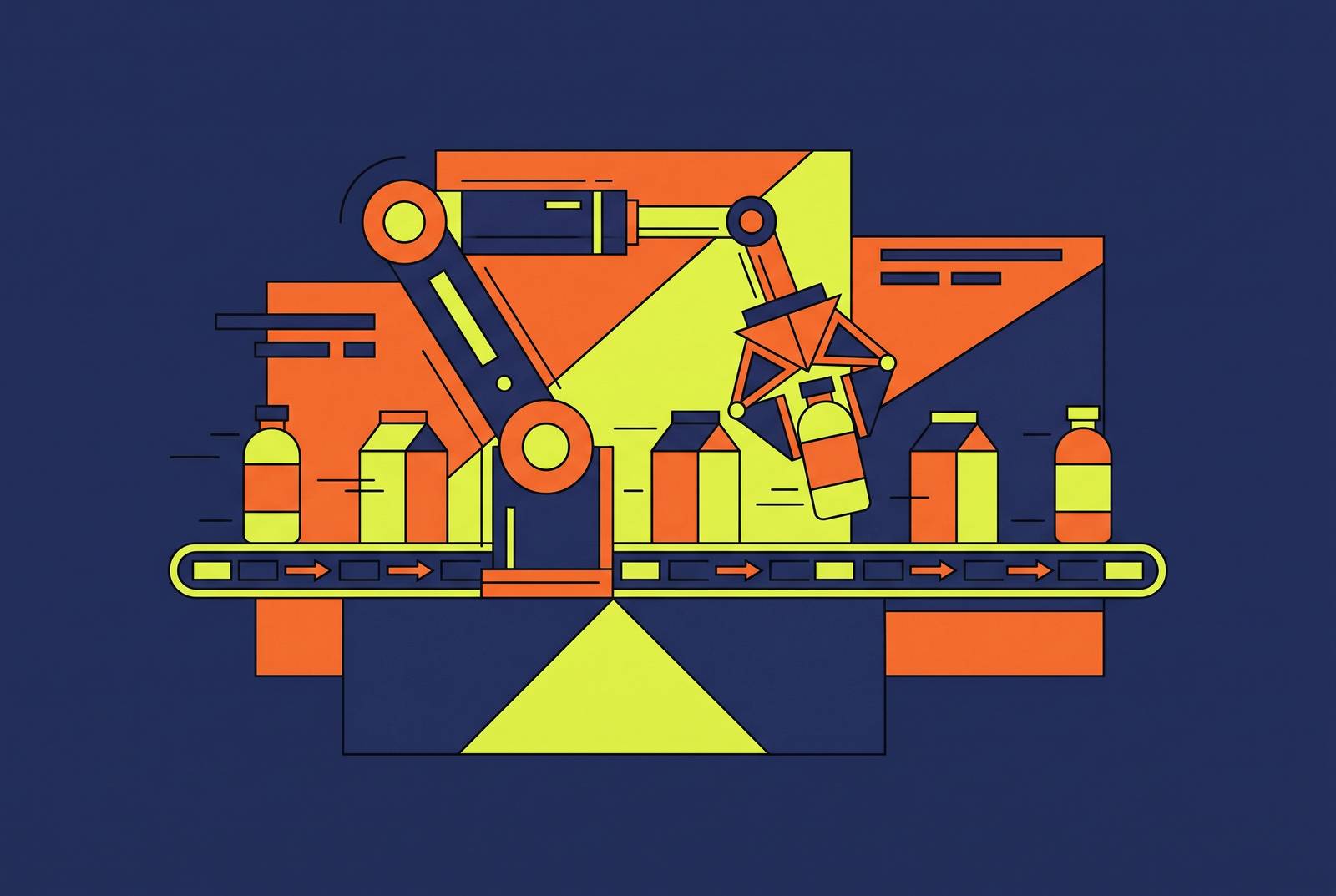
Robotic automation is changing food and beverage packaging lines because manual labor can no longer deliver the throughput these operations need. The shift is structural: labor shortages, SKU proliferation, and tightening food safety rules are hitting packaging lines at the same time, and each mechanism robots bring, consistent cycle rates, fast changeover, in-line inspection, addresses a specific piece of that breakdown.
Why F&B packaging lines are being redesigned around robots
Three pressures are landing on food and beverage packaging lines simultaneously, and none of them is temporary. The first is a chronic shortage of workers willing to take repetitive, physically demanding packaging line jobs, a problem that has outlasted multiple hiring cycles and wage adjustments. The second is SKU proliferation: brands now run far more product variants, package sizes, and seasonal formats through the same end-of-line equipment than they did a decade ago, and each variant demands its own changeover. The third is tightening food safety regulation, which raises the documentation, traceability, and inspection standards a line has to meet on every single run, not just the ones that get audited.
None of these pressures operates in isolation, and that is what makes the current moment different from previous waves of automation interest. Fewer workers are available, SKU changeovers happen more often, and upstream processing lines already run faster than end-of-line packaging can match, so the result is a throughput ceiling that no amount of overtime or temp staffing can lift. A facility can hire more people for a line that has too much manual variability built into it, but that only adds more inconsistency, not more capacity. The ceiling is structural, so it holds regardless of labor market conditions or short-term staffing wins.
Framing this as a story about rising automation adoption misses the more useful question of how robots solve the throughput problem that manual lines cannot. The sections that follow break that down mechanism by mechanism, because a facility deciding where to put capital needs to know which part of its line is actually bottlenecked, not just that robots are generically trending upward in the industry.
Fatigue-free, consistent cycle rates and the baseline throughput advantage
The most fundamental throughput gain robots deliver has less to do with raw speed than with the removal of variability from the cycle. A human operator on a packaging line works fast at the start of a shift and slower toward the end of it, faster on a Tuesday and slower on a Friday, faster when fully staffed and slower when covering for an absent coworker. A robot performing the same palletizing or casepacking task runs the identical cycle time at hour eight that it ran at hour one, and it does so on every shift, every day, without the dip that human fatigue reliably produces. The throughput advantage is about predictability, not top-end velocity.
That predictability appears concretely in equipment reliability. Brewster at Pacteon Group says robotic palletizers carry a remarkably high mean time between failures, and no manual workforce can match that reliability floor, no matter how it trains or incentivizes workers. A line built around a machine that rarely breaks down behaves very differently from one built around a crew whose output depends on who showed up, how many hours they have worked, and how physically taxing the task has been all day.
Bob's Red Mill, the Oregon-based whole grain packaging operation, offers a direct illustration of what this looks like in practice. The company deployed a Universal Robots UR20 cobot for palletizing and hit its required cycle times immediately, freeing up four operators who had previously handled that work by hand. Just as significant as the throughput number is the installation timeline: Universal Robots says getting the UR20 running took a day and a half, compared with the roughly week-long installation that a traditional industrial robot would have required. That difference matters for any facility weighing the disruption cost of automation against the throughput it expects to gain.
The consistency argument also matters for product quality, not just raw units-per-hour. A robot running a uniform cycle rate produces uniform load integrity on every pallet, case after case, which cuts down on the downstream waste and rework that come from inconsistent manual stacking or sealing. A facility measuring only speed will miss this, but a facility measuring total line output, including the units lost to rework, will find that consistency delivers throughput gains the speed metric alone would not show.
Rapid, software-driven changeover and throughput during SKU transitions
Consistent cycle rates solve one piece of the throughput puzzle, but a robot that holds a perfect cycle time and then sits idle for an hour every time the line switches products has not solved the problem that SKU proliferation creates. As the number of SKUs running through a single packaging line grows, the time the line spends not producing, the changeover time between one product format and the next, becomes the dominant constraint on total throughput, often outweighing the cycle-time gains made during actual production.
This is where the losses compound rather than simply add up. A single long changeover during a shift is an inconvenience a plant can absorb. Multiple changeovers per shift, driven by an expanding SKU portfolio and shorter production runs per SKU, turn that inconvenience into the primary reason a line fails to hit its daily output target. A facility running ten SKUs a week loses far more cumulative time to changeover than one running two, even if every other part of the line is identical, and that loss scales with SKU count in a way that traditional rigid automation, built around a single product format, cannot absorb either.
Software-driven changeover addresses this directly by replacing physical retooling with reconfiguration at the control level. Rather than a crew manually swapping grippers, adjusting guide rails, and re-timing a conveyor for each new case size, a robotic cell built for rapid changeover calls up a stored program and adjusts its motion path and end-of-arm tooling parameters in a fraction of the time. Pacteon Group, the palletizing systems integrator whose reliability data anchors the previous section, has worked with customers facing exactly this kind of SKU-driven changeover burden, and the throughput math is straightforward: every minute recovered from changeover is a minute added back to production, repeated across every SKU transition in a shift. A line that changes over in minutes rather than hours can run more SKUs without giving up more output, which is the condition modern F&B packaging now requires as a baseline, not an upgrade.
Machine vision, AI-guided inspection, and throughput without added headcount
The third mechanism compounding these gains is in-line intelligence: machine vision and AI-guided inspection systems that let a line run faster while still catching defects and compliance failures that a human inspector would miss once the line speed increases. This matters because faster throughput is only a real gain if it does not simply produce more scrap or more recalled product. Vision systems convert quality control into a capability that enables higher speed, rather than a constraint that limits how fast a line can safely run.
Nestlé's experience with scoop-detection inspection shows why this capability has to evolve alongside the packaging itself; you cannot install it once and leave it alone. The company used vision systems to confirm that a scoop was present inside nutritional containers before sealing, a straightforward detection task for a standard camera system. When Nestlé switched to transparent scoops, the existing inspection system could no longer reliably detect them, since a clear object against a similarly lit background does not register the way an opaque one does. Nestlé resolved the problem by upgrading to a deep learning-based inspection system capable of distinguishing the transparent scoop from its surroundings. The lesson generalizes: a vision system is only as useful as its ability to keep up with packaging changes, and a facility that treats inspection as a one-time installation rather than an evolving capability will eventually find its quality control falling behind its own product line.
AI is showing up across packaging operations in forms beyond inspection as well, including automated guided vehicles and autonomous mobile robots that move material through a facility without a human driver, and predictive maintenance tools that flag equipment problems before they cause a stoppage. PMMI's 2026 white paper on AI in packaging identified knowledge transfer and predictive maintenance as the two technologies expected to have the strongest positive impact on the packaging industry over the next few years. Predictive maintenance earns that ranking specifically because of what unplanned downtime costs a line: a single unexpected stoppage can erase hours of the throughput gained from consistent cycle rates and fast changeover. A system that flags a failing component before it fails keeps the uptime intact, and uptime is the condition every other throughput mechanism in this piece depends on. A perfectly consistent cycle rate means nothing if the machine running it is down for repairs three days a month.
What the throughput gains look like across real deployments
The mechanisms described so far, cycle consistency, fast changeover, and inspection-driven uptime, do not operate independently in real facilities. They compound, and the deployments that show the largest gains are the ones where more than one mechanism is active on the same line at the same time.
Bob's Red Mill again offers the clearest single-mechanism illustration, even though more than one factor was at play. The UR20 cobot handling case palletizing met the required cycle time, which freed four operators from that task. Just as important for a plant considering whether automation is worth the disruption, the hands-on installation took hours rather than the roughly week-long timeline that a traditional industrial robot installation would have required. Worker adoption of the new system was helped along by an existing condition at the company: because Bob's Red Mill is employee-owned with a profit-sharing structure already in place, the operators freed from palletizing had a direct financial stake in the line's overall performance, which removed much of the resistance that automation projects often face from a workforce worried about job security.
Danish Crown's meat processing operation shows a different combination of mechanisms, and it produced a different kind of gain. Three Universal Robots UR10e cobots now handle palletizing of boxed meat, a task that previously required repeated manual lifting. Universal Robots reports that shift cut employee strain by half, which matters both as a worker welfare outcome and as a throughput one, since strain-related slowdowns and injuries are themselves a source of manual line variability. The automation also increased overall equipment effectiveness by a substantial margin, and it helped the facility manage labor costs during seasonal demand peaks, when staffing a fully manual line to meet volume spikes would otherwise require costly temporary hiring.
The pattern across both cases points to where automation investment pays off most. The largest throughput gains occur where end-of-line packaging operations were previously the bottleneck constraining a facility's entire upstream capacity; automation delivers less when it is layered onto a manual process that was already running efficiently. A facility whose processing lines can produce far more than its packaging line can palletize and ship stands to gain the most from closing that specific gap. A facility whose manual packaging process was never the limiting factor will see a smaller return from the same investment, because there was less structural slack to recover.
What causes automation projects to underperform
The throughput gains documented above are not evenly distributed across every facility or every line configuration, and treating robotic automation as a guaranteed fix regardless of context sets a project up to underperform. The mechanisms described in this piece, consistent cycle rates, fast changeover, and in-line inspection, only compound into the kind of gains seen at Bob's Red Mill and Danish Crown when a facility actually has the conditions those mechanisms were built to address: real changeover burden from SKU proliferation, real bottlenecks at end-of-line relative to upstream capacity, real variability costs from manual fatigue.
Projects tend to underperform in a few recurring ways. A facility that installs a robotic cell without redesigning the surrounding workflow, conveyor layout, upstream buffering, operator roles, often finds that the new equipment runs at its rated cycle time but the line as a whole does not speed up, because the bottleneck simply moves somewhere else. System integration gets underestimated just as often: a cobot that installs in a day and a half, as the UR20 did at Bob's Red Mill, is the exception that depends on a relatively contained task and a facility ready to receive it, not the default outcome for every deployment, and a facility that budgets time and cost as though every installation will go that smoothly is budgeting against the wrong baseline.
There is also a real difference between a pilot and a sustained gain. A single robotic cell added to one part of one line can show the mechanisms described throughout this piece, but the facility may still not capture the compounding effect that Danish Crown's three-cobot deployment or Bob's Red Mill's freed-up labor allocation produced. Capturing that compounding effect requires treating automation as a change to the line's overall operating logic, including how freed labor gets redeployed and how changeover scheduling adapts to the new capability, rather than as a single piece of equipment dropped into an otherwise unchanged process. Facilities that make that distinction going in are the ones positioned to see the kind of gains the mechanisms in this piece actually describe.