Pose Estimation Accuracy for Shiny and Transparent Parts
Depth sensors fail on shiny and transparent parts through different optical corruptions.

Pose estimation depends on the sensor returning geometry a robot can trust: consistent depth, stable appearance, features that don't shift from one frame to the next. Shiny and transparent parts corrupt the sensor data pose estimation relies on through distinct optical mechanisms, specular reflection and light transmission.
How shiny and transparent surfaces corrupt sensor data
Depth sensors fail on these materials through two distinct mechanisms, and the research gives each one a name. Type I depth error comes from specular reflection: light hits a shiny metal surface and bounces away from the sensor instead of back toward it, so the camera reads false depth or no depth at all. Type II depth error comes from transmission: light passes straight through a transparent object and bounces off whatever is sitting behind it, so the depth reading describes the background, not the part itself.
These are not variations on one problem. Shiny and transparent parts each corrupt sensor data through distinct optical mechanisms, specular reflection and light transmission. Shiny metal has a depth signal, just a corrupted one. Transparent glass or plastic often has no usable depth signal to begin with.
The appearance issue compounds the depth issue, and it plays out differently for each material. Shiny metal reflects whatever is around it, so its visual signature shifts with every change in camera angle or lighting, the object looks like a different object from a different viewpoint. Transparent material has no inherent texture or color at all, and what the camera sees is really the background, the lighting, and the scene setup showing through. The same physical object can look entirely different from one frame to the next.
An RGB-D camera pointed at a shiny bin of metal parts produces a depth image that comes back fragmented, patches of missing or wrong data scattered across the surface ClearPose (ECCV 2022) TDoF20. When it is pointed at a transparent object, the depth image looks complete, but it's lying: the numbers describe a shelf or a table behind the glass, not the glass itself. Nearly every mainstream pose estimation method was built assuming Lambertian surfaces, meaning diffuse, matte reflection that scatters light evenly in all directions. That assumption holds for a cardboard box or a rubber ball. It quietly falls apart for both shiny and transparent parts, and most of the accuracy loss downstream traces back to that one broken premise.
The accuracy gap relative to opaque objects
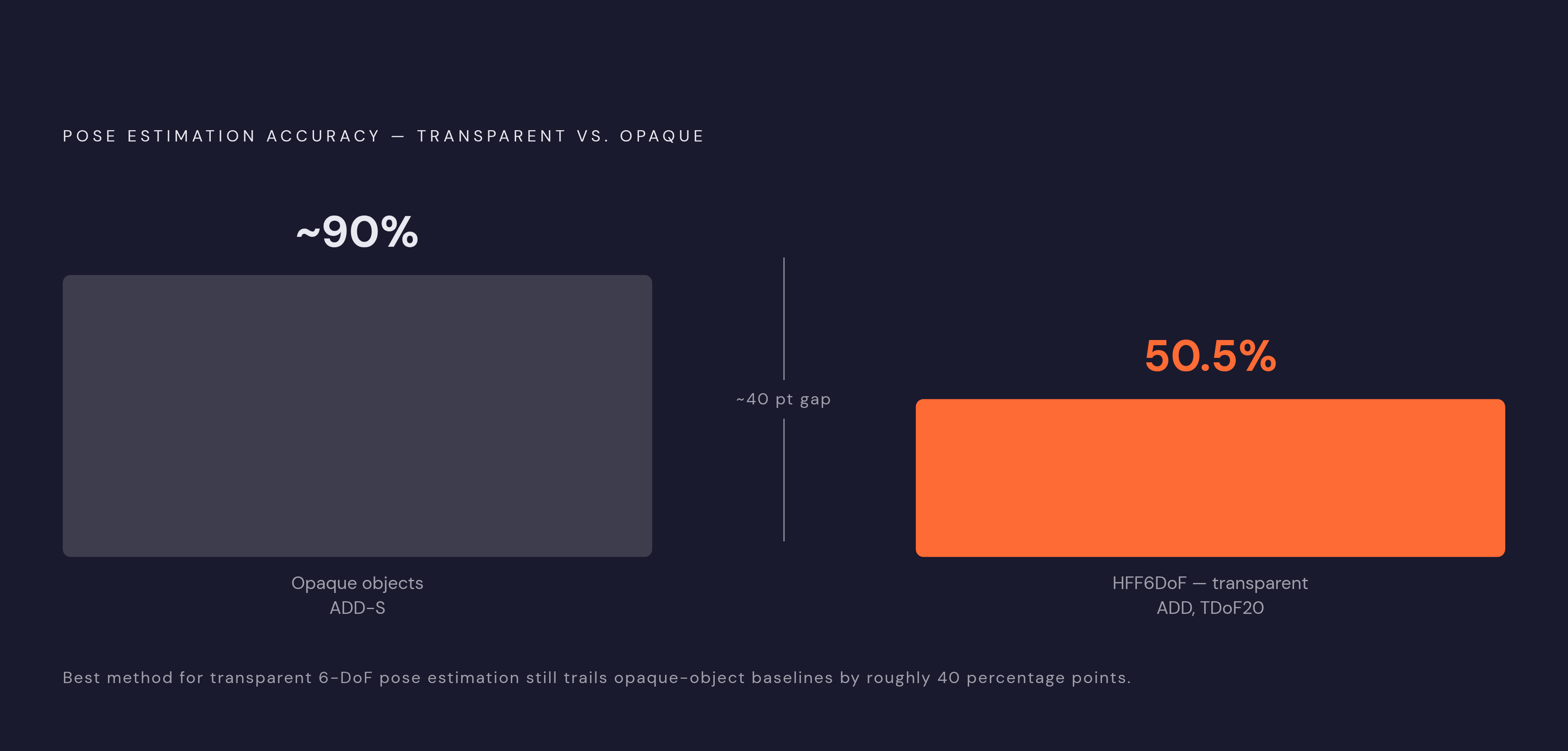
On opaque, textured household objects, pose estimation methods using RGB features reach ADD-S scores around 90 on public benchmarks TDoF20 arxiv.org. Transparent-object methods do not come close to that mark, and the gap is not a rounding error, it is a difference in kind TDoF20 arxiv.org.
HFF6DoF, one of the more capable recent methods built specifically for transparent objects, reaches an average ADD of 50.5% on the TDoF20 dataset, well below the roughly 90 baseline for opaque objects, showing how far the field still has to travel arxiv.org. That's real progress for the transparent-object subfield. Set next to the roughly 90 baseline for opaque objects, though, it shows just how far the field still has to travel TDoF20 arxiv.org. Methods tuned for opaque, Lambertian surfaces simply do not transfer to transparent objects without a steep drop in accuracy, because the depth and appearance assumptions those methods rely on don't hold anymore.
Industrial settings widen the gap further. Bin-picking scenarios add clutter, occlusion, and reflective textureless parts stacked on top of each other, conditions that academic benchmarks built around isolated household objects simply don't recreate. The IMD dataset evaluation found exactly this: industrial metallic object datasets are harder, for both segmentation and pose estimation models, than the household object datasets the field has leaned on for years TDoF20.
None of this is a metrics quirk confined to a leaderboard. A pose estimate that's off by even a few degrees on a reflective part translates directly into a failed grasp or a misaligned placement on a factory floor. The accuracy gap between opaque and shiny or transparent objects is, in practical terms, the gap between a robot that works and one that doesn't.
Benchmark failure locations and measurement methods
It supports segmentation, depth completion, and pose estimation work all at once. TDoF20, coming out of Wuhan University and dated to 2026, takes a narrower but harder angle: 61,886 RGB-depth image pairs across 20 transparent object types, built specifically around heavy inter-object occlusion and multi-object interaction during robotic grasping, a scenario that earlier datasets like ClearGrasp and TransCG mostly sidestepped in favor of depth completion or single-object setups.
On the metallic and shiny side, the IMD Dataset from September 2025 covers 45 true-to-scale industrial components captured with an RGB-D camera under natural indoor lighting, and it supports video object segmentation, 6D pose tracking, and one-shot 6D pose estimation, tested against methods including XMem, SAM2, BundleTrack, and BundleSDF TDoF20. XYZ-IBD, also from 2025, goes further into the industrial weeds: 15 texture-less, metallic, largely symmetrical objects packed into high-density bins to replicate real bin-picking conditions TDoF20. Getting millimeter-level ground truth on that dataset took anti-reflection spray on the parts themselves, multi-view depth fusion, and a semi-automatic annotation process, a level of effort that says something on its own about how hard these materials are to work with TDoF20 XYZ-IBD.
The BOP Challenge, running continuously since 2017, is the closest thing the field has to a standing scoreboard, tracking both model-based and model-free methods across seen and unseen objects TDoF20. The 2024 edition added model-free tracks and real-world AR/VR datasets TDoF20. The BOP Challenge 2025 opened January 13, 2025, with the formal challenge start/submission window beginning February 1, 2025, and early-bird results were presented June 12, 2025, at the CVPR Workshop on "Perception for Industrial Robotics Automation" in Nashville, Tennessee TDoF20. Alongside it, the TRICKY 2025 workshop at ICCV carved out a dedicated track for reflective and transparent objects, running two complementary challenges aimed squarely at this gap TDoF20.
The composition of BOP's 12 unified datasets shows that most of them lean on household objects that are non-symmetric and richly textured. Most industrial parts are the opposite, symmetric and textureless, and that mismatch is a sim-to-real gap the benchmark community is only starting to close. The annotation effort behind XYZ-IBD, spray coatings and multi-view fusion just to get a trustworthy label, is a sign that ground truth for these materials is expensive to produce TDoF20. It's a signal that ground truth for these materials is expensive to produce, which is part of why the datasets covering them stay small relative to the household-object libraries.
Approaches that work around corrupted depth for transparent objects
Three broad strategies have emerged, each addressing depth corruption differently.
The first strategy repairs the depth data before it ever reaches a pose estimator. Depth completion methods use the RGB image as a guide to fill in the gaps or correct the errors in the depth channel. A separate two-stage RGB-D pipeline takes a more geometric route: the first stage strips out the depth error through transparent-object segmentation, surface normal recovery, and RANSAC plane estimation, and the second stage builds an extended point-cloud representation from what's left for the actual pose estimation.
The second strategy skips depth entirely and works from appearance. CAD-model rendering, the backbone of a lot of render-and-compare pose estimation, doesn't work well here because transparency simply can't be baked into a predefined texture map. A render-and-compare approach using NeRF (October 2024) replaces the CAD model, whose texture is unsuitable for transparent objects, with a neural implicit representation enabling view-dependent rendering, evaluated on four large-scale transparent/reflective datasets using ADD, ADD-S, MSPD, MSSD, translation error, rotation error, and 3D IoU metrics TDoF20. Dex-NeRF got there first, using a view-independent learned density function and deliberately placing lights to amplify specular reflections, turning what used to be noise into a usable signal for transparency-aware depth rendering. ReFlow6D takes a different route again, building a refractive-intermediate representation in feature space that's explicitly unaffected by changes in the RGB image and doesn't depend on depth at all TDoF20. The NeRF family's compute requirement means rendering takes real time, which rules these methods out wherever a robot needs an answer in under a second.
The third strategy is to fuse modalities more carefully. HFF6DoF, from Wuhan University, dated January 2026, is a hierarchical feature fusion network with a dual-branch design extracting appearance from RGB and geometry from depth separately, then fusing hierarchically across scales rather than at every convolution stage, avoiding mutual interference from cascade fusion when depth cues are already sparse TDoF20. A decoding stage handles semantic segmentation and keypoint vector-field prediction, and the final pose comes out of RANSAC combined with least-squares fitting TDoF20. The result: 50.5% average ADD on TDoF20, and, tellingly, 91.5% ADD(S) on the opaque YCB-Video benchmark, putting it in the same range as established methods like DenseFusion, PVN3D, and FFB6DoF. That 91.5% matters as much as the 50.5% does TDoF20. It shows the architecture itself works fine; the lower score on transparent objects reflects how hard the domain is HFF6DoF.
Stereo and multi-view setups offer a fourth angle, even if it's more of a bypass than a fix. StereoPose-style methods use back-view NOCS predictions from a stereo pair to work around corrupted depth altogether, though the refined depth maps that come out the other end still show real distortion on highly transparent objects, making the bypass partial.
Approaches that handle shiny and reflective metallic objects
Shiny metal presents a narrower problem than transparency, but not an easier one. The surface reflects the surrounding scene, so its appearance shifts with every change in lighting or camera position, and most industrial metal parts are also textureless and symmetric, which removes the usual visual landmarks a model would lean on for feature matching TDoF20.
One practical answer skips exotic sensors. A multi-view single-camera method described in the Sensors journal combines known camera transformations with pose estimates gathered from multiple viewpoints to refine a single final estimate, and it does this with a standard camera, no specialized hardware required TDoF20. That's a meaningful detail for anyone budgeting a deployment: better viewpoint coverage, not better sensors, closes some of the gap.
Other work goes after the model architecture directly. A 2025 extension of the GDRNPP algorithm, referred to as GDR-Net with material estimation, adds a keypoint prediction output and a dedicated material estimator output onto the network's existing geometry head, aimed squarely at improving how the model reads a scene under reflections and specular highlights TDoF20. It shipped alongside a BOP-compatible dataset of metallic objects photographed under varied lighting and backgrounds, giving other researchers a way to test against the same conditions TDoF20. A separate line of work from ECCV 2024 introduces what it calls reflection correspondences, a way of pulling accurate camera pose and object shape jointly from the appearance of a textureless reflective object, without demanding a tightly controlled image capture setup TDoF20.
Transparent-object methods contrast with this approach. Shiny metal still returns a depth signal, corrupted, patchy, but present, and these methods can lean on partial geometry as a starting point. Transparent objects often return no usable depth signal, which forces the more aggressive workarounds covered above, full depth reconstruction or abandoning depth. And even collecting reliable training data for shiny parts carries its own tax: XYZ-IBD needed anti-reflection spray just to get ground truth annotations that held up at millimeter precision, a reminder that the difficulty here starts well before a model ever sees the data.
Sensor modalities beyond standard RGB-D
Standard RGB-D cameras give fragmented or missing depth for both shiny and transparent parts, and while industrial-grade depth cameras and 3D scanners do better, that improvement comes at a real cost premium. So the sensor that matters is not the best one in the abstract, but the one affordable for the application.
Polarimetric imaging is one answer built on a genuine physical distinction: diffuse reflection off a matte surface is unpolarized, while specular reflection off a shiny surface is polarized, and a polarization filter can exploit that difference directly TDoF20. A multi-modal framework from 2025 combines polarimetric cues with geometric cues for reconstructing the surface of specular objects, encoding surface orientation from the angle between the surface normal and the viewing direction, and under favorable conditions the two signals together uniquely pin down the surface shape TDoF20. That last part comes with a caveat: a flat, textureless surface lit by a single fixed light source still produces just one dominant specular reflection, and estimating disparity in that narrow case remains genuinely difficult even with polarization in hand TDoF20.
Stereo and multi-view RGB setups sidestep the depth sensor's corruption altogether by reconstructing geometry from several camera angles instead of trusting a single depth reading. StereoPose-style methods that pair stereo images with NOCS representations fall into this camp, though residual depth distortion still appears in the final point cloud for objects that are highly transparent, so this isn't a clean solve either. Working from 2D edge information alone leaves too much ambiguity for full 6DoF pose recovery. Multi-view strategies are more reliable than single-view RGB.
None of this changes the fact that sensor choice is often out of a practitioner's hands. Plenty of deployments are built around whatever camera is already bolted to the robot, and the real question becomes how much accuracy can be squeezed out of that fixed hardware rather than which sensor to buy next.
Training data as a bottleneck and the field's response
Most pose estimation datasets are built around household objects because they're non-symmetric, richly textured, and comparatively easy to annotate, which is close to the exact opposite profile of an industrial shiny or transparent part. BOP's 12 unified datasets illustrate the imbalance directly: the majority cover household objects, leaving industrial, symmetric, textureless parts underrepresented across the benchmark.
Getting reliable ground truth for reflective or transparent parts is expensive in a way that's easy to underestimate. XYZ-IBD needed anti-reflection spray, multi-view depth fusion, and a semi-automatic annotation pipeline just to hit millimeter-level labeling accuracy TDoF20. TDoF20 required controlled capture of 61,886 image pairs to cover just 20 object types, a serious lab investment for what is, in the end, a fairly narrow scope.
Physically-based rendering, or PBR, offers a synthetic shortcut: simulate realistic reflections and transparency in software instead of capturing them in a lab. The sim-to-real gap hasn't closed, though, because synthetic renders still fall short of capturing the full variability of real reflective environments, lighting that shifts, backgrounds that change, surfaces that pick up smudges and dust. The IMD dataset, from September 2025, targets this exact shortfall for industrial metallic components, covering 45 objects in varied arrangements, and its evaluation confirmed what the gap would predict: these conditions are more challenging for evaluated models than household datasets TDoF20.
The field is expanding coverage, dataset by dataset, but the specific combination that matters most for industrial deployment, symmetric shape plus specular surface plus cluttered arrangement, still has thin benchmark representation next to the well-worn library of textured household objects.
Practical guidance for choosing a method given material type, sensor, and application constraints
Material type is the first fork in the road. Transparent objects need a strategy that either bypasses depth or actively reconstructs it, while shiny metallic objects can often make do with partial depth data strengthened by multi-view capture or appearance-based refinement.
For transparent parts, if RGB-D is the only sensor available, depth completion should come first, either the stable diffusion plus Mamba-based pipeline or the two-stage RANSAC plane estimation approach, both aimed at repairing the input before pose estimation ever starts. Where real-time speed isn't a hard requirement, NeRF-based render-and-compare gives a far more realistic view of the scene than CAD-based rendering ever could for a transparent surface.
For shiny metallic parts, a multi-view single-camera setup adds real robustness without adding sensor cost, since it works by refining pose estimates across viewpoints rather than upgrading hardware TDoF20. Where the deployment can support the added architecture, a material estimator head, in the style of the GDR-Net extension, improves how the model reads specular highlights and reflections in the scene. And where restrictive image capture isn't practical on the factory floor, reflection correspondence methods offer a way to recover pose and shape from a textureless reflective object without demanding a tightly controlled setup TDoF20. None of these choices are free of trade-offs, compute budget, latency tolerance, and how cluttered the scene gets all push toward different answers, but the material itself, shiny or transparent, is what decides which set of methods is even worth testing first. If the scene involves heavy multi-object occlusion, TDoF20 and HFF6DoF's hierarchical fusion are designed for this, whereas ClearPose/TransCG pipelines were built for simpler single-object or depth-completion scenarios (TDoF20). SOURCE PAGES (what the pages behind the outline's links say).