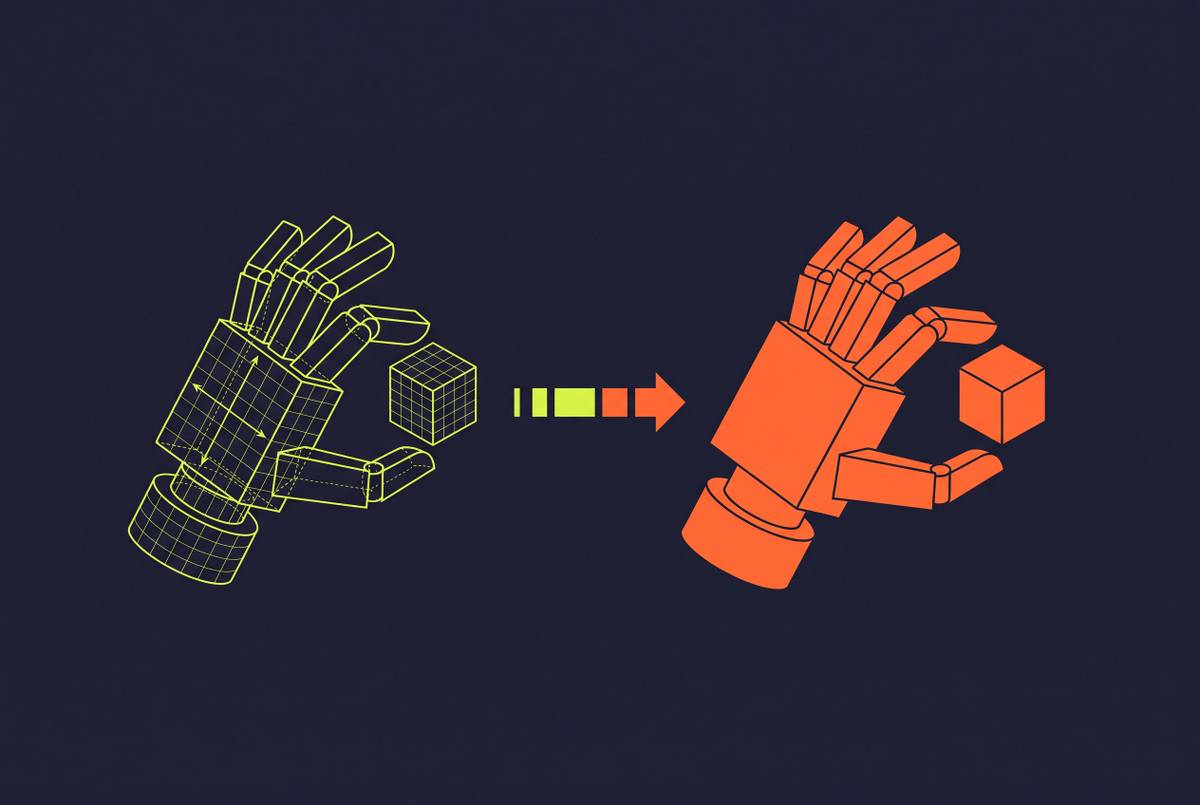
Sim-to-Real Transfer Failures in Production Deployments
Specific simulator gaps cause real-world failures, not generic noise.

Sim-to-real transfer failures follow a pattern. They trace back to specific, identifiable mismatches between what a simulator models and what the real world actually does, not to random noise in an otherwise sound pipeline. Robot policy training now runs at real scale: RT-1 trained on 130,000 episodes pulled from seven different robots, and the Open X-Embodiment effort pooled 527 skills across 22 distinct robot bodies. Yet real-world success rates still land 20 to 60% below simulation benchmarks once policies hit actual hardware. Teams that treat this drop as one problem, and respond by rendering nicer graphics or cranking up randomization, fix maybe a third of what's actually broken. The rest keeps failing quietly, in ways that look like bad luck but aren't.
The MDP anatomy of a simulator, and where each component can be wrong
Robot decision-making gets modeled as a partially observable Markov decision process, which includes a state space, an action space, transition dynamics, a reward function, an observation space, and a sensor model. A simulator approximates every one of those pieces on its own. It is a blend of countless overlapping impressions of reality. It's six or seven separate copies stitched together, each with its own error bars, and each capable of failing without the others failing alongside it.
An Arizona State University paper from 2026 (Liu et al., "The Sim-to-Real Gap of Foundation Model Agents: A Unified MDP Perspective," presented at KDD) makes a point worth sitting with: this same MDP framing applies just as well to foundation model agents as it does to classical robot control. Teams building agents driven by a language model have been rediscovering, piece by piece, a diagnostic structure robotics researchers already worked out years earlier.
Here's what that means in practice, and it matters more than it sounds like it should. A gap in transition dynamics cannot be closed by fixing the observation space, and the reverse holds just as firmly. Pour engineering hours into camera calibration when the real problem is friction modeling, and nothing improves, no matter how many hours go in. Matching the fix to the actual broken component is the difference between disciplined sim-to-real work and months of tuning that never quite closes the gap.
Three buckets carry through the rest of this piece: sensing discrepancies (visual appearance, sensor noise, camera properties), actuation discrepancies (contact models, friction, motor nonlinearities, PID gain mismatch), and task distribution drift (object pose variance, scene clutter, distractor objects).
Visual domain shift: how appearance gaps produce systematic policy failure
Visual domain shift covers lighting, textures, shadows, camera noise, scene composition. The sim images and the real images come from different visual worlds, even when they show the same task. Policies trained on flat, low-fidelity, or poorly lit sim imagery often fail to generalize once anything shifts. A change in lighting or camera angle, something a person wouldn't even register as different, can cut real-world success rates by 30 to 50%.
There's a way to measure this before any hardware gets involved. Compute CLIP ViT-L/14 embeddings from sim and real RGB observations at matching trajectory timesteps, then check the cosine distance between them. A mean distance above 0.25 signals an appearance gap serious enough to need intervention. OpenVLA's 7B vision-language-action model gives a useful reference point: policies stay stable, with less than 10% success degradation, when that CLIP distance sits below 0.20. Cross 0.30, and the fix is expanded domain randomization: varied texture maps, procedural noise layered onto renders, camera exposure randomized across roughly plus-or-minus two stops.
A luminance example from truelabel makes the diagnostic concrete. Sim RGB frames running 32% brighter on average than their real counterparts is a measurable, specific problem, and it has a specific fix: closing the gap through light-intensity randomization during training, not through a vague appeal to "better rendering."
Run the CLIP distance check first, before touching hardware. It costs an afternoon and saves weeks, and it settles a question teams otherwise argue about for a month.
Dynamics mismatch: the failure mode that better rendering cannot fix
Dynamics mismatch lives somewhere else entirely: contact physics, friction coefficients, object mass, actuator lag, motor nonlinearities. Simulators approximate these properties, and often approximate them badly, no matter how photorealistic the rendering looks. This is the failure mode teams miss most often, because it hides behind visuals that look convincing.
Two failure modes stand out. Contact and collision modeling breaks down in ways that have nothing to do with graphics quality: the 2024 Robotic Sim2Real Competition, hosted at ICRA 2024, recorded roughly a 1 in 6 failure rate on placing tasks inside simulation itself, objects falling after being stacked because the simulator couldn't resolve collisions correctly. Researchers there described the effect plainly as mineral jitter and dropping. Separately, actuator nonlinearity trips up policies trained against idealized servo models once they meet real motors with unmodeled friction curves, backlash, and PID gains that drift with use. The ZeroBug team, which took first place in the competition's mineral searching task, addressed this head-on with a feedback-linearized servo system paired with a custom design function built specifically for those nonlinearities.
A subtler problem sits underneath both of these: policies learn to exploit simulation artifacts as though they were legitimate strategies. They find the exact parameter regime where the simulator behaves incorrectly and lean on it, because it works, in sim. Real parameters then differ even slightly, and the whole strategy collapses. Even simulators marketed as high-fidelity aren't immune to this. Direct transfer from these systems still shows a real-world performance drop of roughly 24 to 30%.
Fixing visual domain shift while leaving dynamics mismatch untouched buys partial improvement, not resolution. These are two separate gaps, and treating them as one just wastes a diagnostic cycle. They need two separate diagnostics and two separate fixes, run in sequence, not folded into one generic "improve the sim" effort.
Why domain randomization alone is not a production strategy
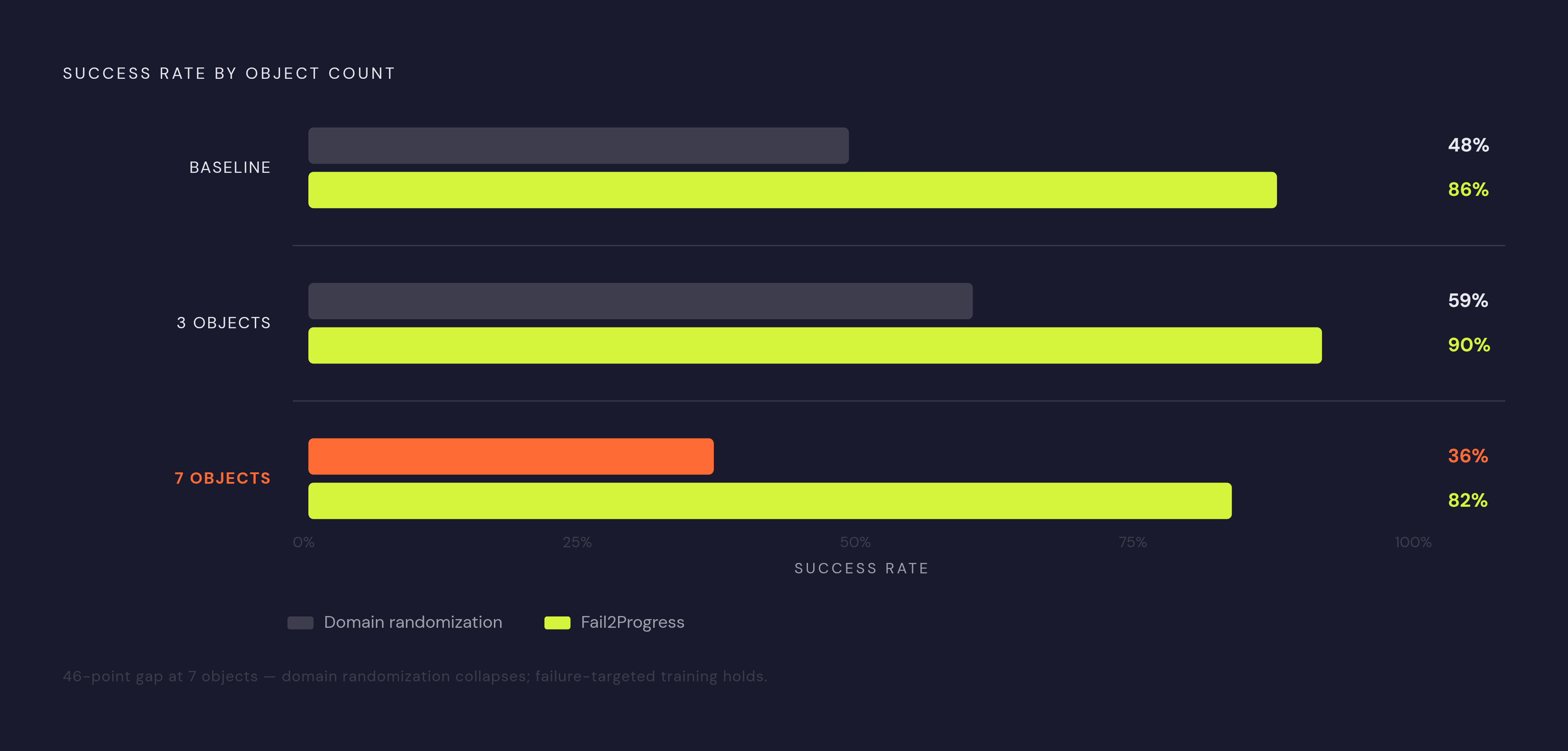
Domain randomization is the field's reflex response: randomize physics parameters like friction, armature, gravity, mass, randomize rendering parameters like texture, material, lighting, and hope the policy learns to ignore all of it and focus on the task. This is the wrong default, and the data on it is not close. Randomizing everything doesn't necessarily touch the specific gaps causing failure. It just makes the learning problem harder without a matching payoff.
Domain randomization alone lands at an average success rate around 48%, while failure-targeted training methods (Fail2Progress is one example) reach 86%. The gap widens as tasks get harder: at 3 objects, domain randomization hits 59% against 90% for failure-targeted training; at 7 objects, it drops to 36% against 82%. That's not a marginal difference worth splitting. It's a sign that broad randomization is solving the wrong problem.
The fix is to profile the gap empirically before deciding what to randomize. Run the policy on real hardware, catalog which failure modes actually show up, then aim randomization at the simulation parameters most likely responsible. For manipulation tasks specifically, contact stiffness, friction, and object mass carry the most weight, not texture or lighting, which are easier to randomize but do far less for contact-rich work. Domain randomization stays necessary. It just can't be the whole strategy, and it can't be applied as a uniform default across parameters that have nothing to do with the actual failure.
What production infrastructure for sim-to-real transfer looks like in 2026
NVIDIA Isaac Sim, built on Omniverse and supporting both the PhysX and Newton physics engines, is the leading platform for high-fidelity robot simulation as of 2026. It runs thousands of parallel environments on specialized hardware, randomizing lighting, textures, object placement, and physics parameters all at once. It's now used across industrial, healthcare, and household robotics, both as an algorithm testbed and as a data-generation platform for perception training.
A representative use case from AWS and NVIDIA's industrial assembly work shows the shape of it: engineers model a UR robot arm inside Isaac Sim, specify physics parameters including material properties, friction coefficients, and contact dynamics, then train through reinforcement learning in Isaac Lab across thousands of parallel scenarios, with domain randomization sweeping insertion angles, initial positions, friction values, and part tolerances.
The hybrid strategy standard in 2026 pairs simulation-based pre-training with a small amount of real-world fine-tuning, typically 50 to 200 real demonstrations. Simulation handles coverage and diversity; the real demonstrations handle fidelity no simulator fully captures. DROID's dataset of 76,000 real-world trajectories illustrates the value of grounding simulation-based training in real-world diversity, which the hybrid pre-training and fine-tuning approach is designed to capture.
Before any of this reaches hardware, enforce a baseline: run at least 1,000 simulation episodes across the full task distribution. A sim success rate under 85% predicts real-world performance 15 to 30 percentage points lower still, and touching hardware before that baseline clears just burns robot-hours on a policy that was never going to transfer. Fix the simulation-side training first. None of this works without solid evaluation infrastructure either, logging, metrics, failure attribution, since that's what determines how fast a team reaches a deployable threshold instead of guessing at one.
Threshold-based diagnostics: reading the gap numbers to decide what needs fixing
A 35% drop, say from 90% success in sim down to 55% in the real world, signals transfer trouble severe enough to need more than one fix applied at once. The diagnostic sequence matters, and it should run in a fixed order, not whichever fix happens to be top of mind.
Check CLIP embedding distance first. When the CLIP distance check reveals a meaningful appearance gap, visual domain shift is likely a dominant contributor, and rendering-side domain randomization becomes the priority. If the visual gap checks out fine but manipulation failures persist anyway, shift attention to contact and dynamics parameters: stiffness, friction, object mass, actuator lag. If both of those check out and problems still show up, look at task distribution drift instead: object pose variance, scene clutter, how many distractor objects sit in frame.
The RSC 2024 numbers back up why order matters here. A roughly 1 in 6 stacking failure rate showing up inside simulation itself points squarely at the simulator's contact model as the root cause. No amount of domain randomization fixes a physics model that's simply wrong, and no amount of visual polish touches it either.
Speed matters too, and it's evidence for a broader point: the ZeroBug team's perception system ran at 11 milliseconds per frame with sub-centimeter servo accuracy, and that combination held up in transfer without further tuning. Well-characterized, right-sized systems transfer more reliably than overbuilt ones chasing marginal accuracy gains. Set the accept-or-reject threshold before deployment starts, not after results come in. Gate production readiness on the gap measurement itself, so a policy that aced simulation benchmarks doesn't ship anyway and fail in the field.
The same gap in foundation model agents and AI production deployments
The Arizona State paper (Liu et al., 2026) proposes formalizing foundation model agent evaluation using the same classical sim-to-real structure: Observation, Action, Transition, Reward. Same four components, different domain, same failure logic underneath.
One example from the paper makes the point vivid. Multilingual tool calling produces actions that are operationally invalid, even though the model correctly understood user intent and picked the right tool. It generates parameter values written in the user's language, and those values then violate execution-level conventions the tool actually requires. That's a pure observation-space gap producing an action-level failure, the same structural mismatch that shows up when a robot's camera model doesn't match its real sensor.
Composio's 2026 analysis names a pattern worth calling out directly: the "Stalled Pilot." A demo works cleanly in staging, wired up against something like Confluence or Salesforce API access. In production, the LLM starts receiving garbage data and hallucinates outputs in response. The model itself isn't broken. The integration layer feeding it data is the broken component, and prompt tuning does nothing to fix an integration problem, however much of it gets tried.
The scale here is sobering. S&P Global reported that 42% of organizations stopped most of their AI activities in 2025, and Gartner estimates more than 40% of agentic AI projects will be shut down by 2027. That's not because the underlying models are bad. It's because the deployment gap between staging and production never got properly diagnosed, and monitoring made the problem worse rather than catching it: infrastructure looks perfectly healthy, uptime metrics green across the board, while the agent quietly produces wrong answers underneath. Most teams can tell you what happened. Far fewer can tell you why, or whether it's about to happen again.
Whether the system in question is a robot arm or an LLM agent, the diagnostic logic doesn't change. Find which component of the environment model is broken. Apply the fix that matches that component. Nothing else works reliably, and no amount of general-purpose polish substitutes for that match.
What ongoing gap monitoring looks like once a system is in production
The gap doesn't sit still once a system ships. Lighting shifts with the seasons, object inventories change, actuators wear down and behave differently than they did on day one. A policy that transferred cleanly at launch can degrade later with no new training signal telling anyone it's happening.
Standard backend monitoring won't catch this kind of decay. Latency and uptime metrics can look perfectly healthy while output quality quietly erodes underneath them, so observability needs to sit at the output level, not just the infrastructure level. For robotics, that means continuous logging of real-world trajectories against sim baselines, with CLIP embedding distances and contact-failure rates recalculated on a regular cadence, catching drift before it turns into a field incident.
For AI agents, 89% of production teams have observability tooling in place, but only 52% run formal evaluations. That 37-point gap means most teams log output without actually assessing it against a structured gap metric. Golden-path test suites were good enough for early, simple LLM applications. They stop being good enough once agents start chaining reasoning steps, calling tools in sequence, and holding memory across multiple turns, since the gap between test performance and production performance only widens as that complexity grows. Formal evaluation against real-distribution inputs stops being optional at that point.
The practical output for any team running these systems is a small set of gap metrics, per-task success rate, trajectory divergence, a taxonomy of failure types, tracked on a cadence that matches how fast the real environment actually changes. Agencies and platforms managing AI visibility across multiple clients face a version of the same problem. AI-driven search surfaces shift, citation patterns move, and a brand that showed up consistently in AI responses last quarter might not this quarter. Systematic tracking across clients, with reporting built per client, is the same discipline as sim-to-real gap measurement, just applied to brand presence inside AI conversations instead of robot trajectories.