Imitation Learning From Operator Demonstrations on the Line
Robots learn factory tasks directly from human demonstrations, avoiding hand-coded programming.
Manufacturing has run on automation since the first assembly lines replaced hand tools with machines, and robots now handle the bulk of high-volume, repeatable work on factory floors worldwide. But a large share of assembly tasks still get done by human hands, not because robots can't move fast enough or hit tight tolerances, but because the tasks themselves don't hold still long enough for a robot to be programmed against them.
What imitation learning actually does with an operator's demonstration
Deploying a robotic system carries real cost and real risk: a bad configuration can damage product, stop a line, or worse. Products change often, parts vary from batch to batch, and shop floors get rearranged as production needs shift. Traditional robot programming, hand-coded trajectories loaded onto a teach pendant, assumes a fixed world. The moment that world stops being fixed, the program breaks. The skill needed to adapt lives in the operator's hands, not in a config file, a gap imitation learning is built to close.
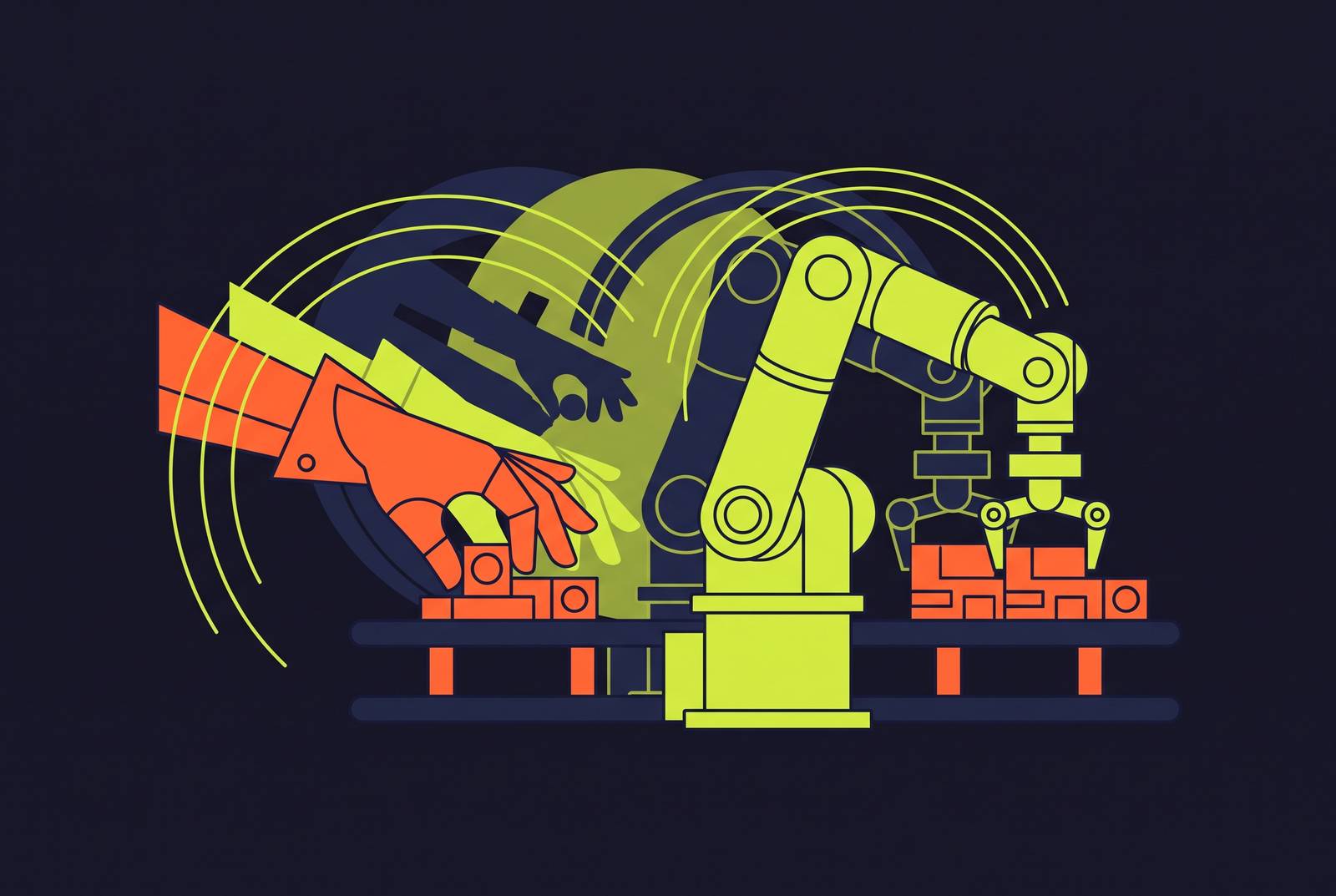
Imitation learning lets an AI system learn directly from a human demonstration, then reproduce the action and adjust it as conditions shift. The system records what the operator does: what they see, how much force they apply, where their hands move. Research out of Fraunhofer and the University of Augsburg, describes mapping those hand trajectories onto a robot's end-effector so the motion translates without needing a separate coding step. Depending on the demonstration tool, the action data gets pulled out directly or inferred from what was recorded. What comes out the other end is a policy: a function that takes in what the robot currently sees and outputs what it should do next.
This matters because it opens automation to tasks that used to sit outside the reach of robotics: things too variable, too unstructured, too fiddly to hand-code. And it removes a real barrier to adoption, since the operator doesn't need to know anything about robotics. They just do the job the way they'd normally do it. Research on imitation learning for robotics describes demonstration tools, hand-mounted rigs or teaching interfaces, built specifically so an expert can demonstrate a task intuitively, without any robotics background at all.
Behavior cloning: the foundational algorithm and its central failure mode
Behavior cloning is the starting point for most of this work. States get pulled from the demonstration data and fed in as input, and the policy gets trained the way any supervised learning model gets trained: by comparing predicted output against the operator's actual action and minimizing the error, usually with mean square error or cross-entropy loss. It's simple, and it's worked well in domains like driving, locomotion, and navigation, where datasets are large and fairly consistent from one example to the next.
The trouble is compounding error. A small prediction mistake nudges the robot into a state it never saw during demonstration, an out-of-distribution state, and once it's there, the next prediction is even less reliable than the last. Errors stack. The policy looks fine near the exact conditions of the demonstration and falls apart the further it drifts from them.
On a production line, this isn't an abstract risk. Parts show up in different positions, different orientations, with different surface textures from one unit to the next, and the robot runs into states the operator simply never demonstrated. Downstream, that drift shows up fast: misalignment, damage, a part that doesn't seat right. There's no quiet failure mode here. The line either builds a good product or it doesn't.
Interactive correction: how DAgger and its successors close the distribution gap
DAgger, short for Dataset Aggregation, is the standard fix for this. Instead of training only on the operator's original demonstration, the expert gives feedback on what the robot's own policy actually does. Each round works the same way. The current policy runs the task, its new observations get collected, an expert relabels those observations with the correct action, the corrected data gets folded into the training set, and the policy gets retrained. That loop keeps the statistical assumption behind supervised learning, that training data and real-world data come from the same distribution, roughly intact.
On the floor, this looks like an operator watching the robot attempt the task and correcting what it gets wrong, with that correction becoming new training data rather than a one-off fix.
Work presented at NeurIPS in 2025, from Li and Zhang, sharpens this picture considerably. If the cost of getting expert feedback is measured per trajectory, behavior cloning generally can't be beaten, which limits how much interactive correction actually helps. But if the cost is measured per state, interactive methods can provably do better. Their method, Stagger, a one-sample-per-round variant of DAgger, beats plain behavior cloning under low-recovery-cost conditions. A second method, Warm-Stagger, blends offline demonstrations with interactive annotations and comes with a guarantee that it won't do much worse than using either data source alone.
For a factory, this isn't just theory. Getting an operator's correction costs real time, time off the line, attention pulled from other work, and that cost shapes which algorithm is actually usable in practice. Warm-Stagger's ability to combine a batch of offline demos with a handful of interactive corrections, with a guarantee against doing much worse than either data source alone, matters precisely because operator time is expensive and scarce.
What makes a demonstration useful, and how few might be enough
Most visual imitation learning methods need a lot of data, which is a real constraint in manufacturing, where tasks and parts are often specialized to one line or one product. Research on one-shot visual imitation learning for manufacturing names data scarcity directly as a limiting factor on how broadly these methods can be applied.
Quality matters as much as quantity, and quality breaks into a few separate ideas. Feasibility comes first: the demonstrated motion has to be something the robot can physically do. Human joints and robot joints don't move the same way, and an expert can demonstrate something without realizing it's outside the robot's reach or torque limits. Research on feasibility-aware imitation learning addresses this directly. Consistency matters too, since demonstrations that swing wildly in style just look like noise to a behavior cloning model that has no way to tell stylistic variation from meaningful variation. And coverage matters: the demonstrations need to span the range of positions, orientations, and surface conditions the robot will actually run into on the line.
Some frameworks tackle this by checking whether a given demonstration is even feasible for the robot, then giving the operator feedback so they can adjust and redo the demonstration if needed. Demonstrations judged more feasible get weighted more heavily during policy training, an approach aimed at improving both data efficiency and robustness.
The one-shot visual imitation work out of Fraunhofer IGCV and the University of Augsburg pushes this further. Their framework strings together hand detection, object detection, trajectory segmentation, and skill learning through Dynamic Movement Primitives, and research in this area has explored reproducing multi-step pick-and-place tasks from very few human demonstrations. That's a meaningful claim: one demonstration, not thousands. The authors frame it as a way to cut programming complexity and give industrial robots more flexibility, though the testing so far has been in simulation rather than on a physical line.
A related mechanism appears in patented approaches that encode this same structured correction loop directly into a defined workflow: an initial operator demonstration is recorded, the robot attempts the task, the operator corrects what went wrong, and the corrected data feeds back into training, DAgger's logic made explicit rather than left as a general algorithmic principle.
Put together, these threads point to one conclusion: fewer demonstrations are possible, but only when someone is actively managing the quality of what gets recorded. Quantity and quality trade off against each other; they don't substitute for one another.
Force-sensitive and bimanual tasks: where the demonstration must carry more than motion data
A lot of precision assembly work is fundamentally about factors beyond where the end-effector goes. It's about how hard it pushes. Insertion tasks need controlled contact force as much as correct positioning, and delicate operations like attaching a film, fastening a cable, or seating a connector involve force that a skilled operator adjusts continuously and often without conscious thought.
Research published in ScienceDirect in 2025 describes a force-conditioned visuomotor diffusion policy trained on hand-guided demonstrations for a bimanual robot: one arm holds a battery housing steady while the other inserts the battery cover, a task with real positional and real force requirements at the same time. The demonstration data here has to capture force behavior directly, not just the path the hands traced through space.
That has a direct consequence for how demonstrations get collected: the teaching interface needs a way to record force, not just position or a video feed. And it has a consequence for which tasks make sense to automate this way in the first place. Tasks where force is the central challenge are harder to learn from demonstration than tasks where the challenge is mostly about path, and that difference should shape which jobs get picked first for imitation learning deployment.
Digital twins as a rehearsal space before the policy touches the real line
A policy trained on operator demonstrations can't just get tried out on the live line. A mistake means a collision, a damaged part, or a stopped line, and none of those are cheap ways to find out a policy needs more work.
A framework published in 2026 in the International Journal of Precision Engineering and Manufacturing, from Springer, describes a simulation-based digital-twin approach for learning human-like movement patterns inside a virtual factory. It's built on proximal policy optimization and folds in generative adversarial imitation learning, which produces a dual-reward setup: one reward tied to task completion, another derived from how closely the agent's behavior matches the demonstrations. The framework was tested across seven virtual factory layouts, ranging from a simple loop and a serpentine aisle to a narrow U-turn and asymmetric route configurations.
Performance got measured on completion rate, cycle time, collision count, how often the agent took shortcuts, path length, and an energy proxy, with dynamic time warping used to quantify how closely an agent's path matched a human trajectory. The comparison set included behavior cloning and DAgger, and the researchers tested five different strengths of the imitation reward: 0, 0.001, 0.1, 0.5, and 1.0.
The finding worth sitting with: stronger imitation rewards improved trajectory similarity on several of the maps, but that gain came with trade-offs in efficiency and robustness, and those trade-offs shifted depending on the route's layout. No single reward setting won across every map. For practitioners, that means the tuning decision, how heavily to weight human-likeness against raw efficiency, gets made with evidence from simulation, rather than guessed at live on the floor.
The expert ceiling: why the policy can only be as good as the demonstration it learned from
Imitation learning, by design, only closes the gap between the expert's performance and the policy's. It doesn't aim past the expert. Surveys on dexterous manipulation through imitation learning state this plainly: the learned policy's performance is bottlenecked by the performance of the expert it learned from.
On the floor, this plays out in a few concrete ways. If the operator demonstrating the task has a habit that isn't quite optimal, the robot learns that habit as though it were correct. If the operator is inconsistent from one demonstration to the next, the policy ends up learning some blended average that may not represent any single coherent way of doing the task. And if the operator's technique is adapted to human anatomy, wrist angle, grip strength, reach, the robot might reproduce a version of it that's technically possible but mechanically inefficient for a machine with different joints and different limits.
Which operator gets recorded matters more than it might seem. Skilled operators don't all perform a task identically, and whatever variation exists between them shows up directly as variation in the resulting policy. The same body of research names learning from suboptimal demonstrations as an open research problem: building imitation learners capable of producing a policy that outperforms the expert it learned from, rather than just matching it.
The practical upshot for anyone running a demonstration session: use the most skilled operator available, and review the collected data for quality before training starts. CarbonSix SigmaKit builds this into its workflow directly, letting users filter and review demonstration data before a model gets generated from it.
Where imitation learning is now deployable on real factory floors
CarbonSix SigmaKit launched in September 2025 and is described as the first commercially available industrial robot AI product built on imitation learning. It runs directly on the factory floor and doesn't require the user to have specialized robotics expertise or extra equipment beyond what the system provides.
The task list gives a good read on where this technology actually stands today: film attachment and removal, assembly, machine tending, cable fastening, hanging operations, all non-standardized, delicate work that's historically resisted conventional robot programming. The company points to mobile devices, consumer electronics, automotive components, food, and materials as target industries.
The workflow itself is straightforward. Users demonstrate the target task repeatedly to build up a training dataset, filter and review what's been collected, and the system generates a model, in under a day depending on the task, that gets deployed as a robotic skill straight onto the unstructured task it was trained for. Since launch, the company reports sales inquiries and reservations coming in, along with proof-of-concept projects underway with major global manufacturers.
CarbonSix was founded in 2024 and is based in Wilmington, Delaware, having raised $4 million in seed funding. Its CHO, Jehyuk Kim, is an AI and robotics researcher with a background spanning MIT, Yale, Seoul National University, and KAIST, and previously served as co-CEO. Terry Moon, also on the team, was formerly Chief Strategy Officer and Vice President at SUALAB, a company acquired by Cognex Corporation in 2019 for roughly $195 million. CTO Dr. Hyungju Suh holds a PhD from MIT CSAIL and has worked on projects with the Boston Dynamics AI Institute, Toyota Research Institute, and NASA's Jet Propulsion Laboratory.
What the task list reveals is where the frontier currently sits: tasks where force and dexterity matter but raw positional precision is manageable are deployable now. The hardest force-dominant tasks, the kind described in the bimanual battery-assembly research, are still mostly research territory. Still, the distance between an academic paper and a shipping product has closed fast, roughly the same span of time covered by the research cited throughout this piece.
Where the process still breaks down, and what that means for practitioners choosing tasks
Some failure modes survive every algorithmic improvement made so far. Compounding error still shows up whenever the robot wanders into states far outside the demonstration data, and while an interactive imitation-learning correction method and Warm-Stagger reduce how often that happens, neither removes the risk entirely. Infeasible demonstrations can still slip into a training set undetected unless something like FABCO's feasibility-checking infrastructure is built in, and that infrastructure is extra cost and extra setup, not something that comes free. And the expert ceiling holds no matter how good the algorithm is: if no operator performs the task at its actual optimum, nothing in the training pipeline can correct for that on its own.
For a plant manager or process engineer deciding what to hand over to imitation learning first, the pattern in the research points toward tasks with real variability in part position and orientation, but a demonstrable and consistent right way to do them, tasks where a skilled operator's best technique, captured and reviewed carefully, actually represents something close to optimal. Force-dominant tasks and tasks with no clear best operator technique remain the harder cases, and the honest answer for those, for now, is that the technology isn't quite there yet.
Sources
- image-ppubs.uspto.gov
- (PDF) Imitation Learning for Robotics: Progress, Challenges, and Applications in Manipulation and Teleoperation
- Digital Twin-Based Imitation Learning for Human-Like and Efficient Driving of Mobile Robots in Virtual Factory Environments | International Journal of Precision Engineering and Manufacturing | Springer Nature Link
- CarbonSix says its toolkit brings robot imitation learning to the factory floor - The Robot Report
- Dexterous Manipulation through Imitation Learning: A Survey
- Visual imitation learning from one-shot demonstration for multi-step robot pick and place tasks | Scientific Reports
- sciencedirect.com
- nips.cc