Sim-to-real in production: what breaks when a learned policy meets a real line
Perception failures and physics mismatches derail policies faster than anyone expects.
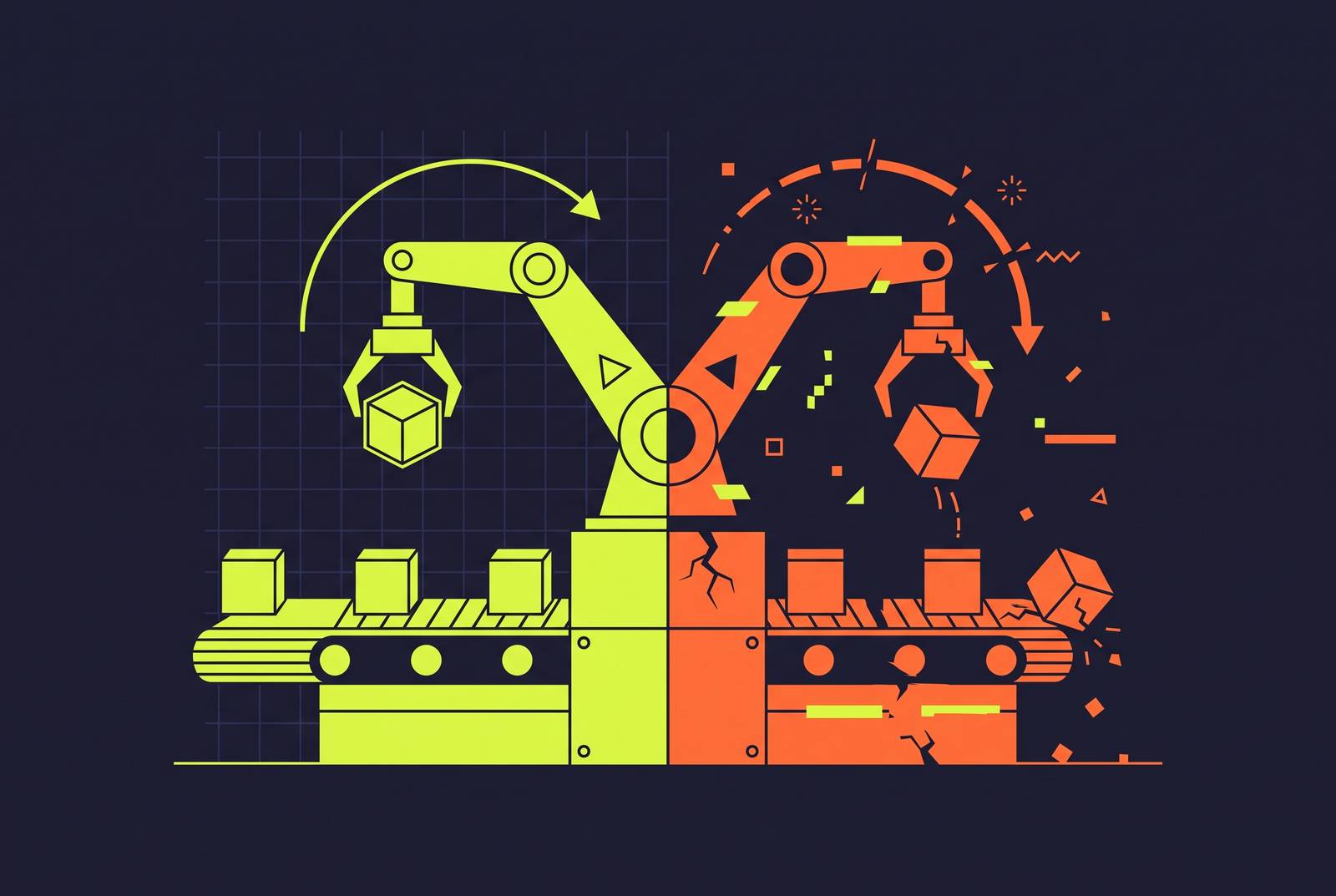
The moment every robotics team eventually lives through is consistent enough that you can nearly set a clock to it: the policy trains clean, the sim metrics look strong, and then the robot hits a real factory floor and hesitates, drifts, or fails at something it handled ten thousand times in simulation. That gap, the distance between learned behavior in a controlled virtual environment and reliable performance on an actual production line, is the central unsolved problem in robotics deployment today. Understanding what causes it is not academic exercise. It is the operational difference between a system that ships and one that sits in a corner while your integration team fields increasingly uncomfortable calls from the customer.
The Sim-to-Real Gap Is Not One Problem
Most people hear "sim-to-real transfer" and imagine a single failure mode. A visual discrepancy, or a sensor calibration issue that needs tightening. In practice it is a cluster of distinct, compounding problems, and conflating them is precisely how teams end up chasing the wrong fix for weeks.
Physics Fidelity
Simulation physics engines make approximations. Contact dynamics, friction coefficients, the micro-slip behavior of a gripper on a slightly oily part surface: these are either simplified or absent in most training environments. A policy trained in sim learns to exploit whatever physics model it was given. On a real line, those subtle dynamics differ, often enough to corrupt grasps that looked perfectly stable in training.
The problem is asymmetric in an important way. Simulation can be made more accurate, but compute cost scales quickly, and even high-fidelity sim diverges from physical reality in ways that are genuinely hard to characterize in advance. You do not know what you are missing until the robot is standing in front of a real bin.
Sensor Noise and Perception Drift
Cameras in simulation render cleanly. Real vision systems contend with variable lighting, lens distortion, dust on optics, heat shimmer near ovens or weld stations, and the minor but meaningful differences between the sensor modeled in sim and the one actually bolted to the cell. A policy that learned to read part position from a clean synthetic depth map will be operating on assumptions that simply do not hold once it is reading from a physical sensor in an industrial environment.
And this is not a calibration problem you fix once and forget. Perception drift is continuous. Lighting changes with the time of day, with seasons, with whether someone left a bay door open during a shift change. The policy has no model for any of that unless you deliberately built it into training.
Action Latency and Motor Dynamics
Simulated actuators respond instantly, or with a fixed idealized delay. Real servo systems have latency that varies with load, temperature, and control loop timing. A policy that learned tight feedback loops in sim will generate commands that assume a responsiveness the physical system cannot actually provide. The result is oscillation, overshoot, or compounding positional error that accumulates across a multi-step task. Small errors stack. By step eight of a twelve-step sequence, you are operating in territory the policy was never trained to recover from.
Distribution Shift at the Object Level
Parts on a real line are not the CAD models used to generate training data. They have scratches, mold flash, color variation across production batches, and positional variance that exceeds whatever domain randomization you ran during training. The moment you introduce a part variant the sim never encountered, you are asking the policy to generalize in ways it was never explicitly tested on. Sometimes that generalization holds. Sometimes it does not. In production, "sometimes it does not" is not an acceptable risk profile.
What Actually Breaks First
The pattern that emerges across actual deployments is consistent enough to be predictive: perception fails before control does. The policy's action logic is often reasonable; it simply receives bad inputs and acts reasonably on incorrect information. The apt description I have heard from a line supervisor is "the robot doing exactly what we told it, just for a part that isn't there." Fixing the vision pipeline, improving lighting, tightening calibration, and enriching the training distribution with real sensor data from the actual environment recovers the majority of failures in the first deployment wave.
The second wave is subtler, and frankly more interesting from an engineering standpoint. These are the edge cases where physical dynamics diverge from sim in ways nobody anticipated during training. A part orientation the randomization did not cover. A conveyor speed fluctuation that pushes a grasp outside the policy's confidence region. A bin with parts nested against each other in a configuration the policy has no behavioral strategy for. You watch the robot pause at the edge of its competence, and you realize the sim never showed it that particular corner of the world.
These failures are harder to remediate because they require retraining, real-world data collection, or fallback logic that routes the edge case to a human or a simpler rule-based handler. None of those options are fast or cheap.
Approaches That Actually Reduce the Gap
Domain Randomization
The standard approach: randomize simulation parameters aggressively during training so the policy learns robustness across a wide distribution of conditions. Vary lighting, object textures, friction values, sensor noise levels, object poses. The hypothesis is that if the real world falls somewhere within the range of variation you trained on, the policy generalizes.
Domain randomization works, genuinely. It trains policies that are meaningfully more robust than those trained on a narrow sim distribution. But it cannot cover what you have not thought to randomize, and the list of unspecified conditions is consistently longer than any team's pre-deployment checklist.
Real-to-Sim Adaptation
Rather than making sim more like an imagined real world, this approach instruments the actual deployment environment and uses that data to calibrate the simulator. You measure your real actuator latency profiles. You capture your real sensor noise characteristics. You scan your actual parts and feed those geometries into the sim asset pipeline. The simulation becomes a model of your specific line, not a generic approximation of a generic factory.
It is more labor-intensive upfront. But it compresses the gap significantly, because you are no longer guessing at the distribution shift. You are measuring it. That distinction matters more than it sounds.
Residual Policy Learning and Fine-Tuning on Hardware
Some teams train a base policy in sim and then fine-tune it with a modest amount of real hardware data. The sim policy establishes general competence; the hardware data corrects specific systematic errors that sim introduced. The challenge is data efficiency. Hardware trials are slow, expensive, and carry real risk of equipment damage. Fine-tuning only works if the sim policy starts close enough to real-world performance that you are making corrections rather than functionally relearning from scratch. If the gap is too wide, you are not fine-tuning; you are retraining with extra steps and more bruises.
How Much of This You Solve In-House
Which of these approaches to pursue, and how much to rely on platform toolchains versus internal capability, is a genuine strategic decision, not a procurement detail. The teams that treat it as the latter tend to find themselves locked into a sim-to-real methodology that does not match their actual production environment. What matters is that someone on the team understands the underlying failure modes at a physical level, because no software layer, regardless of how it is marketed, abstracts away the physics of a real gripper contacting a real part under real conditions.
The Operational Reality Nobody Publishes
Simulation benchmarks are optimized to perform well on simulation benchmarks. A policy that achieves high pick success on a curated test set in sim can fail at a rate that stops a production line when the real distribution hits it. The people who know this most viscerally are the integration engineers who get called late at night when the robot stops cycling and nobody is sure why.
The corrective is not to distrust simulation. Sim is indispensable for safe exploration, for training at scale, for testing policies before they touch expensive hardware. The corrective is to treat simulation as the beginning of training, not the validation environment. Real-world performance data, collected systematically from the actual deployment cell, has to enter the loop. The policy needs to see what it will actually encounter.
Companies that close the sim-to-real gap in production are not doing something mystical. They are being disciplined about data provenance, rigorous about measuring real-world failure modes rather than sim-world success rates, and clear-eyed about the fact that deployment is not the end of a development cycle. It opens a new one, and that new cycle is driven by the physical world, not the simulator, which is what it should have been all along.