Bimanual Robot Arms in Assembly Tasks
Coordinated dual-arm systems replace costly fixturing by having one arm hold while the other works.
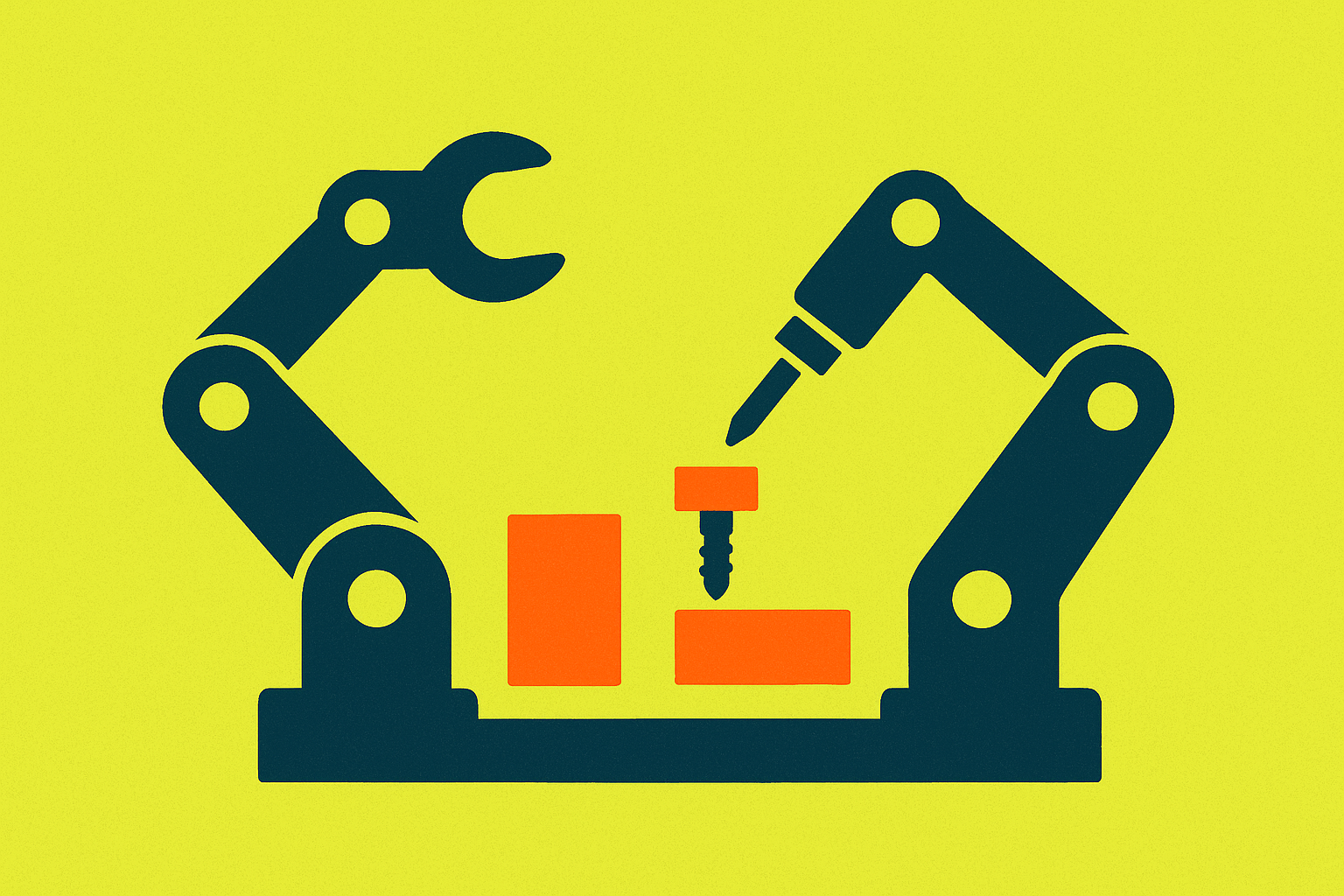
Bimanual manipulation means controlling two robot arms at once, coordinating their motion and the forces they apply, so the pair can handle assembly tasks the way a person would with two hands. That distinction, coordinated versus independent motion, explains why factories are buying dual-arm systems now, and why building them is a lot harder than bolting a second arm onto a workstation.
A single arm can pick, place, and fasten. Holding a bracket steady while a screw goes into it, pressing a housing shut evenly from two sides, or handing a part from one grip to another without some fixture doing the holding for it: these are different problems, and together they make up a huge chunk of real assembly work. Factories have historically solved it with jigs, fixtures, and conveyor stops that hold a part still so a single arm can do its one job. Dual-arm systems swap that fixturing for a second arm that does the holding itself, so one arm becomes the vise and the other becomes the hand. This piece is about that specific slice of robotics, assembly. Surgical robots, warehouse arms, and service robots that happen to have two limbs are a different conversation, worth having elsewhere.
Here's the honest version of the pitch, and here's where it oversells. Two arms can multitask, running independently on separate steps or locking into tight sync when the job calls for it. They can replace more than one single-arm station, which matters when floor space is the constraint and not just cycle time. And they open up a category of dexterity, in-hand transfer, symmetric force, coordinated holding, that fixturing was never built to replicate. What the pitch skips is the cost: two arms sharing a workspace is a much harder planning problem than two arms working alone. Most of what follows is about exactly how much harder, and where that difficulty actually bites. The short version, for anyone in a hurry: asynchronous coordination is the real bottleneck, and most of the market is still underrating that relative to synchronous motion.
How large the assembly robot market has grown and what is driving it
The global assembly robot market was valued at $8.6 billion in 2025 and is projected to reach $13.8 billion by 2036, a 4.4% compound annual growth rate, according to Fact.MR. That's slower than industrial robotics overall, and the gap is the more useful number here: assembly is the harder, more precision-dependent slice of the business, and precision doesn't scale as fast as volume does.
The IFR's World Robotics 2025 report backs that up with installed-base figures: 542,000 robots installed in 2024, the fourth straight year installations topped half a million units, bringing total operational stock to 4,664,000 units, up 9% year on year.
Geography does most of the explaining once the numbers sit side by side. Asia accounted for 74% of new deployments in 2024, versus 16% in Europe, with the Americas accounting for the remainder. Dense, high-mix electronics and automotive lines are exactly where the case for a second coordinated arm is strongest, so it tracks that bimanual adoption is moving fastest where production density is already highest.
Automotive is the industry setting the pace here, and it's worth holding onto for the closing section. Everything downstream in this piece, the planning problems, the imitation learning, the benchmarks, eventually has to prove itself on an automotive or electronics line before it means much outside a lab.
The synchronous versus asynchronous distinction that defines bimanual task design
Two arms work together in one of two basic modes, and nearly every bimanual task falls cleanly into one or the other.
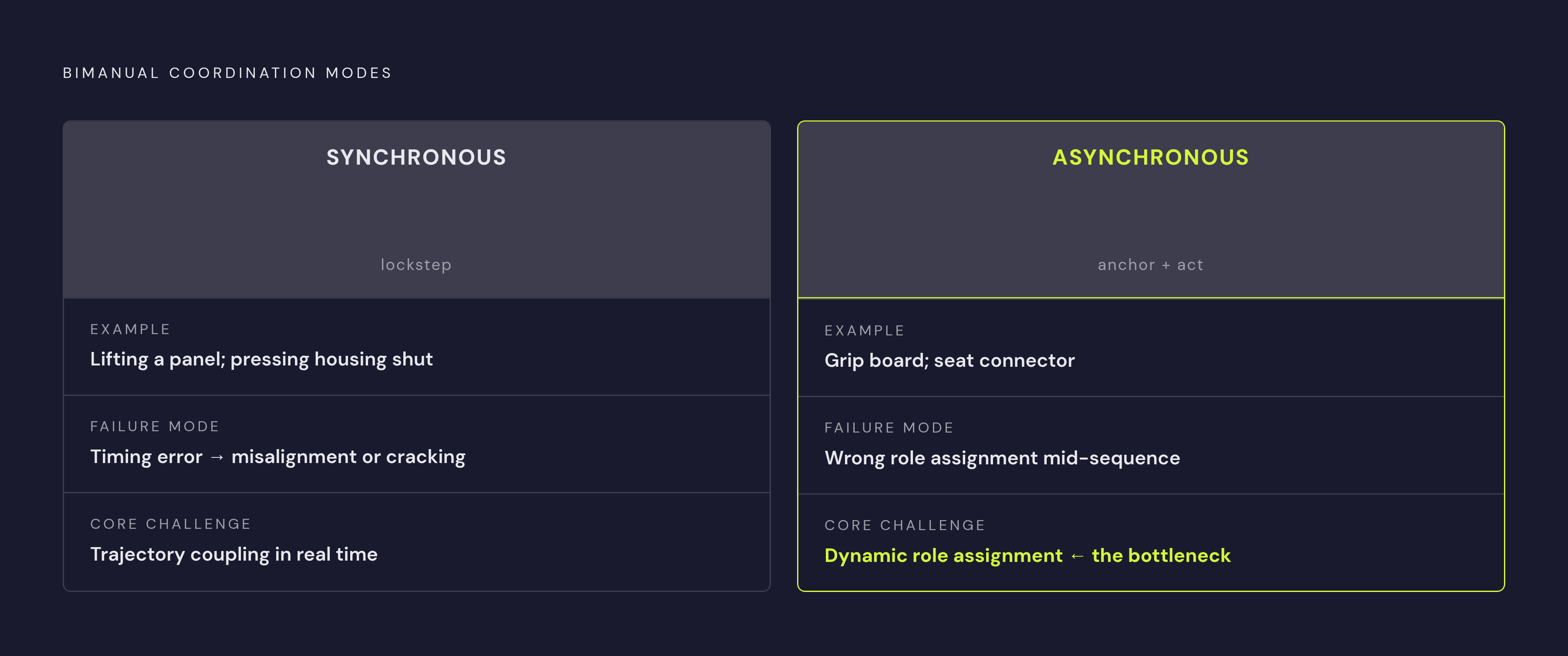
Synchronous, or parallel, coordination means both arms act together, often mirroring each other's motion. Lifting a large panel with two hands, or gripping a housing symmetrically before pressing its two halves shut, both require lockstep movement, and timing errors here don't stay contained. They show up directly as part misalignment or a cracked housing, since there's no room for one arm to lag a beat behind the other.
Asynchronous coordination puts one arm in a holding or restraining role while the other does the actual work. Picture one arm gripping a circuit board steady while the other seats a connector into it, or one hand holding a bottle while the other twists the cap. This mode needs role differentiation: the system has to decide, dynamically or by instruction, which arm anchors and which acts. That's a planning problem more than a timing problem, and it's the harder of the two to engineer well. Anyone building for this mode should treat it as the harder target from day one, because bolting asynchronous logic onto a synchronous architecture later tends to mean a rebuild, not a patch.
People switch between these modes constantly without thinking about it. Robots don't get that same latitude. Each mode needs its own explicit logic for who's holding and who's moving, and a system that slides between the two on demand is one of the harder open problems in the field. That split sets up exactly which technical problems show up next: synchronous tasks demand tight, real-time coupling between two joint trajectories, while asynchronous tasks demand a planner that can reassign roles mid-sequence without starting over.
The three core technical challenges that make bimanual assembly harder than it looks
Three problems show up again and again in bimanual assembly research, and they compound rather than stack.
First, temporal synchronization. Single-arm motion planning assumes one kinematic chain moving through space on its own schedule. Bimanual planning has to couple two chains whose actions depend on each other: arm B's grip has to be in place before arm A's fastening motion starts, and drift in that timing produces dropped parts, misaligned joints, or force spikes strong enough to damage the components being assembled.
Second, spatial collision avoidance. Two arms sharing a workspace means the path planned for one arm has to account for where the other arm actually is in real time, not where it was when the plan was drawn up. Standard single-arm planners treat obstacles as fixed points; bimanual planners have to treat the partner arm as a moving obstacle that might not stay put. One common architecture splits this into two layers: a Task Planner that decides the sequence of actions, and a Global Motion Planner that works out the actual trajectories, feeding collision information back up the chain so the system can replan when a sequence turns out to be physically impossible.
Third, long-horizon reasoning under partial observability. Assembly sequences run many steps deep, and a mistake made in step three sometimes doesn't surface as a visible failure until step seven, by which point the fix costs a lot more. Add partial observability: cameras occluded by the arms themselves, parts that shift slightly after being placed, grasp quality that's uncertain even when the gripper reports success. The planning problem stops looking like clean optimization and starts looking like guesswork with extra steps.
These three don't fail independently. A system that nails synchronization but can't reason six steps ahead still falls apart on a complex assembly, because the error just shows up later instead of not at all.
The real bottleneck sits underneath all three, and it's the one most people overlook first: data. Dual-arm hardware costs real money, so bimanual demonstration datasets stay far smaller than the single-arm datasets researchers have spent years piling up. Foundation models need thousands of examples to generalize well, and dual-arm hardware budgets can't feed that appetite at the same scale single-arm robotics has enjoyed. Betting the near-term future on bigger bimanual models alone is really a bet against a budget line, and budget lines tend to win.
How imitation learning and transformer-based policies are closing the coordination gap
The Action Chunking Transformer, ACT, born out of the ALOHA research lineage, tackles synchronization in a fairly direct way: instead of predicting one action at a time, it uses image inputs to predict a whole chunk of coordinated bimanual actions at once. Predicting a multi-step, two-armed motion as a single coordinated unit sidesteps a lot of the drift that creeps in when each arm gets planned action by action, independently of the other.
Mobile ALOHA put a number on how far this gets you with limited data: using just 50 demonstrations per task, co-training with existing static ALOHA datasets increased success rates by up to 90% on complex mobile bimanual tasks. That's the data scarcity problem getting solved sideways, by pooling data across setups rather than logging more robot hours. The rig behind it uses two ViperX 300 arms mounted on a mobile base, and the co-training approach mixes static ALOHA data with mobile data to stretch a small dataset further than it would otherwise go.
PerAct2 takes a different angle on the same problem, learning features at both the voxel level and the language level, using a mix of shared and private transformer blocks so the two arms can specialize without losing coordination. The approach uses a mix of shared and private transformer blocks so the two arms can specialize without losing coordination, with language instructions guiding task execution. This line of work leans on benchmarks like RLBench's bimanual extension, 13 tasks across 23 variations, and BRMData, 10 household tasks including flexible object handover.
On the force side, transformer-based bilateral imitation learning has started enabling dynamic stiffness adjustment on hardware that doesn't require a research lab's annual budget, which matters because precision contact tasks, the kind where too much force cracks a part and too little means it never seats, used to need expensive, purpose-built rigs.
All of this shares one limitation: deterministic behavior cloning, the standard imitation learning approach, struggles when a task has more than one valid solution. If there are three equally correct ways to hold a part while fastening it, a deterministic policy tends to average them into a fourth, worse way that satisfies none of them. Diffusion models address this differently, by generating a distribution of possible actions instead of committing to a single blended answer, which is the clearest reason to expect them to gain ground in this space. For any task with more than one valid trajectory, a deterministic policy is a poor fit, however cheap it looks on paper.
Why diffusion-based foundation models represent a step change for bimanual generalization
Bimanual tasks are full of what researchers call multi-modal action distributions: situations where the same task can be finished by several genuinely different, equally valid arm trajectories. A deterministic policy collapses those options into a single averaged path, which satisfies none of the original valid solutions. Diffusion models generate a distribution of possible actions and sample from it, rather than committing to one blended answer.
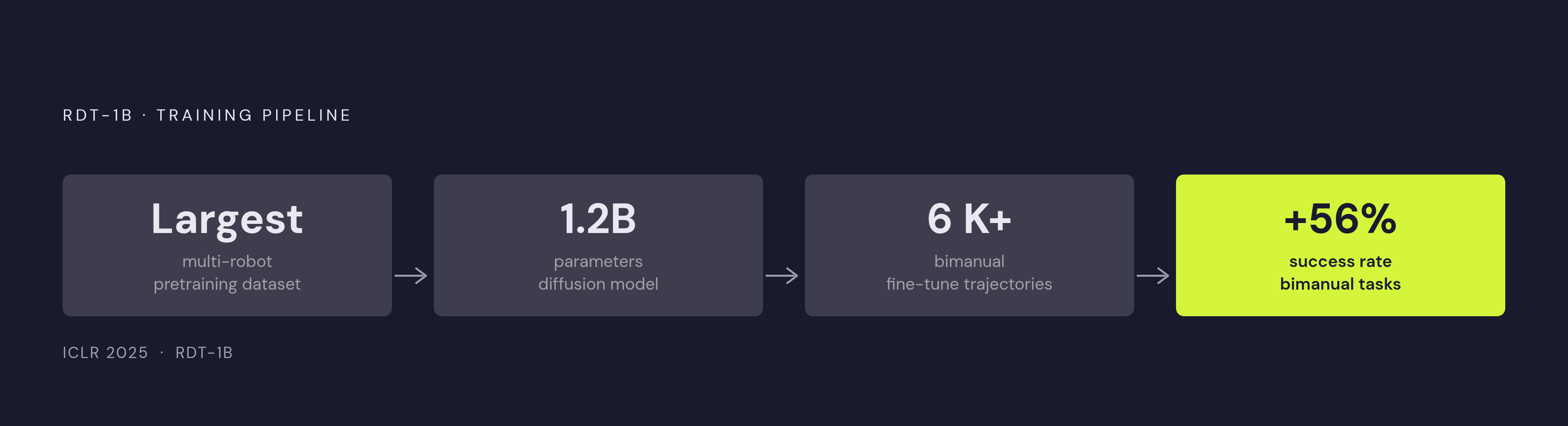
The Robotics Diffusion Transformer, RDT-1B, is the clearest example of what that buys. It was pre-trained on the largest multi-robot dataset collection assembled to date and scaled to 1.2 billion parameters, the largest diffusion-based pre-trained model for robotic manipulation at the time of its publication. It was then fine-tuned on a self-collected bimanual dataset covering multiple tasks across more than 6,000 trajectories, and the payoff was a 56% improvement in success rate on challenging bimanual tasks over baseline methods, reported at ICLR 2025.
What that improvement buys in practice: zero-shot generalization to objects and scenes the model never saw during training, so a new part variant doesn't need a fresh round of demonstrations. It follows plain-language instructions for task setup, so deployment doesn't mean reprogramming every time a task shifts slightly. And new skills come from as few as one to five demonstrations, a direct answer to the data cost problem dogging this whole field.
The problem isn't solved, though. Diffusion-based policies still hit real limits on the factory floor, and the gap between simulation performance and real deployment conditions remains a known challenge in the field.
Cross-robot pretraining deserves its own mention as a workaround here. Training on a mixed pool of data from many different robot platforms, then fine-tuning on the specific target hardware, is one approach researchers have pursued to address the data scarcity problem that bimanual systems face.
How trajectory planning handles the geometry of two arms working in shared space
Here's the geometric version of the problem from two sections back: any trajectory planned for arm A that treats arm B as a fixed, unmoving obstacle fails the moment arm B actually moves, and given that it's a robot arm doing a job, it will move.
One line of work addresses tasks requiring the arms to change grasp configurations multiple times over a sequence, seeking shared intermediate configurations both arms can pass through to reduce redundant regrasping. Fewer regrasps means fewer chances for small positioning errors to stack into a real assembly defect.
A separate line of work explores hierarchical motion architectures that split planning into a global stage, which sketches a feasible trajectory skeleton, and a local stage that handles real-time adjustment. The global stage sketches a feasible trajectory skeleton; the local stage handles moment-to-moment obstacle avoidance on top of it, and together they produce collision-free paths faster than sampling-based methods working alone.
Real hardware makes the abstractions concrete, and also exposes where they crack. One setup uses two Kinova Gen3 arms fitted with Robotiq grippers and an RGBD RealSense camera, running impedance controllers and a gradient-based energy function for planning, tested on assembling structural beam components from the RAMP benchmark. The result held up even when parts weren't sitting in their intended starting positions, the kind of robustness that matters once a system leaves the lab. But the setup also turned up a specific, physical limitation: internal stiction in the Kinova Gen3 joints made the controller struggle with millimeter-scale adjustments whenever the arm was fully extended. That's friction in a gearbox, plain and simple, and a reminder that a policy can be correct while the arm itself still refuses to comply.
BiAssemble, presented at ICML 2025, tackles a geometry-first version of the problem: reassembling broken fragments back into their original shape. That requires reading geometric cues off irregular surfaces to figure out how to grasp, align, and manipulate pieces together. The approach breaks the task into three steps: picking up fragments using point-level affordance learning, aligning them by transforming the target assembled pose into collision-safe positions for each arm, and predicting the insertion direction needed to keep the pieces from colliding as they come together. The lesson outlasts the specific example: bimanual planning has to encode part geometry and assembly intent, alongside the plain mechanical fact of where the robot's joints are allowed to swing.
What the RoboTwin challenge and recent benchmarks reveal about where the field actually stands
The RoboTwin Dual-Arm Collaboration Challenge, run at CVPR 2025, gives an honest snapshot of where things stand. Built on the RoboTwin simulation platform and the AgileX COBOT-Magic robot platform, the competition ran in three stages: two rounds in simulation followed by one round on real hardware. That last stage carries the most weight, because simulation success and real-world success are separate claims, and treating them as interchangeable is a common mistake in how this field reports progress.
The challenge covered 17 dual-arm manipulation tasks spanning rigid objects, deformable objects, and tactile-based scenarios, deliberately broad so the test measured generalization rather than a narrow party trick. Sixty-four teams entered, more than 400 participants total, and top-performing approaches included methods called SEM and AnchorDP3.
The spread of results tells its own story, and it takes reading across categories rather than at the topline to see it. Rigid object assembly is the most mature category by a wide margin. Results were consistent across teams, suggesting the underlying methods have converged on something that works reasonably well. Deformable object tasks, cable routing, fabric handling, and tactile-based scenarios were the hardest, with success rates dropping and variance between teams widening considerably. And here's the single most instructive data point from the whole challenge: methods that ranked near the top in simulation didn't always transfer cleanly to the real-world round. That gap, sim-to-real, remains one of the field's biggest open problems, and no amount of simulation polish closes it on its own.
Worth naming plainly what current benchmarks still don't test well. Long-horizon sequences beyond a handful of steps remain largely untested, mixed sequences combining rigid and deformable objects in a single assembly run are rare, and performance under the kind of noise a real factory produces, vibration, inconsistent lighting, parts a fraction of a millimeter off spec, isn't well represented either. A benchmark leaderboard reads better as a snapshot of a moving target than as any kind of finish line.
Mobile ALOHA, RDT, and BiAssemble all feed into this same benchmark ecosystem, and the progress across them is real and measurable. But the ceiling is still visible from where the field currently stands, and nobody serious is claiming otherwise.
How automotive and electronics manufacturers are deploying bimanual systems today
Automotive remains the lead sector for assembly robotics, for reasons already covered: large, heavy components that benefit from synchronous two-arm lifting, subassemblies that need one arm holding while another fastens, and production volume high enough to justify dual-arm cells over conventional fixturing.
Electronics manufacturing sits right behind it, for a different reason entirely. Consumer electronics assembly is small-scale, high-mix, and unforgiving on tolerance: connectors that need one arm steady while another seats a component, circuit boards that need to be held without flexing while a second arm solders or fastens. That's asynchronous coordination, described earlier, showing up constantly on a production floor, arm as anchor, arm as actor, switching roles task to task without a line changeover. Automotive is where synchronous coordination earns its keep; electronics is where asynchronous coordination does, and the two industries are quietly running two different halves of the same experiment.
Both are running the live version of the lab work covered in every section above. The synchronous and asynchronous task categories, the temporal and spatial planning challenges, the imitation learning and diffusion approaches chasing generalization: all of it eventually has to survive contact with a real production line running real tolerances at real speed. That's an ongoing story, and the benchmarks covered above are the closest thing available to a scoreboard for how it's going.