Force and Torque Control for Precision Insertion Tasks
Robots feel their way through tight fits when position alone won't work.
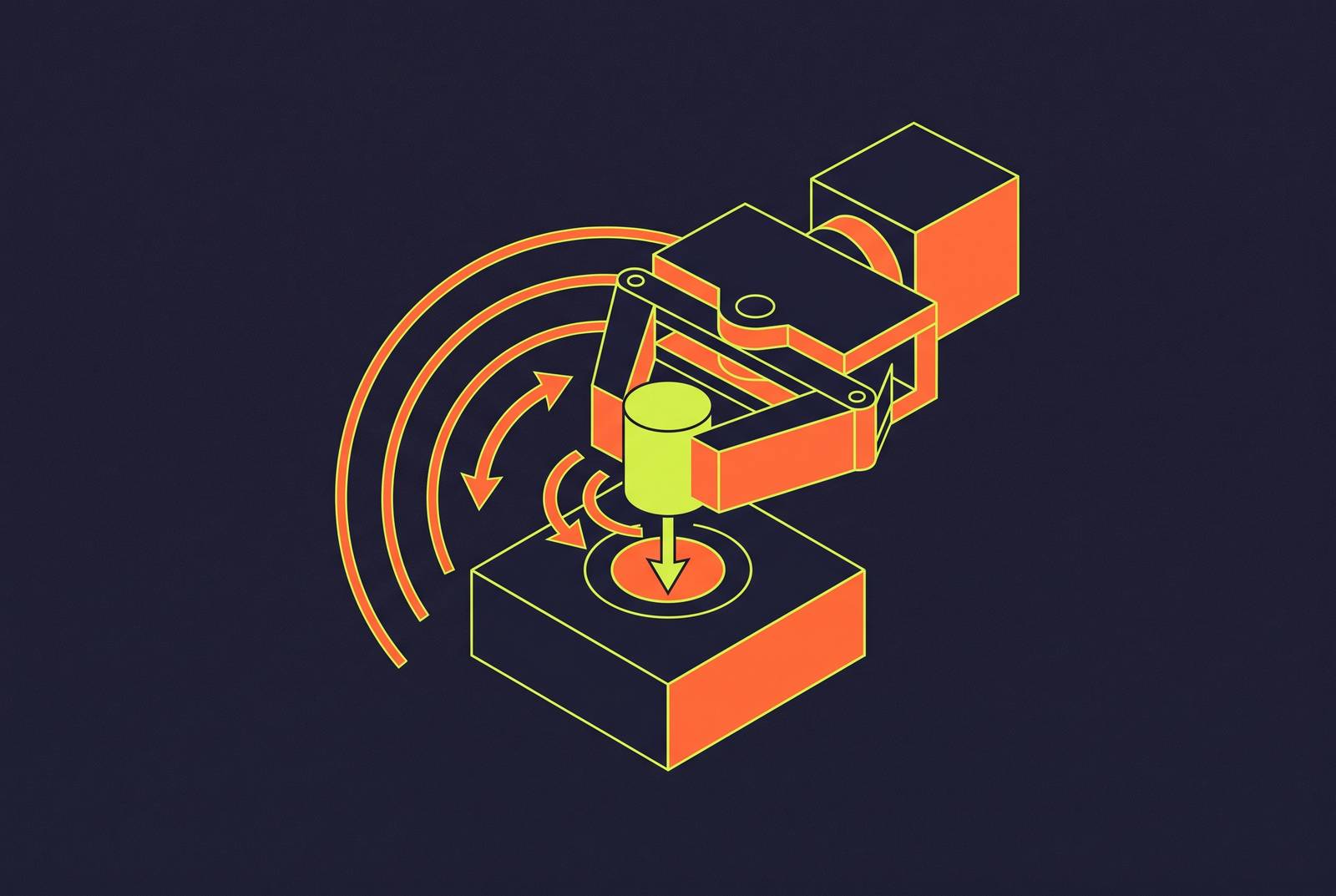
Robots miss holes constantly, and not because they can't move precisely. A modern industrial arm hits a commanded position with impressive repeatability under ideal conditions. The problem is nobody knows the exact position of the hole in the first place: sensor noise, calibration drift, and thermal expansion all conspire to make the robot's picture of the world slightly wrong. Once the clearance between peg and hole gets smaller than that error, position control stops being enough, and the robot has to feel its way in rather than just move to a coordinate. That shift, from planned motion to sensed motion, is what force and torque control is actually for, and it's the backbone of most modern robotic assembly work.
Here's the sharper way to put it. If a robot always knew, to the micron, where a hole sat and how it was tilted, insertion would just be geometry: move the peg to point A, align it to orientation B, push. No sensors needed, no feedback loops, no drama. But that "if" is the whole ballgame. Real hole positions come from imperfect fixturing, parts that shift slightly between stations, and vision systems squinting through glare. When the gap between what the robot thinks and what's actually true exceeds the mechanical clearance of the fit, blind execution turns into a coin flip. Miss the aperture and the peg scrapes across the surface. Get the angle wrong and it wedges, generating friction that no amount of extra push force will fix, only make worse. Push hard enough against a jam and something bends: the part, the fixture, or the end effector itself. Kinematic planning can't fix this, because the issue was never accuracy. It's contact that nobody modeled in advance.
The contact mechanics that make insertion go wrong
Peg-in-hole mating breaks down into three stages, and each one fails in its own particular way. Hole-searching comes first: the peg hovers somewhere near the target and has to find the opening. Chamfer-entering follows, where the peg's leading edge meets the beveled rim of the hole. Inserting is the final push down the shaft. Miss the timing or geometry at any stage and the whole sequence stalls.
During hole-searching, positional uncertainty is the enemy. If the estimate is off by more than the search radius, the peg wanders near the hole and never finds it, like patting down a dark room for a light switch that's three feet from where memory says it should be. Chamfer-entering punishes angular error instead. Even a degree or two of misalignment turns a smooth entry into a glancing impact, loading the peg sideways against the chamfer edge. Once the peg is actually inside the hole, small pose errors carried over from the earlier stages can jam the fit entirely, especially under the tight clearances of interference-fit assemblies where there's no room left to correct.
It gets stranger. Research published in Autonomous Robots describes a floating-target problem: the act of making contact can nudge the target part itself, especially when it isn't rigidly fixed. So the hole isn't just uncertain, it's moving mid-task, which no static trajectory plan can account for. A 2026 Scientific Reports paper on staged vision-force collaboration adds another wrinkle: camera-based localization faces reliability challenges right at the hole entrance on metallic components, which happens to be the exact moment vision matters most. The sensor meant to guide the final approach gets least reliable right when precision counts most. All these failure modes trace back to one root cause: the system has no real-time read on the forces happening at the contact point, and no way to correct once things go sideways.
Passive compliance versus active force feedback
One long-standing fix is mechanical, not computational. Passive compliance comes in two flavors: either the robot structure flexes a bit under load, or a dedicated compliant device, like a Remote Center Compliance (RCC) wrist, sits between the arm and the tool and soaks up misalignment through spring-like give. RCC wrists have been a staple of peg-in-hole assembly for decades, and they work fine for small, predictable misalignments.
Here's the honest problem with them: passive compliance is deaf. It bends when force hits it, but it never reports back what that force actually was, so the control system has no way to adjust its plan mid-task. It's a shock absorber, not a sensor, and treating it like the latter is where a lot of tuning headaches start.
Active compliance flips that. The robot measures the interaction force between shaft and hole in real time and adjusts its position and orientation on the fly. That's not a minor upgrade over passive systems, it's a different category of solution. Passive compliance gives one hardwired reaction to contact, no matter what's happening. Active compliance changes its reaction based on what the sensors report at that instant. Given that difference, the real question is which sensing and control setup delivers active compliance best, which is where the rest of this piece is headed.
How six-axis force/torque sensors read the contact state
A six-axis force/torque sensor measures force and torque along three linear axes and three rotational axes at once, giving a full picture of the contact wrench, meaning every push, pull, and twist happening at that joint. Most get mounted at the wrist, right between arm and end effector, catching forces as close to the actual contact point as the hardware allows.
Torque matters more than people expect here. Lateral force alone tells a controller that something's pushing sideways, but it can't tell a hole that's slightly off-center from a peg that's slightly tilted. Jamming and wedging are rotational problems at heart, and only torque data resolves them.
On the high end sit dedicated wrist-mounted six-axis sensors with high sampling rates and fine force resolution, which are widely used in sub-millimeter insertion work. That resolution isn't cheap, and it isn't always necessary. A software-only alternative exists: estimate joint torque from the robot's own dynamics model, using motor current and known link parameters instead of a dedicated sensor. It costs nothing extra in hardware, which is the whole appeal, but the precision tops out around ±0.5 Nm. Fine for basic collision detection. Not fine enough for tight-clearance insertion where microns decide the outcome. A workaround using Jacobian-based inversion combined with digital-twin torque compensation has been proposed for robots that lack dedicated F/T hardware, essentially squeezing more accuracy out of the model-based approach without buying new parts.
As a rule of thumb cited by industrialmonitordirect.com, dedicated F/T sensors earn their cost once gear ratios climb past roughly 20:1, once the task needs fine force resolution, once a person works near the robot, or once drivetrain friction makes position-loop force estimates too noisy to trust. Beyond wrist sensors, tactile skins like GelSight's vision-based elastomeric sensors read contact geometry at sub-millimeter resolution right at the surface, an active research area that fills in detail the wrist sensor can't see.
Hybrid force/position control: splitting the task space
The core idea behind hybrid force/position control is almost architectural: split the task space into a position-controlled part and a force-controlled part, run separate feedback laws on each, and stitch them together with a selection matrix deciding which axis gets which kind of control. Position gets tracked wherever geometry constrains motion; force gets regulated wherever contact happens. Both run at once, just on different degrees of freedom.
A 2025 study in Advances in Mechanical Engineering (Li et al.) put this into practice using a six-axis wrist-mounted sensor as the admittance controller's input, with position and pose deviation as output. The three assembly stages, searching, chamfering, inserting, got treated separately, each with its own tuned parameters, and the result was position accuracy of ±3.5 micrometers on a φ25H7/g6 clearance-fit part, tight tolerances even by precision-assembly standards. The same setup enabled drag teaching, where an operator physically guides the robot arm through a motion and the force-controlled system records it, cutting down on manual programming.
A related parallel-mechanism approach used force-following control to cut axial pose accuracy error between a component and its shell by more than 85%. Not a bad result for what amounts to letting the robot argue with itself about where to go.
But hybrid control has a known soft spot: switching between position mode and force mode can produce unstable transient behavior right at the seam, a jolt or oscillation exactly where the controller changes its mind about what it's optimizing for. Engineers work around it through careful tuning, so it isn't fatal. Still, it raises the obvious follow-up: what if the switching itself is the problem, and the fix is a controller that never has to switch at all?
Impedance and admittance control: continuous compliance without switching
Impedance control answers that question by modeling the interaction between robot and environment as a spring-damper-mass system, adjusting the relationship between force and position continuously instead of toggling between two control modes. Admittance control does the same job from the other direction: impedance control commands force based on position error, admittance control commands velocity based on measured force. Same physics, opposite input-output pairing.
Because there's no mode-switching involved, the instability risk baked into hybrid schemes simply doesn't apply. Compliance is continuous by construction, and that's the whole argument for preferring it over hybrid control whenever the hardware allows it.
NVIDIA's IndustReal workflow, running on a UR10e arm, shows why this matters in practice. The project used impedance control specifically because rigid position controllers generate large, unintended forces the moment perception or alignment is even slightly off, which in assembly work is basically always. One wrinkle worth noting: impedance control needs direct torque commands, which most industrial robot controllers don't expose by default. UR reportedly gave early access to a direct torque control interface specifically to make this kind of work possible, which says something about how far standard industrial APIs still lag behind the research.
Patent activity in recent years shows impedance and admittance control dominating collaborative robot safety filings, with the field converging on architectures that pair compliance control with spatial and velocity limits layered on top. Variable impedance control and learning-based impedance policies are an active research thread too: instead of fixed stiffness and damping values, these adjust the parameters online based on what the contact state looks like moment to moment, aiming to cut down on impact and jamming. The staged vision-force framework mentioned earlier (Scientific Reports, 2026) does exactly this during insertion, adjusting virtual stiffness and damping in real time and showing measurable gains in insertion success rate and peak contact force on both clearance-fit and interference-fit metallic valve components.
Searching for the hole when uncertainty is larger than the tolerance
A complete insertion task usually runs through four phases: grasp, approach, search, insert. Search eats up the most time by a wide margin in most setups, because it's the phase where the robot is groping around for information it doesn't have yet.
Blind search patterns like spirals or Lissajous curves eventually find the hole, provided the path is dense enough to guarantee coverage, but "eventually" is doing a lot of work in that sentence. Depending on how far off the initial position estimate is, the robot might trace a long, winding path before it stumbles onto the actual opening. Efficient it is not, and anyone who's watched one of these searches run in real time knows the particular boredom of waiting for a robot to find a hole it's centimeters away from.
A more interesting approach comes from a 2024 arxiv paper (Wang et al., 2404.03943), which frames the search as a Partially Observable Markov Decision Process, a formal way of handling situations where the robot can't directly see the true state of the world but can infer it from noisy observations. The method builds its search primitives by analyzing the static stability of different contact configurations, since the geometry of contact itself carries information about how far off the peg is. A finite-state-machine controller, run through a Cartesian impedance controller, executes the search using nothing but proprioceptive sensing: no camera, no tactile pad, just the robot's own sense of force and position. Not unlike fumbling for a doorknob in a dark room, no visual reference, just the feel of the surface guiding the hand toward the gap. Compared against blind spiral and Lissajous searches, this method posts higher success rates, shorter search times, and shorter total trajectory length, and it holds up across a range of initial displacement errors rather than only working in the best case.
The staged vision-force framework takes a hybrid route: vision narrows the search to a small local neighborhood, and an Archimedean spiral inside that neighborhood handles the fine centering, with convergence confirmed once lateral forces and torques settle below a set threshold, an RMS convergence criterion. The point underneath all of this: force feedback during search isn't just a safety net that stops the robot from breaking things. It's an information channel, arguably the primary one, turning search from a blind sweep into something closer to educated guessing that gets less blind with every touch.
Vision and force as complementary sensing channels
Cameras and force sensors are good at different jobs, and the trick is knowing when to hand off from one to the other. Vision handles the big picture: it compresses global pose error and gets the peg into the rough neighborhood of the hole fast, faster than any force-based search could manage from a standing start.
But vision has a blind spot exactly where it matters most. Specular reflection off metal parts, loss of depth data, and partial occlusion from the end effector itself all degrade localization right as the peg nears the hole, and once contact actually starts, visual reliability drops further still. Force feedback picks up the slack, handling fine pose correction and contact regulation in the small neighborhood where vision has already lost its nerve.
The staged vision-force framework formalizes that handoff into three phases: vision-guided coarse alignment first, then force-guided residual correction using the Archimedean spiral inside the vision-defined neighborhood, then compliant insertion under variable-parameter admittance control once contact is established. Each phase leans on the sensing channel best suited to it, and each one knows when to pass the baton.
Hardware is starting to reflect the same logic. Bota Systems' SensONE combines force and inertial data in a single sensor unit, fusing sensing modalities at the hardware level instead of stitching them together in software after the fact. GelSight-style tactile sensors take a different route: a deformable elastomeric layer sits over an internal camera and light source, capturing contact geometry and local force at resolutions down to fractions of a millimeter, filling in detail at the contact surface a wrist-mounted sensor simply can't resolve. The principle scales past these specific examples too: whenever one sensing channel starts losing reliability, the system needs the other channel already stepping in to confirm what's happening, rather than discovering the gap after the fact.
Two-level hierarchical control: planning and compliance as separate layers
Most current research settles on a two-layer architecture: a high-level planning module sitting on top of a low-level control module, each handling a different kind of decision. The low-level layer runs the moment-to-moment physics, an impedance controller or a hybrid force/position controller resolving compliance and contact force in real time. The high-level layer handles something slower: recognizing which contact state the task is in (searching, chamfering, or inserting) and issuing the right commands down to the controller below.
The POMDP-based search method mentioned earlier fits this structure cleanly. The POMDP itself acts as the upper-layer estimator of contact state, while the finite-state-machine and Cartesian impedance controller do the actual executing underneath. The floating-target work from Autonomous Robots (Wu et al., 2026) extends the idea further, with an upper layer that iteratively predicts where the target is heading based on incoming F/T data and adjusts the reference trajectory accordingly, improving insertion outcomes in situations where the target itself won't sit still.
This upper layer is where machine learning is getting folded in most aggressively right now: contact-state classifiers, variable impedance schedules, search policies learned from demonstration or simulation instead of hand-coded. NVIDIA's IndustReal project is a case in point, training impedance control policies in simulation (Isaac Gym in the original paper, Isaac Lab in a 2025 follow-up) before transferring them onto a physical UR10e arm. The hierarchical split is what makes that transfer practical: the learned policy operates at the planning level, deciding what should happen next, while the compliant low-level controller handles the physical give-and-take of contact, moment by moment.
Where the sensor market is heading and what it signals for adoption
None of this stays theoretical for long, because the money is already moving. The torque sensor market for robotic systems was valued at USD 2.40 billion in 2025 and is projected to reach USD 6.88 billion by 2035, a compound annual growth rate of 11.0%, according to Roots Analysis. Within that, the six-axis force/torque sensor segment alone was valued at USD 935.9 million in 2024, with a forecast of USD 2,500 million by 2035 at a compound annual growth rate near 9.3%, per Wise Guy Reports.
Those numbers point toward one conclusion worth stating plainly: active force sensing has stopped being a lab curiosity, and it's the default path forward, not a nice-to-have next to passive compliance and open-loop position control. It's moving from research demos into the kind of hardware line items that show up in a plant manager's procurement spreadsheet. That shift lines up with everything covered above. Passive compliance, hybrid force/position control, impedance and admittance schemes, hierarchical planning architectures: all of it depends on sensors that can actually read the contact state as it happens. As those sensors get cheaper and more common on the factory floor, the control strategies built around them stop being research topics and become the standard way robots handle a problem that kinematic planning, on its own, was never built to solve.
Sources
- Research on hybrid force/position control method for robot peg-in-hole assembly - Xiangpan Li, Bingjing Guo, Jianhai Han, Xiang Zhang, 2025
- A staged vision-force collaborative framework for precision robotic insertion of metallic valve components | Scientific Reports
- arxiv.org
- Online insertion trajectory correction for robot peg-in-hole assembly with floating targets | Autonomous Robots | Springer Nature Link
- patsnap.com
- industrialmonitordirect.com