Tactile Sensing Integration in Industrial Grippers
Robots can now feel what they grip, preventing damage to fragile objects.
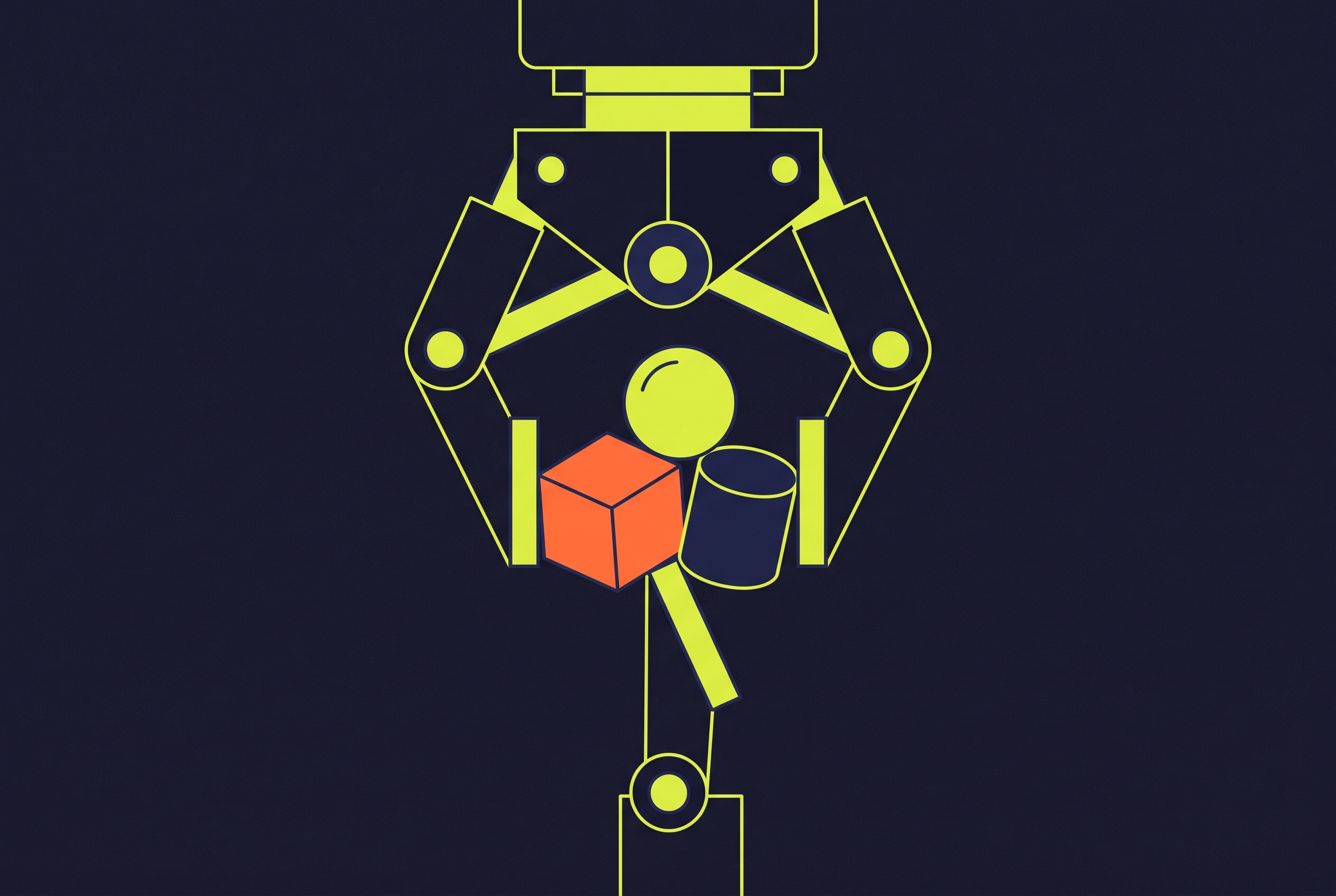
Industrial grippers have operated blind at the fingertip for decades, and no amount of camera improvement will change that, because contact force simply isn't something a lens can see. A camera can tell a controller where an object sits, what shape it has, and roughly how far away it is. It cannot tell the controller that the fingertip has just applied more force than the object can withstand, because force at the point of contact is a mechanical event. That distinction sounds small until you watch what it does to a production line.
Vision-only systems compensate for this missing data the only way they can: they apply grip force conservatively, often well past what the task requires, to avoid dropping the object. That works fine on a steel bracket. It fails on a strawberry, a circuit board, or a folded shirt. Three failure modes follow directly from this blind spot. Rigid, excessive grip force cracks or crushes fragile items on contact. Irregular or unexpectedly shaped objects slip free of a grip calibrated for a different geometry. Recognition errors, meanwhile, waste cycles and introduce inefficiency even when no object is damaged, because the system has to guess at properties it cannot measure.
Slippage deserves particular attention, because it is not a minor inconvenience that production engineers shrug off. An object that slips from a gripper becomes a damaged part, a line stoppage, and a cost that compounds with every downstream station that was expecting the part to arrive intact. None of this is a software bug that a better camera algorithm will patch. It is a structural limit of vision as a sensing modality: a camera measures light reflected off a surface, and grip force is a mechanical event that happens at a surface the camera usually can't even see once the fingers have closed around it. Closing that gap requires a different kind of sensor altogether, one that sits where the contact happens.
What Tactile Sensing Measures
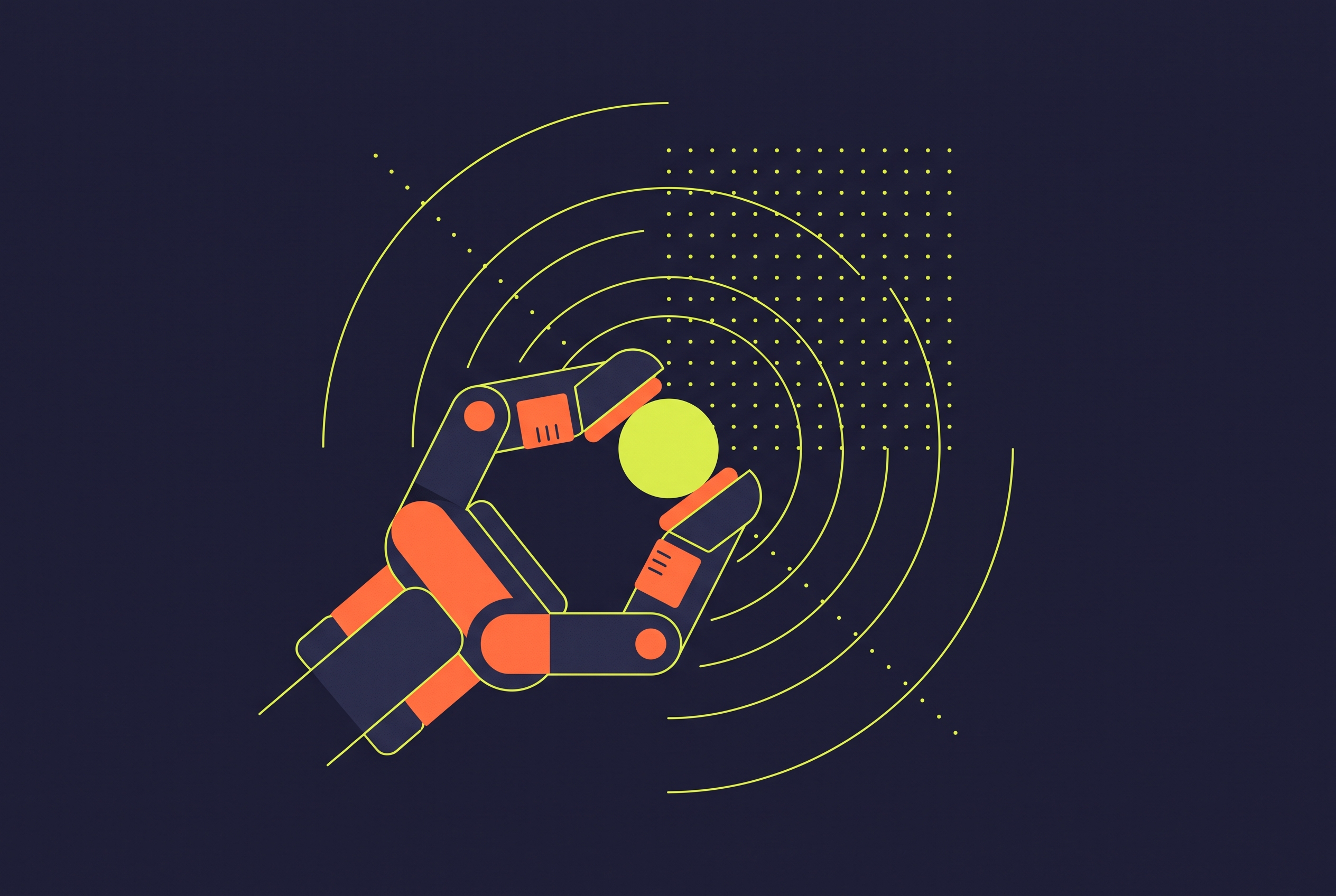
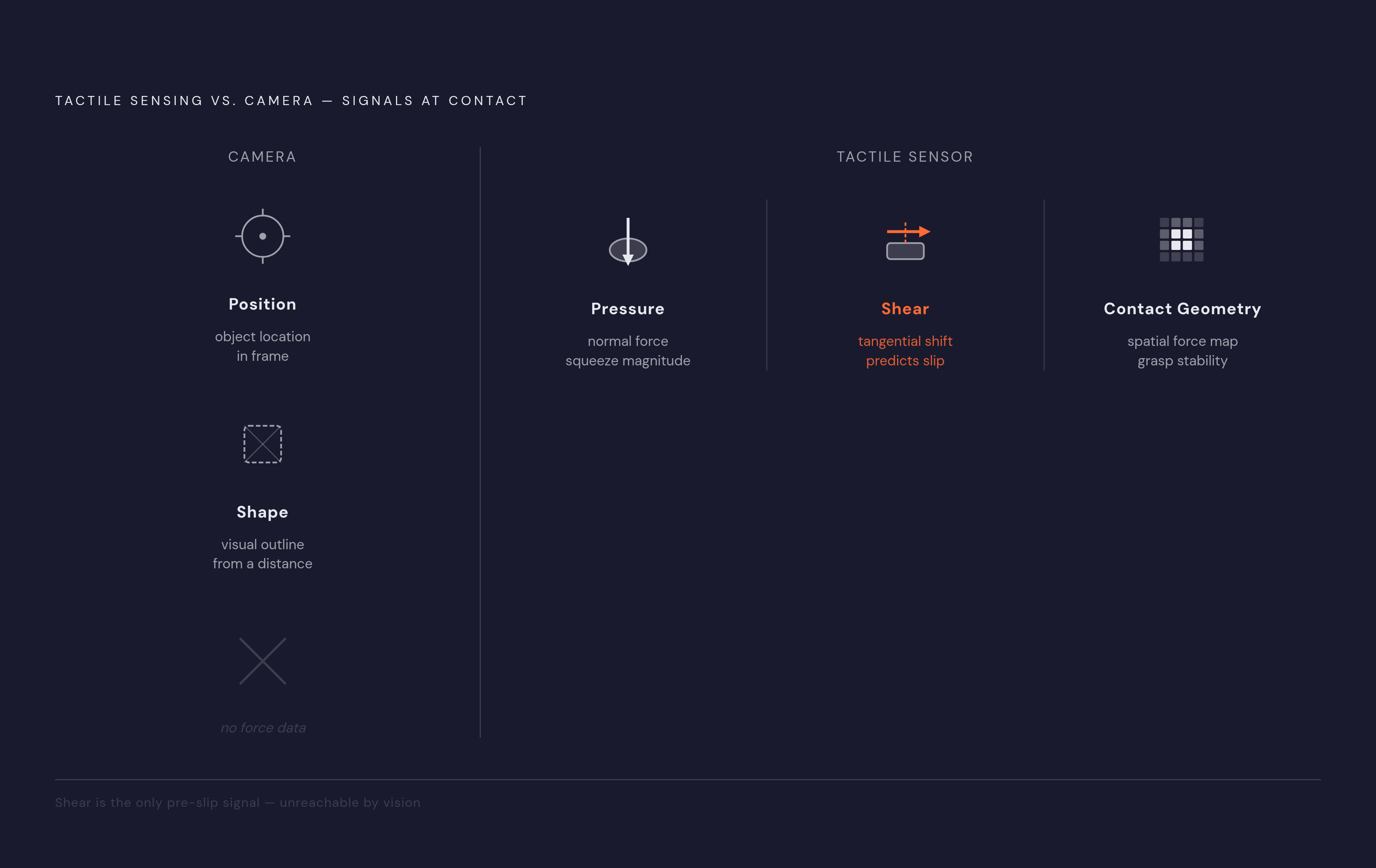
Tactile sensing fills the gap vision leaves by measuring three things at the point of contact that a camera has no access to: pressure, shear, and geometry.
Pressure, or normal force, tells the controller how hard the fingertip is squeezing the object. It is the most basic input a grip controller needs to avoid crushing something fragile, a direct, continuous readout of the force being applied. Shear force matters for a different reason: the signal appears in the fingertip's tangential force readings before an object actually slips. A shift in tangential force across the fingertip means the object has started to move relative to the gripper, and a controller that detects this shift can tighten its grip before the object is lost. Research on calibration-free slip control for anthropomorphic hands with tri-axial tactile sensors has shown that slip can be detected from relative changes in baseline-subtracted tangential force, using a commonly acquired online baseline rather than object-specific calibration, which matters because it means the controller doesn't need to be retrained or re-tuned for every new object it picks up.
Contact geometry rounds out the picture. The spatial pattern of force across a fingertip surface, read as a map rather than a single number, reveals the shape of the object being held, the texture of its surface, and whether the grasp pose is actually stable. That information refines how the gripper manipulates the object without requiring a separate vision system to re-scan it mid-grasp. Shear-based grasp control built on tangential force signals across multi-fingered underactuated hands has been used specifically to detect and correct incipient slip before an object is lost, folding geometry and shear data into a single corrective loop.
The clearest demonstration that this sensing does the real work, rather than mechanical sophistication, comes from the GET gripper: a design with only one degree of freedom and three fingers. A one-degree-of-freedom gripper is about as mechanically simple as a multi-fingered hand can get, and yet, with tactile feedback integrated into its control loop, it achieves robust grasping across varied objects. Dexterity comes from what the gripper can feel, not from how many joints it has.
The sensor technology landscape and what each type trades away
No single tactile sensor technology satisfies every constraint an industrial gripper design has to meet, and the choice between them is a genuine trade-off, not a search for the best option. Each modality buys a specific capability at a specific cost, and the right choice depends entirely on what the application actually needs.
Piezoresistive and capacitive sensors benefit from mature, well-understood manufacturing processes, which keeps them easier to produce at scale. But in exchange, they need complex structural designs to support multi-modal sensing, and signals can cross between channels. Piezoelectric and triboelectric sensors respond well to dynamic, changing signals, which makes them useful for detecting motion and vibration, but they cannot hold a stable static force reading, a real limitation for any task that involves holding an object still for inspection or assembly. MEMS sensors offer high precision and stability, but they're stiff and don't mechanically conform well, so they can't adapt to the soft, flexible gripper surfaces that irregular objects often require.
Optical and visuotactile sensors are at the richer end of the spectrum: they deliver full 3D geometry alongside force maps, not just a single scalar reading. That richness comes at the cost of physical space, and fingertip integration is exactly where space is scarcest. A recent entry in this category, elastic optical waveguide sensing, illustrates both the promise and the open questions. Fan et al., writing in Microsystems & Nanoengineering in 2026, built a soft gripper with three flexible silicone fingers, each integrating three EOWS units, and validated the design on a fruit-sorting task that demanded multi-modal tactile signal acquisition. So the result points toward a workable path for non-destructive handling of delicate produce, but whether the fabrication process holds up at manufacturing scale is still unresolved.
Fabric-based and e-skin sensors often need handcrafted assembly or many manual steps in cleanroom conditions, so what limits how widely they can be deployed is production yield, not the underlying physics. Carbon-based composites run into nonlinearity and hysteresis that make accurate calibration difficult to sustain. Large-scale sensor arrays trade mechanical flexibility for channel count: pack in more sensing points, and you need more wiring, and more wiring means a stiffer, harder-to-integrate finger. Across every one of these modalities, long-term stability under the repeated mechanical loading of an industrial shift remains a shared, unresolved challenge. No vendor has fully solved it, and any procurement conversation should treat that gap as a known constraint.
How the sensing layer connects to the control architecture
Putting a tactile sensor into a fingertip does not, by itself, close the control loop. Three architectural layers sit between the sensor and the actuator, and each one introduces failure modes that no amount of sensor quality can fix on its own. A 2026 paper in Chemical Engineering Journal, "Flexible tactile sensors: Five core challenges and system-level integration bottlenecks" by Chen Y. et al., maps this out as a three-layer framework: the material-network layer, the device-integration layer, and the edge-intelligence layer. So engineering and procurement teams get a shared vocabulary for a problem people usually discuss only in vague terms.
At the material-network layer, sensitivity and durability work against each other when mechanical fatigue and environmental interference from multiple physical fields hit at once. Sensors degrade in ways that quietly shift their calibration rather than triggering an obvious fault, so a sensor can be feeding the controller bad data long before anyone notices a failure. At the device-integration layer, the challenge is separating normal force, shear, and vibration signals that all arrive at the same time through the same contact point, a problem known as multidimensional haptic decoupling. Even where individual sensor units work well on their own, scaling a working fingertip design up to cover an entire hand remains unsolved at the product level. At the edge-intelligence layer, denser sensor arrays and additional sensing dimensions overwhelm traditional signal-processing methods, so they can no longer build adequate slip-detection models from the raw data. So the compute and machine-learning burden shifts onto the robot's controller, and that adds latency and integration cost that the sensor's own specifications never capture.
Two specific failure modes sit inside this three-layer structure, and they deserve attention on their own. Soft grippers under sustained load experience structural relaxation, or creep, which corrupts force readings unless the control model is built to account for it, a detail that matters for any task requiring a grasp to hold steady over time. Separately, most prior sensing work has focused on fingertips, so the palm is largely unaddressed, even though it plays a real structural role when you grasp large or irregularly shaped objects with the whole hand.
One architectural response to all three layers comes from the University of Bristol's TacEA monolithic end-effector, identified in a 2026 Patsnap landscape article as a design that combines tactile sensing, shape adaptation, and gripping within a single material system. By folding sensing and mechanical adaptation into one integrated structure rather than stacking separate components, TacEA reduces the number of interfaces where calibration drift and signal decoupling problems can arise.
Learning-based control and sim-to-real pipelines as the answer to the compute burden
Learning-based control, not faster conventional algorithms, is addressing the edge-intelligence bottleneck described above, where dense sensor arrays overwhelm traditional signal processing. Machine learning is the mechanism that makes dense tactile data usable in real time.
Deep reinforcement learning and convolutional neural networks let a gripper generate a grasp pose for an object it has never seen before, and it doesn't need an explicit model of that object's geometry stored in advance. That capability is what allows a single gripper to handle novel items on a production line without being reprogrammed for each new product variant. Rochester Institute of Technology's GR-ConvNet, from 2020, demonstrated that this approach is computationally practical, achieving high accuracy on the Cornell grasping dataset at roughly 20 milliseconds of inference time, fast enough for real-time grasp synthesis.
The bigger shift is in how these models get trained. Sim-to-real pipelines combine durability trials with a simulation engine that generates domain-randomized tactile image data, letting a reinforcement-learning policy train entirely in simulation before being transferred onto physical hardware. So you no longer need to collect large volumes of real-robot data by running thousands of physical grasp attempts, which had made tactile-informed reinforcement learning too costly for most industrial deployers to justify. Training with tactile feedback included, rather than vision alone, produces policies that handle contact uncertainty better, because the policy learns to treat contact signals as confirmation of what's happening at the fingertip rather than relying entirely on a prediction made before contact occurs.
This pipeline carries its own dependency, though. A model trained on tactile data is only as reliable as the sensor's long-term calibration stability, and if a sensor drifts under the kind of cyclic loading described in the previous section, the policy built on top of it degrades silently, without an obvious fault signal. That makes bias management, normalization, and outlier detection in the data pipeline a precondition for trusting the model, not an afterthought to handle once the system is already in production.
Three current hardware implementations
Three hardware implementations, at different points on the path from lab prototype to factory floor, show how this sensing-and-control architecture is reaching buyers and integrators today or in the near term.
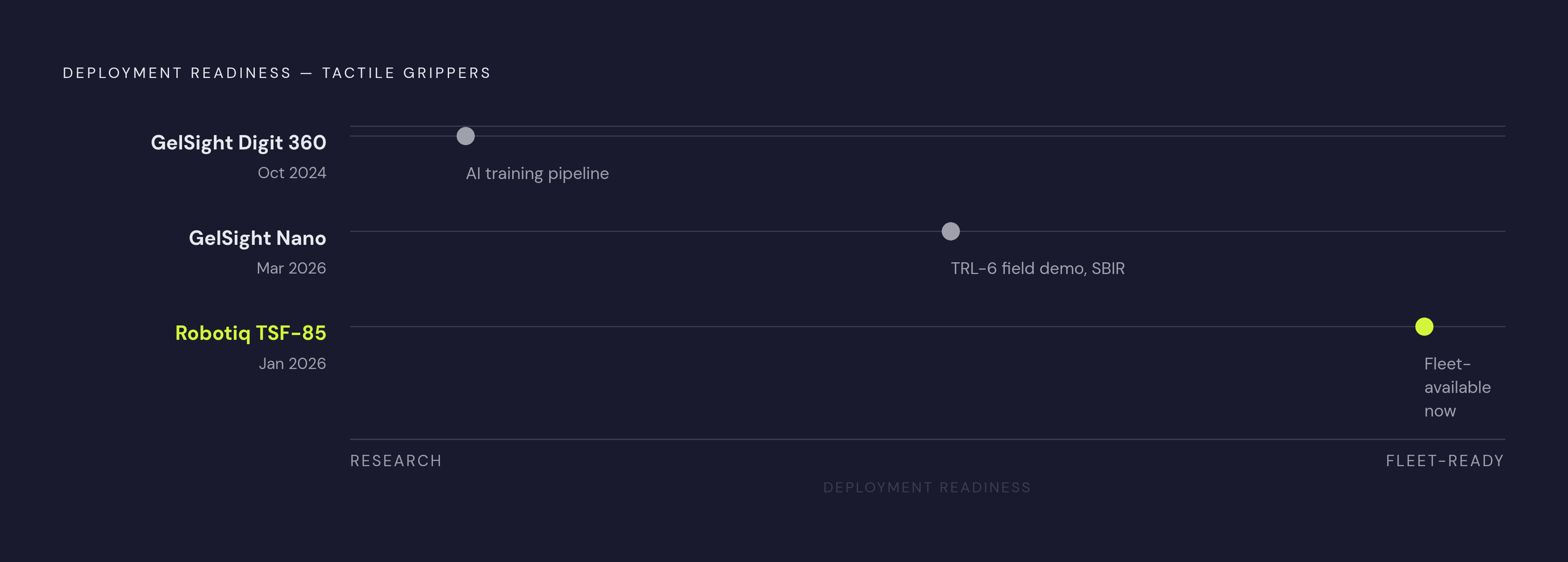
Robotiq's TSF-85 tactile sensor fingertips, launched January 27, 2026, out of Lévis, are built for the company's 2F-85 Adaptive Gripper and are available now. They connect through native RS-485 communication with a USB conversion board, which keeps them compatible across different robot brands. The sensing architecture uses a 4x7 grid of static taxels to measure force distribution across the fingertip, performs micro-slip detection at 1000 Hz, and includes an integrated IMU for proprioceptive awareness of contact. Robotiq positions the TSF-85 explicitly for Physical AI workflows, including reinforcement learning, vision-language-action models, and imitation learning data collection across fleets of robots, which makes it the clearest example of tactile sensing built for immediate industrial deployment at scale.
GelSight Nano, made by a different vendor, is further from the factory floor and closer to defense logistics. The U.S. Air Force awarded a Phase II SBIR contract for the project in March 2026. The sensor uses a folded-optics, wafer-level-camera stack housed inside a durable elastomeric shell, so it can withstand high-cycle grasp durability while it streams 3D shape and force maps from a compact sensing field, a design aimed squarely at the space constraint that limits optical tactile sensors elsewhere. Prototype fingertips are set to undergo a TRL-6 field demonstration at Warner Robins Air Logistics Complex. The Air Force contract frames the work as supporting "intelligent robotic grasping and dexterity" for industrial logistics, with aerospace maintenance and overhaul work serving as an early proving ground for high-precision tactile sensing.
GelSight's collaboration with Meta AI on Digit 360, announced in October 2024, points toward a different use case: research infrastructure. Meta AI researchers describe the sensor as capable of acting as a "peripheral nervous system" on a robot, feeding the multimodal touch signals from which an AI system can build richer models of the physical world. Digit 360 treats tactile data as training infrastructure for physical AI, not just as a control signal for a single grasp, and that lines up directly with the sim-to-real and vision-language-action training directions described above. Taken together, these three projects span the full range from fleet-ready industrial hardware to a defense-sector field trial to AI research infrastructure, and none of them is a finished endpoint for the technology.
The absence of testing standards
No standardized testing protocol currently exists for evaluating tactile sensors, and that absence has a direct cost for anyone trying to buy this technology. A buyer in a regulated industry, aerospace or food handling among them, cannot put two tactile fingertip products side by side and compare their slip-detection accuracy, their force resolution, or their long-term drift under cyclic load using a common benchmark, because no common benchmark exists. Suppliers face a related difficulty: without an agreed protocol, a manufacturer has no standard way to certify that its sensor meets a given performance threshold, so procurement teams are left evaluating competing claims on marketing language.
This gap doesn't mean the technology is unproven. The GR-ConvNet inference speed, the TRL-6 field demonstration planned for GelSight Nano, and Robotiq's fleet-scale positioning all point to a technology that works in specific, documented contexts. What the gap means is that procurement decisions in regulated industries move slower than the engineering does, because the question a compliance officer has to answer, whether this sensor performs reliably across the specific load cycles and environmental conditions this plant operates in, has no standard test to point to for an answer. Until that changes, the honest approach for a buyer is to ask each vendor for the specific test conditions behind every performance claim, rather than treating a published number as comparable to a competitor's published number.
Sources
- Intelligent soft robotic gripper for non-destructive grasping and attribute recognition via multi-modal waveguide tactile sensors
Provided the basis for the elastic optical waveguide sensing discussion, including the three-fingered silicone gripper with EOWS units validated on a fruit-sorting task.
- Grasp EveryThing (GET): 1-DoF, 3-Fingered Gripper with Tactile Sensing for Robust Grasping
Provided the GET gripper example demonstrating that a 1-DoF, three-fingered design achieves robust grasping through tactile feedback rather than mechanical complexity.
- Shear-based Grasp Control for Multi-fingered Underactuated Tactile Robotic Hands
Provided the basis for the discussion of shear-based grasp control using tangential force signals across multi-fingered underactuated hands to detect and correct incipient slip.
- Frontiers
Informed the discussion of soft gripper structural relaxation under sustained load corrupting force readings, and the gap in palm sensing for large or irregular objects.
- Robotiq brings the sense of touch to Physical AI
Provided details on Robotiq's TSF-85 tactile sensor fingertips, including their positioning for Physical AI workflows such as reinforcement learning and imitation learning.