Human-Robot Handoff in Collaborative Assembly Cells
Most collaborative cells fail at the handoff, not the robot arm.
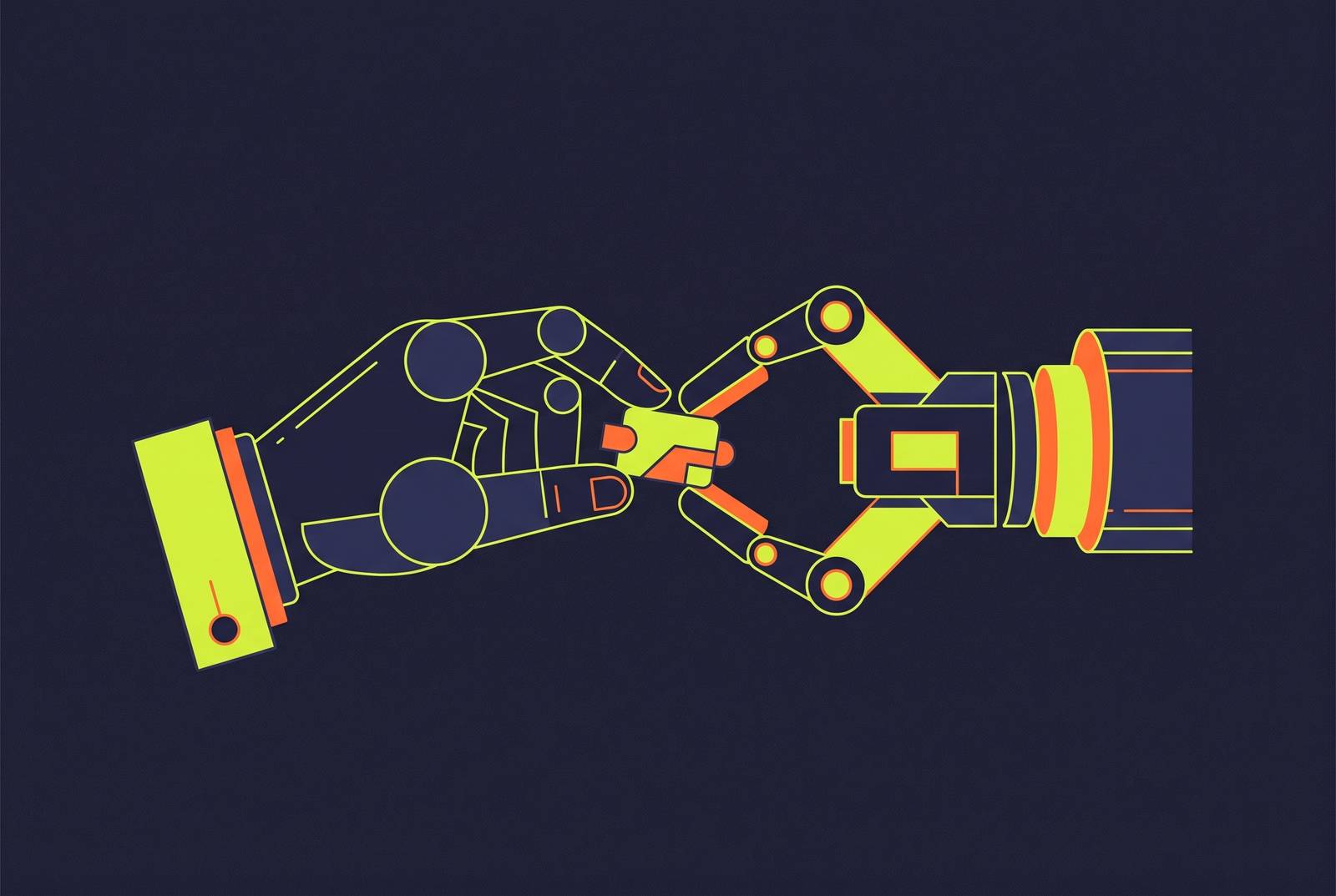
Cobots made up 12% of new industrial robot installations worldwide in 2024, roughly 64,500 units, growing 13% year over year according to the IFR World Robotics 2025 report. That's not a pilot-program number anymore. This piece is about the one moment inside a collaborative assembly cell that actually decides whether all that installed capacity pays off: the handoff, the second when a part, a task, or a decision passes between a human hand and a robot gripper (or the reverse), where the cell's whole throughput and safety record gets written.
Payload rating, reach, repeatability. Those numbers sell the robot, but they don't run the cell, and a cobot rated for 0.5mm repeatability can still blow a cycle time target, or worse, hurt someone, if the handoff choreography around it is sloppy. Most cell budgets go almost entirely to the arm, with the handoff treated as something to sort out later on the floor. That's the wrong order of operations, and it's the argument this piece is making: the arm is the easy part to spec, the handoff is the part that actually fails, and the money keeps flowing toward the part that was never the problem. What follows works through the mechanics, the sensing, the standards, the psychology, and the failure patterns that decide whether a handoff is smooth or expensive.
What a handoff actually is, and the three forms it takes in an assembly cell
A robot arm placing a bracket into a waiting palm is the version everybody designs for first. It's also the version that gets the rest of the cell wrong, because the two harder forms of handoff get skipped in early design, and those are exactly the ones that cause trouble later.
Robot-to-human is the classic case: the robot releases, the human grasps. The robot has to signal that it's actually ready to let go, and it has to modulate how fast it opens its gripper so the object doesn't drop or get yanked prematurely. Human-to-robot runs the other direction. The person presents an object or a sub-assembly, and the robot has to recognize that intent and move its end-effector into position without lurching in a way that startles the operator standing eighteen inches away. Then there's task-authority transfer, the sneaky one. No object changes hands at all. It's a scheduling-level swap: the robot finishes drilling, and now it's the human's turn to inspect, deburr, or fasten. Nothing physical moves between them, but if whose turn it is isn't unambiguous, both parties either freeze or barrel into the same workspace at once.
Researchers at the Polytechnic University of Catalonia sorted human intent during handover into four buckets: collaborative, gesture, neutral, and adversarial. Adversarial doesn't usually mean the worker is trying to sabotage the line. It just means the human's motion is fighting the robot's expected trajectory, maybe because they're distracted, maybe because they're reaching for something else entirely. Design for the collaborative case only, and the robot misreads that motion every time it shows up on a real shift, not a demo floor. Building for the ideal operator and hoping the real one shows up is the design failure worth naming here, because most operators, on most shifts, won't be that person. That's not cynicism. That's shift work.
One more wrinkle specific to assembly, as opposed to warehouse pick-and-place: handoffs in a collaborative cell often happen mid-part. The robot might hold a housing steady while the human threads a screw into it, so the handoff isn't a discrete event with a clean before and after. It's a smear across several seconds where control is partially shared. Object handover research, generally, is further along than assembly-specific handoff research. The foundational work exists, but translating it into a working production cell is still very much in progress, and that gap is exactly why a cell tuned for one handoff type tends to handle the other two badly.
The physical mechanics of grasp transfer: force, stiffness, and the moment of release
In simple object handover, the robot can lean on force cues transmitted through the object itself, sensing the human's tug and releasing accordingly. That trick falls apart the moment precision matters, because the shared object is also the thing being positioned. Ask one connection to carry both the message and the payload, and something gives. In an assembly cell, task accuracy is what gives, and that's exactly the thing that can't be spared.
Researchers at Nara Institute of Science and Technology and Kyushu University, publishing in Frontiers in Robotics and AI in 2025 (Yamamoto, Tahara, and Wada), routed the signal a different way: instead of sending it through the object, they conveyed the robot's stiffness directly to the human's forearm. Sixteen participants ran through a collaborative task involving unscrewing, repositioning, and reattaching a part while the robot held and adjusted its position. Three conditions were tested within the same subjects: no stiffness signal at all, a real-time stiffness signal, and a predictive one that anticipated the change before it happened. The predictive and real-time conditions both shortened completion time and cut subjective workload scores across the tested conditions. Telling the human what the robot's arm is about to feel like, before it feels like that, saves time and mental effort. Not a shocking finding on its face, but it's satisfying to see a number actually attached to it.
A separate biomimetic study from December 2025 found something worth sitting with: robots that adjusted their approach posture, using kinematic redundancy (extra degrees of freedom that let the same end position be reached multiple ways), reduced impulse forces on the human specifically when the robot's trust estimate of the human was low. The robot isn't just deciding where to put its gripper. It's deciding how to get there based on a running estimate of how predictable the human is being at that moment.
Release isn't a binary switch. It's a ramp, and the failure that shows up as jolted hands and dropped parts is almost always someone treating it like a switch anyway. Stiffness should taper, not snap, and the readiness signal needs its own lane, one that doesn't compete with the task for the human's attention. A few candidates for that lane show up across the research: robot gaze direction, which has been explored as a readiness signal; auditory cues flagging destination; mixed-reality overlays showing what the robot's about to do next; and tactile or wearable cues that signal the upcoming handover position before it happens. None of these interferes with the object being transferred. That's the whole point of picking them.
How the robot reads human intent before the handoff begins
Before any of the stiffness-ramping or gaze-cueing described above can happen, the robot has to know a handoff is coming, and it has to know fast enough to act on it. Speed and accuracy at once is the upstream problem the whole field is chasing, and nobody's fully solved it.
A few approaches show up repeatedly in the recent literature. Skeleton-based prediction, where the system tracks the human's joint positions to infer intent in real time, appears in a 2025 Frontiers in Robotics and AI paper by Mavsar, Simonič, and Ude, aimed at reducing worker strain in industrial task-sharing. Wearable data gloves fitted with six inertial measurement units (IMUs) have been shown in published research to predict handover intention accurately enough to drive efficient object exchange. Surface electromyography (EMG), reading electrical signals off the forearm muscles, paired with an attention neural network called GSANN, hit 99.43% accuracy in a 2021 gesture recognition study. Gaze-based recognition gets its own treatment in a 2024 paper from Belcamino and colleagues. And then there's the newest entrant, vision-language models, which a 2025 paper from the International Conference on Computer Modeling and Simulation proposes pairing with large language models to support real-time scene understanding in assembly cells.
The enthusiasm around that last one needs a check, and it's the check most vendor pitches skip entirely. Task success rates in that vision-language study ran 97.5% for simple instructions, dropping to 87.5% for medium complexity and 75% for complex ones. A one-in-four miss rate on complex handoffs isn't a rounding error. It's a stoppage every few cycles, and anyone pitching vision-language models as handoff-ready owes an answer for what happens on that fourth try. The papers so far don't give one, and that silence is worth treating as a warning sign rather than a footnote.
Dynamic Movement Primitives sound elegant on paper and lag badly in practice. The framework, in theory, lets a robot adapt its trajectory mid-motion, ingesting partial trajectory data or catching the onset of a human's movement and adjusting on the fly. Folding that kind of live detection into the DMP framework remains, per the research, underexplored. The math is ahead of the engineering here, worth remembering the next time a demo makes it look solved.
A 2024 paper in the journal Robotics describes what a production-grade version of this actually looks like: a cell running 3D volumetric monitoring in real time, hand gesture recognition, classification of contact-based interaction types, and detection of hand-object interaction, all running together to anticipate what the worker's about to do. No single sensor carries that load, and betting the whole system on one modality is the recurring mistake across this literature. Vision alone falls short. EMG alone falls short. Gaze alone falls short. Fuse two or three and the system starts to hold up, though the bill goes up too, along with the latency budget, so the sensing stack is as much a cost decision as a technical one.
The safety standards that set the hard limits on handoff design
None of the above gets built without a ceiling on it, and that ceiling is ISO 10218:2025, which folded the older ISO/TS 15066 (the standard governing allowable force and pressure by body region) into one unified framework. It sets contact force thresholds by body region, because a robot bumping a fingertip and a robot bumping a sternum are not the same event. But it also requires an application-specific risk assessment for every deployment, and treating a cobot's "collaborative-ready" label as a substitute for that assessment is the single most common shortcut that gets teams in trouble. That label is a starting point, not a certificate, and mistaking one for the other is probably the most avoidable error in this entire piece.
The standard leans on three core safety functions to enable cage-free operation: power and force limiting, speed and separation monitoring, and safety-rated control systems. All three need to be designed around the handoff zones in a cell from the start, not bolted on afterward, because bolting them on afterward is exactly how a cell passes validation on paper and fails on the floor. Compliance isn't a one-time stamp either. Reassessment is required whenever the process changes, so a cell validated with one handoff configuration needs another look if the geometry, the worker assignment, or the task sequence shifts even slightly.
Here's the number that reframes where the actual danger sits, and it might be the most important fact in this section. A study covering robot-related occupational fatalities from 1992 to 2017 found that 58.5% happened during maintenance work: unjamming a feeder, cleaning a sensor, troubleshooting a fault, not during normal production cycles. Most risk assessments pour their attention into the nominal production loop, the repeatable handoff that happens a thousand times a shift, and wave through the maintenance procedure as an afterthought. That's the wrong emphasis, and the data says so plainly. The handoff engineers spend the most hours perfecting is the routine one. The handoff most likely to hurt someone is the improvised one that happens when something's already gone wrong and nobody scripted the choreography for it.
There's a financial layer too, since safety and compliance travel together in a facility's budget conversations. OSHA penalties run $16,550 per serious violation and $165,514 per willful or repeated one, numbers that turn regulatory conformance into a line item on the business case rather than a footnote in the engineering spec. And the frontier here is moving: a preprint proposes embedding ISO 10218 compliance directly into the robot's control loop as a hard mathematical constraint the controller physically cannot violate, rather than a rule the cell designer has to remember to apply. If that approach matures, safety stops being something a designer bolts onto a cell and becomes something baked into the math running it.
How trust and cognitive load shape the human side of every handoff
Robots don't get tired or nervous. The humans standing next to them do, and that changes the physics of the handoff, not just the mood in the room.
The Penn State biomimetic study mentioned earlier (published in Biomimetics, December 2025) tested three trust conditions, high, moderate, and low, and measured what happened to the human body under each. Under low trust, hand movement slowed down. The angle between the human's hand and the robot's arm widened into what the researchers called a "braced handover configuration," essentially the body's own defensive posture, and grip force went up too. None of that is subjective. It shows up directly in cycle time and in the force numbers at the point of contact, which means trust isn't a soft metric tucked into an employee survey somewhere. It's a variable with hard consequences for throughput and for whether contact forces stay inside the ISO/TS 15066 limits.
Cognitive load stacks on top of that. A worker who doesn't understand how much force the robot's about to apply, how fast it's moving, which direction it's headed, or what it plans to do next carries an invisible tax on every cycle. That's precisely why the Yamamoto team's stiffness-signaling work matters beyond its own experiment: telling the robot what the human is doing is only half the equation. Telling the human what the robot is doing closes the loop.
Research into human-robot collaboration has identified several recurring sources of that cognitive stress, including how the robot moves, what it looks and sounds like, the physical layout of the workspace, and how the work itself is divided between human and machine. Useful, mostly because it turns "the robot stresses people out" from a vague complaint into four separate things a design team can go audit.
Automating more of the handoff away sounds like the obvious fix. It's the wrong one, and worth saying plainly rather than hedging around it: robots that do too much of the thinking for the human create their own failure mode, call it overassistance. Workers in cells where the robot manages every transition start losing situational awareness, and skills that used to be sharp erode from disuse. Minimizing human effort at all costs is not the design goal it looks like on a spec sheet. Preserving enough human agency that the person stays actually present in the loop is the harder target, and it's the one most spec sheets don't have a line item for.
Much of the current engineering work still leans on physical ergonomic models (joint angles, reach envelopes, lift limits) while skipping past mental workload almost entirely. That's a real gap: stress-related conditions carry well-documented costs across the global economy. Reliability and predictability appear consistently in the research as significant drivers of human trust in a cobot, alongside factors like speed and physical presence. A robot that's occasionally unpredictable at the handoff, even when that unpredictability is technically safe, erodes trust out of proportion to the actual risk involved. Consistency beats cleverness here, and any design team chasing a faster average cycle time at the cost of a predictable one is optimizing the wrong variable.
The failure modes that break handoff performance in practice
Put all of the above under production pressure and the same handful of failures show up again and again. None of them are exotic, and calling them "edge cases" is mostly a way of avoiding the fact that they're predictable and recurring.
Ambiguous role transfer sits at the top of the list: neither the human nor the robot gets a clear signal that authority has shifted, so both hesitate, or worse, both act at once. It's especially nasty in task-authority handoffs, since there's no physical object serving as a natural cue that something changed hands. Intent recognition latency is a separate but related problem: even a highly accurate sensing system is worthless if it flags the human's intent after the human has already committed to a motion. By then the robot's response is chasing a trajectory that's already obsolete.
Force mismatch at release shows up in two opposite flavors, and both count as failures. A robot that snaps its grip open too abruptly creates an impulse load, basically a jolt the human wasn't braced for. A robot that never clearly lets go, holding onto ambiguous residual grip force, creates a kind of tug-of-war deadlock instead. Trust-degraded biomechanics, the braced posture and elevated grip force documented in the Penn State study, slows the whole cycle down and can push contact forces past the standard's allowable thresholds. That's a safety problem and a throughput problem showing up in the exact same moment.
Then there's the maintenance blind spot again. That 58.5% fatality figure from the 1992 to 2017 dataset isn't a historical curiosity. It's a flag that cell layouts creating awkward handoff postures during unjamming or sensor-clearing carry outsized risk relative to how much design attention they typically get. Overassistance drift deserves its own line here too, distinct from the others, because it doesn't announce itself. It doesn't show up as one bad shift or one dropped part. It shows up slowly, as workers lose the reflexes to catch a problem the system itself misses.
One mitigation worth calling out because it addresses several of these at once, before a single bolt gets installed: virtual commissioning. A 2024 Procedia CIRP paper (Zhou et al.) describes a system built on AutomationML, using Asset Administration Shells, WebGL, ROS, and OPC UA to simulate an entire human-robot collaboration cell, including handoff sequences, PLC logic, and robot programs, against a digital twin before the physical line exists. Tested on a battery pack harness assembly case, the approach caught configuration conflicts and timing failures in simulation, where fixing them costs a fraction of what fixing them on a live line would.
Design principles that produce reliable handoffs across cell configurations
A handful of principles fall directly out of the research above, and they hold up across different cell layouts and different products moving through them, provided nobody skips the boring ones to chase the exciting ones.
Keep the signaling channel separate from the task medium. That's the direct lesson from the Yamamoto stiffness study: route the handoff signal through a haptic band, a gaze cue, an audio tone, or a mixed-reality overlay, anything but the object itself when precision is on the line. Design for the neutral and adversarial human, not just the cooperative one, because the Polytechnic University of Catalonia's four-class framework is a warning built into a taxonomy: a system tuned exclusively for ideal, attentive behavior fails in exactly the moments it's needed most, when a worker is tired, distracted, or just having an off day.
Build consistency before chasing speed. Reliability is the trust driver the research keeps surfacing, and a handoff that's a beat slower but behaves the same way every time earns more trust, faster, than one that's quicker on average but occasionally does something unexpected. Take the maintenance and recovery handoff as seriously as the production handoff, given what the fatality data says about where risk actually concentrates, and stop letting it stay the afterthought it currently is in most risk assessments. If a design team has to choose where to spend the next engineering hour, the fatality data says spend it there, not on shaving another tenth of a second off the routine cycle.
Run virtual commissioning before physical build, following the Zhou et al. model, to catch timing conflicts and configuration errors while they're still cheap to fix. Treat intent recognition as a layered system rather than a bet on one sensor: combine at least two complementary modalities, vision with EMG, gaze with skeleton tracking, whatever fits the application, and feed that fused signal into the robot's motion planning directly rather than parking it behind a separate safety check. Track cognitive load the same way a line tracks cycle time, using something like the four-variable framework (motion, attribute, workplace, task), so mental workload becomes a metric someone actually owns instead of a thing everyone assumes is fine until someone quits.
None of these principles are complicated on their own. Stacked together, across a cell running hundreds of handoffs an hour, they're the difference between a collaborative assembly line that hits its numbers and one that just looks good in the sales brochure.
Sources
- Frontiers | Effect of presenting robot hand stiffness to human arm on human-robot collaborative assembly tasks
- Research on Virtual Commissioning System for Human-Robot Collaboration Assembly Cell based on AutomationML - ScienceDirect
- LLM and VLM-Assisted Human-Robot Collaboration Framework for Smart Assembly Cells | Proceedings of the 2025 17th International Conference on Computer Modeling and Simulation
- Effect of presenting robot hand stiffness to human arm on human-robot collaborative assembly tasks
- Human–Robot Collaborative Manufacturing Cell with Learning-Based Interaction Abilities
- emergenresearch.com
- Biomimetic Approach to Designing Trust-Based Robot-to-Human Object Handover in a Collaborative Assembly Task
- Biomimetic Approach to Designing Trust-Based Robot-to-Human Object Handover in a Collaborative Assembly Task