Workforce Reskilling Programs for Cobot-Integrated Production Lines
Effective reskilling depends on matching training to each cobot interaction tier.
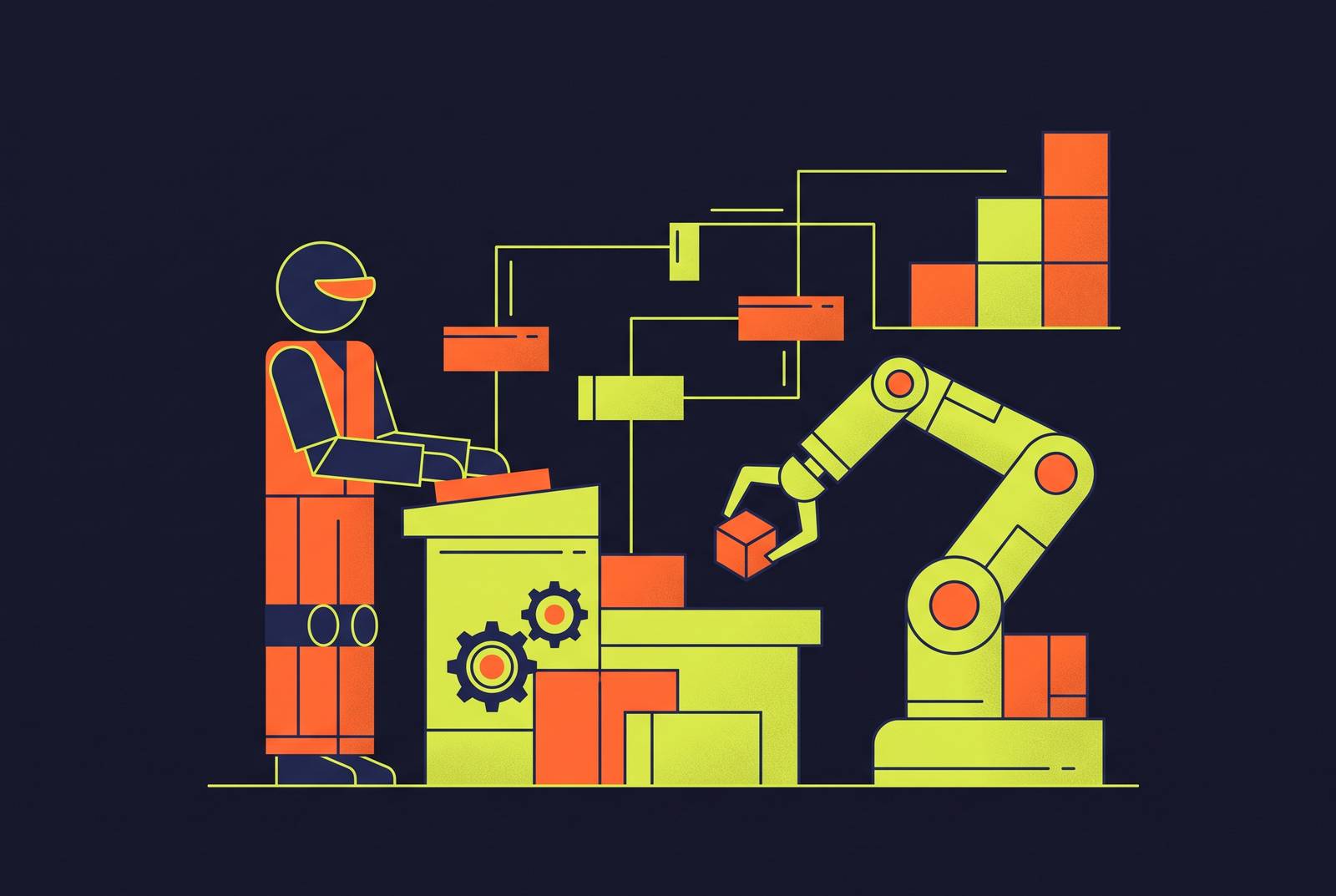
A worker who once welded a seam by hand and now loads a fixture while a cobot welds has not entered the same job as the worker who monitors, reprograms, and troubleshoots a cell of three cobots. Both are "working with a cobot." Their training needs sit at opposite ends of a spectrum, and that distance is the right place to start any conversation about reskilling. Dornelles, Ayala, and Frank, writing in the International Journal of Production Research, laid out four types of human-cobot interaction: coexistence, synchronism, cooperation, and collaboration. Moving along that spectrum from coexistence to collaboration changes not just how much contact a worker has with a cobot, but what kind of thinking the job demands. Their research found that upskilling effects concentrate at the collaboration end, while coexistence and synchronism more often produce reskilling or outright deskilling. Company size shapes the outcome too: smaller firms tend toward substitution and reskilling, while larger firms more often reach genuine upskilling. The finding that matters most for program design is where most deployments actually sit. At the time of the study, most companies were still in early implementation, focused on substituting workers for repetitive tasks, which puts the bulk of real-world cobot deployment at the coexistence or synchronism end, exactly where deskilling risk runs highest and upskilling happens least often on its own.
Skill demands at the coexistence end of the spectrum
At the coexistence level, the cobot takes over repetitive physical execution, and what remains for the worker depends entirely on whether the job around that cobot gets redesigned on purpose. Left alone, the role narrows without gaining anything in return. South Carolina's auto sector offers a clear case: cobots were brought in to clean welding dust off car frames, a repetitive job that is hard on the body, while the workers who used to do that cleaning moved into inspecting the cobot's output for quality. The job did not vanish; its content changed completely. A worker who spent a shift doing physical, repetitive motion now spends it making visual judgments and deciding when a problem needs to be escalated to someone else. Those are different skills, and nothing about installing the cobot teaches them automatically. If that shift in what the job requires goes unnamed and untrained, a worker is left holding a narrower role without the specific competencies to do it well or to grow out of it. The common assumption that cobots will upgrade a workforce on their own runs into the data here: Dornelles, Ayala, and Frank found coexistence-level deployment tends toward reskilling or deskilling, not upskilling, and that is precisely the deployment pattern most manufacturers are running today. None of this makes the coexistence-tier worker's situation a story of decline. It makes the training task narrow and specific: basic robot interface literacy, quality-check protocols tied to what the cobot actually produces, and clear rules for when to escalate rather than guess. Programs that try to teach programming or systems thinking to a worker whose actual job is inspecting welding dust removal are solving a problem that doesn't exist in that role, and they burn training budget and worker patience doing it.
What close collaboration demands from workers beyond coexistence
Collaboration-tier work asks for something categorically different: supervising a cell, programming new tasks into it, diagnosing why it stopped, and reading the data it produces to catch problems before they become downtime. Lead-through programming, where a technician physically guides a cobot arm through the motion it needs to repeat and the cobot records the path, has made basic task programming accessible to operators who have no background in robotics. That accessibility is genuinely useful, but it also raises the bar for what reskilling has to cover next. Once basic programming is something most operators can pick up quickly, a training program's real value lies in what comes after: troubleshooting when a cell faults out, optimizing a process that is running but running inefficiently, interpreting the data a cobot generates, and recognizing safety risks before they become incidents. The economics make this concrete. A welder who can program, monitor, and step in across several cobot welding cells produces more than one welder working one station ever could, but that only holds if the reskilling program actually built the supervisory and diagnostic judgment a cell lead needs, rather than stopping at how to operate a teach pendant. Brian Drees, Senior Director of Operations Excellence at ODW Logistics, named this challenge directly: workers are shifting from performing repetitive physical tasks to managing, monitoring, and troubleshooting automated systems, and experienced associates often carry deep operational knowledge of the floor but little exposure to robotics, controls, or the kind of decision-making that reading a data stream requires. Collaboration-tier training has to close that specific gap. It cannot stop at technique. It has to build judgment: the ability to look at a cell that is behaving oddly and figure out why, rather than simply knowing which buttons start and stop it.
Framing the cobot as tool versus teammate in training
Whether a worker treats a cobot as a tool they operate or as a teammate they coordinate with changes how they respond when something goes wrong, how closely they pay attention to it, and how seriously they take the training meant to prepare them for it. A curriculum can get every technical detail right and still fail if it ignores this. Richard Pak, psychology professor and director of the Human Factors Institute at Clemson University, describes the mechanism directly: whether a cobot gets introduced as a teammate or as a tool sets expectations that shape everything that follows, including how a worker interprets the cobot's behavior and whether the cobot reads as something supportive or as a threat to the worker's professional identity. Safety, efficiency, and comfort are tangled together in how a cobot cell actually runs day to day. Yunyi Jia, also at Clemson, points out that if a cobot moves too fast, crowds a worker's space, or gets introduced without any real explanation, workers will not work with it well, no matter how capable the machine is on paper. A reskilling program that covers only technical competencies and skips this framing question risks training workers who know how to run the cobot but resist actually integrating it into their work. This matters most for experienced workers whose sense of their own craft was built around manual execution, where a cobot's arrival can fragment the work and erode the professional identity that used to come from doing the whole job by hand. Program design has to account for that loss directly, not assume it will resolve itself once the technical modules are complete.
How well-designed programs structure curriculum for each interaction tier
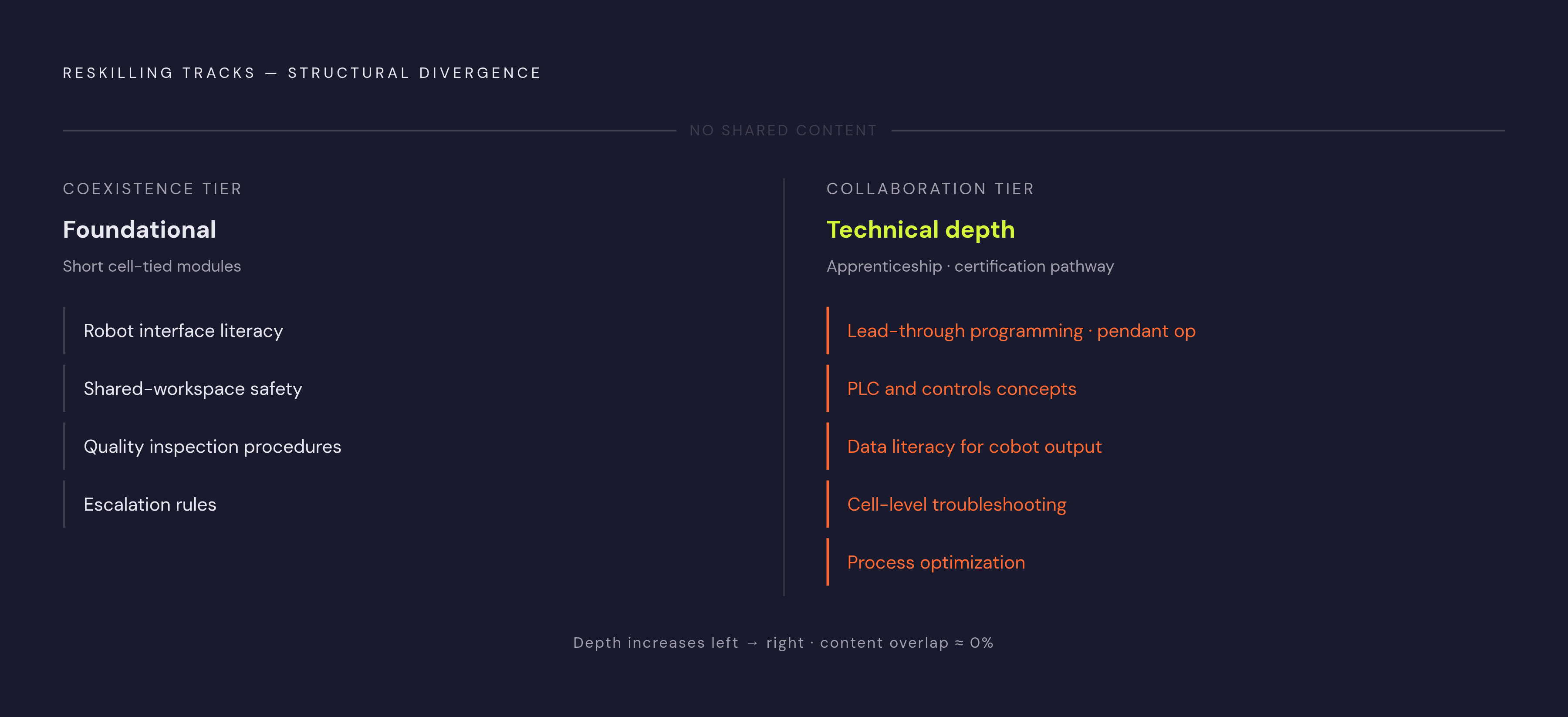
The design implication of everything above is that a reskilling program needs two structurally different tracks, not one curriculum stretched to cover everyone. A foundational track serves workers whose jobs involve coexistence with a cobot. A technical-depth track serves workers moving into close-collaboration roles. They share almost nothing in content or pacing, and treating them as one program flattens the distinction that makes reskilling work.
The foundational track covers basic robot interface literacy, safety awareness specific to shared-workspace cobots (how force-limiting behavior works, what speed-and-separation monitoring does, and how emergency stop protocols function), quality inspection procedures, and clear rules for when to escalate a problem rather than try to solve it alone. It runs as short modules tied directly to the worker's own cell, built around doing rather than sitting in a classroom. The goal is narrow and achievable: a worker who can perform the redefined role well and knows exactly where the edge of their authority sits.
The technical-depth track covers lead-through programming and pendant operation, basic PLC and controls concepts, data literacy for reading cobot output and catching anomalies before they cause downtime, cell-level troubleshooting and fault recovery, and process optimization thinking. It runs longer, structured more like an apprenticeship or certification pathway, with problems that get progressively more open-ended and less supervised as the worker advances. The goal here is ownership: a worker who can program new tasks into a cell, diagnose what's wrong with it, and improve how it runs, beyond simply responding when an alarm goes off.
Framing and mindset run through both tracks, but weigh heaviest at the start of either one. Workers need to understand clearly what their role is now, why the cobot is there, and that their existing operational knowledge still matters and still forms the base the rest of the training builds on. None of this works without the job itself being redesigned to match. The Dornelles, Ayala, and Frank research is clear that cobots can produce upskilling, but only depending on the organizational choices made during implementation. Training a worker for a job that the plant hasn't actually redesigned yet is training for a role that doesn't exist.
Mapping program models, vendor certifications, community colleges, state workforce systems, onto the two tiers
The programs manufacturers can actually enroll workers in today split along roughly the same line, and most manufacturers need more than one of them to cover both tiers well.
Vendor certifications from companies like FANUC, Universal Robots, and ABB certify competency on a specific platform without requiring a formal degree. ABB's own course listings state that there are no formal prerequisites for most of its operator and programmer courses, which makes these programs genuinely open to workers without an engineering background. That openness fits the collaboration tier especially well, since the technical depth these certifications teach, programming paradigms, fault recovery, platform-specific interface work, is what a cell lead or technician needs. Michigan Tech runs one of a small number of FANUC Authorized Satellite Training Programs in the country and the only one in Michigan, certified to train and certify students, industry representatives, and displaced workers alike. That single fact captures both the strength and the limit of the vendor model: where one of these programs exists, it offers real, certifiable depth, but geography constrains how many workers can reach it, and a worker certified on one company's cobot platform isn't automatically competent on another's, a real concern for any plant running a mixed fleet of equipment from different manufacturers.
Community college programs tend to serve both tiers at once, though less deeply at either end than a specialized program might. South Carolina's ReadySC, working through its Technical College System, including Greenville Technical College, Trident Technical College, Piedmont Technical College, and Central Carolina Technical College, represents this model well: broadly accessible, spread across a region, tied to what local employers actually need. Kapil Chalil Madathil of Clemson University describes ReadySC as delivering the right kind of training, and notes that most manufacturers hiring from these programs are pulling from two-year degrees in ways that help those manufacturers raise productivity. These programs can cover foundational safety and interface literacy for coexistence-tier workers and offer a structured path into collaboration-tier technical work, but curriculum depth and pace vary by institution, and not every community college robotics program has caught up to current cobot platforms or to what collaboration-tier roles actually require now.
State workforce systems operate at a different scale. South Carolina's S.C. Nexus brings together colleges, national laboratories, private companies, and the state's economic development arm, S.C. Commerce, aiming to build regional tech-workforce capacity broadly rather than train any one worker deeply. That scale makes state systems well suited to reaching the foundational tier across a large existing workforce, including workers who would never seek out a vendor certification or enroll in a community college program on their own initiative.
Reskilling as an ongoing requirement on cobot-integrated lines
The tier a worker sits in is not permanent. As manufacturers deepen their use of cobots, adding more capable systems, expanding what counts as a collaborative application, and in some cases beginning to bring humanoid robots into the workflow, workers who were trained for coexistence will need to move toward collaboration, and the programs built to reskill them need to be designed to carry them there rather than start over from zero each time the equipment changes. Cobots, advanced CNC equipment, and the broader category of smart machinery have already become standard shop-floor tools rather than experimental upgrades, which makes reskilling a present operational requirement rather than something to plan for later. The window for treating it as a pilot program has closed. The path from cobots to humanoid robots makes the stakes of this clearer still: organizations building out cobot integration now are, whether they frame it this way or not, building the infrastructure, the organizational habits, and the workforce fluency that humanoid deployment will eventually require. Today's reskilling program is the first chapter of a longer transition, an ongoing process rather than a single adjustment made once and left alone. That raises a real structural question for manufacturers relying mainly on vendor certifications and community college tracks: whether those programs run deep enough to carry a worker all the way from coexistence-level competency through collaboration-level mastery, or whether manufacturers need to start building internal progression paths that do that work directly. The right question for a manufacturer to ask is how to build a workforce development system that can keep moving workers up the interaction spectrum as integration deepens, a question about the design of the system itself, not a question about which program to buy next.
Sources
- Seamless Interaction Design with Coexistence and Cooperation Modes for Robust Human-Robot Collaboration
- Media Framing Moderates Risk-Benefit Perceptions and Value Tradeoffs in Human-Robot Collaboration
- Harnessing Cobot Technology to Enhance Workforce Efficiency and Competitiveness
- Hands-on Training for Cobot Users - ASME
- A Conceptual Framework for Enhancing Workforce Readiness for Smart Manufacturing in the AI Era