Domain Randomization Strategies for Industrial Robot Training
Picking the right uncertainties to randomize matters more than randomizing everything.
Domain randomization does not work because it prepares a robot for every possible situation. It works because it forces a policy to get good at handling the specific uncertainties that will actually show up on the factory floor, and picking the right way to do that separates a policy that transfers from one that falls apart the moment it leaves the simulator.
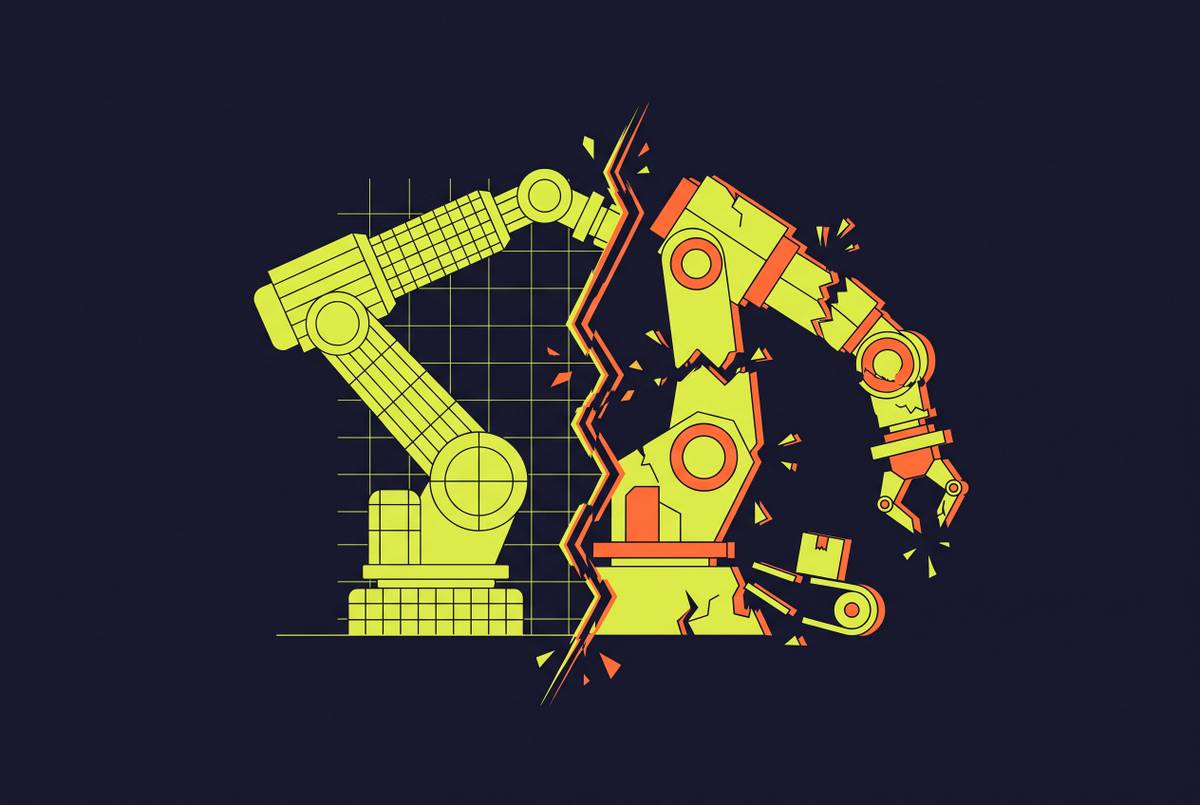
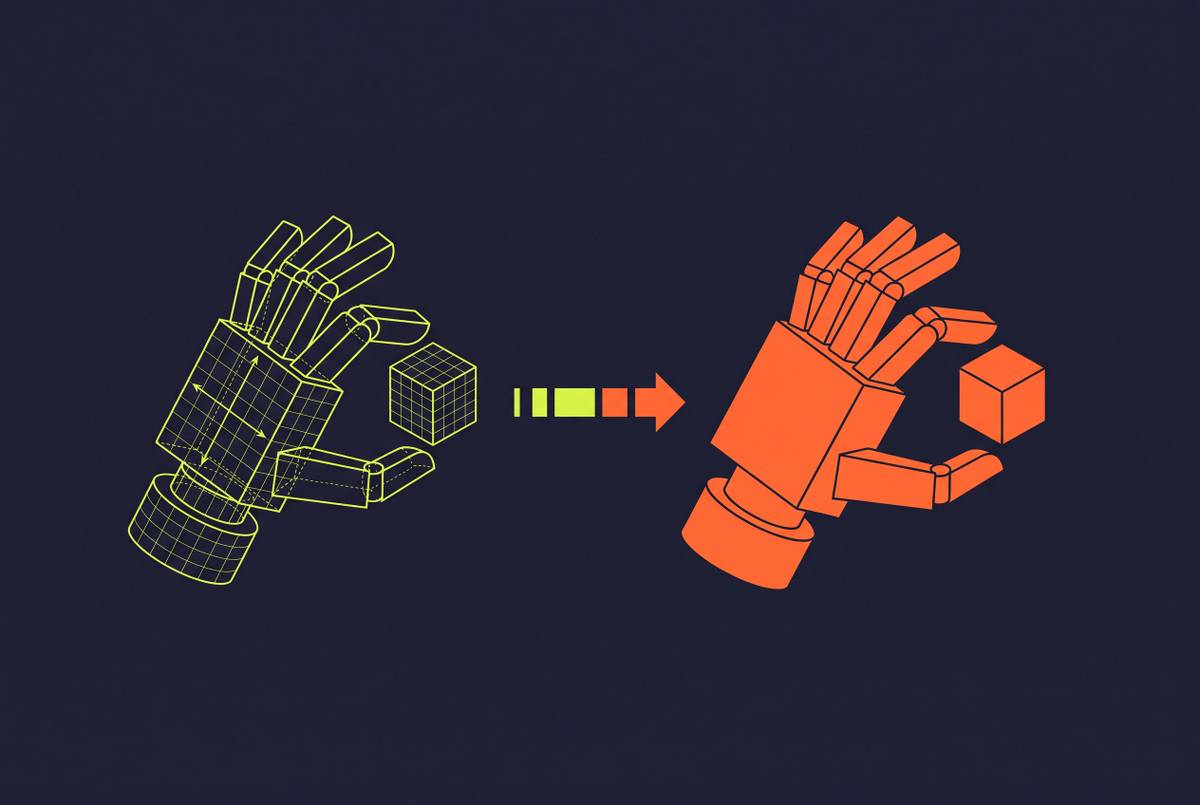
Even a simulator that gets the geometry and dynamics right down to the decimal still lies to the robot in small ways. Material properties drift, inertial estimates are approximations, force sensors carry noise the design model never accounted for, and manufacturing tolerances mean no two parts on the line are quite the same part. Training in simulation is cheap and safe, which is why the field leans on it, but the gap between the simulated world and the real one decides whether a policy ships or gets shelved. That gap is usually dozens of small, partially hidden mismatches compounding at once, not one glaring bad parameter, and that's what makes it harder than it looks on paper. Contact-rich assembly work, gear insertion, bolt tightening, snap-fit connectors, sits right at the center of this because it demands wide force bandwidths and near-zero tolerance for surprise. That makes it the toughest and most honest test bed for any domain randomization method, and the one worth judging every technique below against.
What uniform domain randomization gets right, and where it runs out
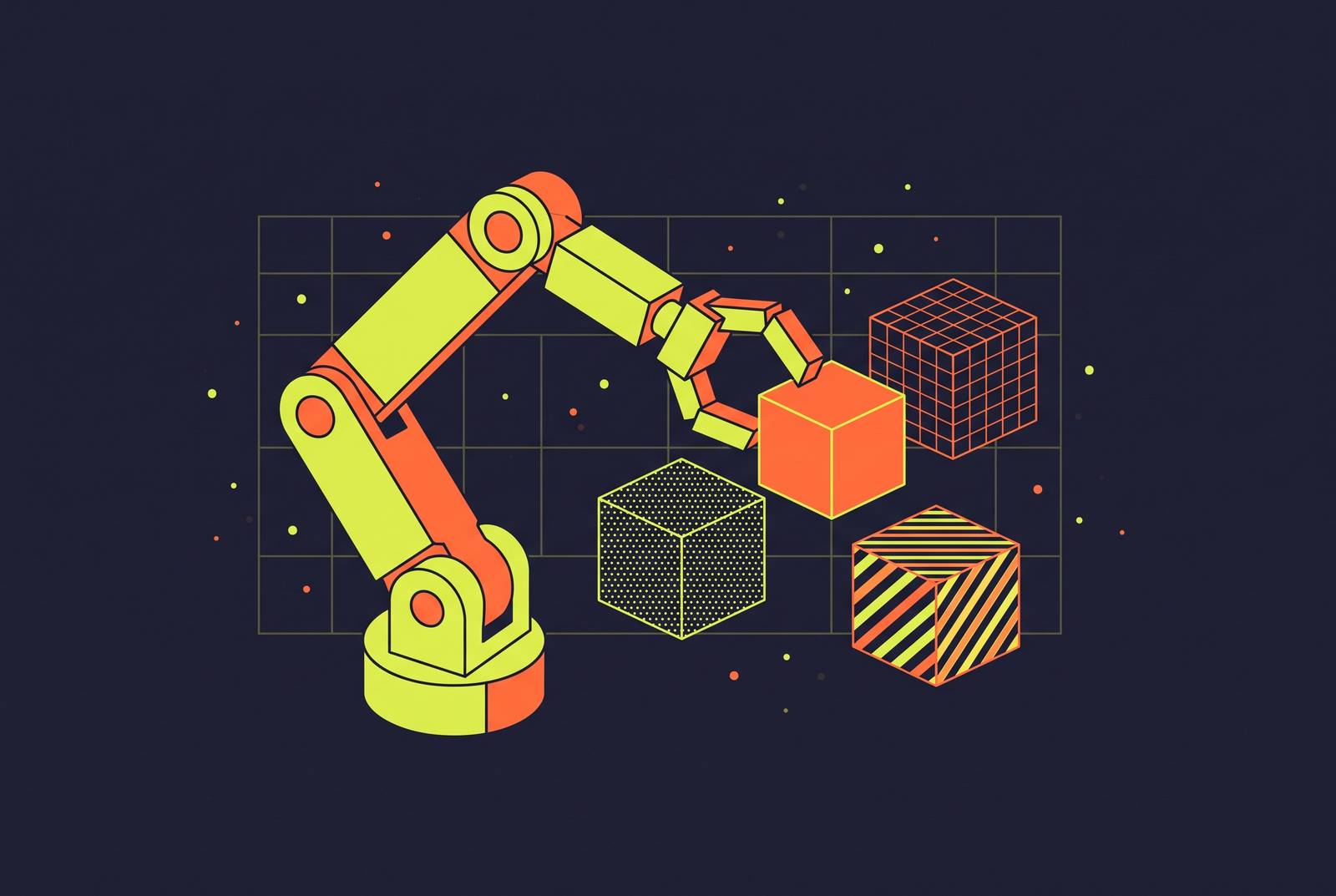
The standard approach fits in one sentence: pick a set of simulator parameters, sample them from a hand-set distribution (Gaussian or uniform, with bounds an engineer chose), and train one policy across all of it. In industrial settings that usually means randomizing robot mass, floor friction, contact stiffness, and sensor noise, the physical quantities nobody can pin down exactly in the real world.
This buys robustness, but robustness costs something. A policy trained across a wide spread of environments cannot be perfectly tuned for any single one of them, and that tradeoff is baked into the method from the start. Go too wide with the distribution and the policy has no coherent strategy to learn, because the task itself becomes too variable to solve well. Go too narrow and the policy overfits to the simulated range and breaks the moment real hardware deviates from it even slightly. Finding the middle is not a solved problem, and there's no formula for setting the bounds correctly. Worse, the failure often doesn't show up during training at all. The loss curves look fine, the sim success rate looks fine, and then the policy underperforms on the real robot with no warning anyone caught in advance.
A 2021 Springer Nature study on industrial robots looked at exactly this, how different degrees of randomization affect transfer, and used attention maps to get a qualitative read on what the policy was actually paying attention to during deployment. That's a useful diagnostic, and an underused one, since most teams have no visibility into whether their policy learned the task or just learned a shortcut that happens to work in simulation but means nothing on real hardware. Standard DR also locks its parameter set at the start of training, so it has no way to adapt as real-world conditions shift months or years into a robot's service life.
None of that makes uniform DR useless, and it would be a mistake to treat it that way. It has moved real policies into real factories, and it remains the right first move precisely because it's cheap to set up and easy to diagnose when it fails. But its ceiling is set entirely by how good the engineer's guess was, and that's a shaky foundation for a deployment pipeline that has to run for years without a rewrite. Teams that stop here are betting the deployment on a single hand-tuned guess holding up indefinitely. It won't.
Entropy maximization as a principled alternative to manual distribution tuning
The next step past manual tuning starts from a different premise: generalization comes from maximizing the diversity of parameters the policy sees, held in check by whether the policy can currently succeed under that diversity. Push it past what the policy can handle, and training collapses instead of improving.
DORAEMON, short for Domain Randomization via Entropy Maximization, published at ICLR 2024 by researchers at Politecnico di Torino and TU Darmstadt, builds this into a constrained optimization problem. It grows the entropy, meaning the spread, of the sampled dynamics parameters over the course of training, but constrains how fast that entropy can grow using the policy's own success rate as the limiting factor. No real-world data enters the loop anywhere. It's a purely simulation-based method, and it showed zero-shot transfer on a robotic manipulation task under unknown real-world parameters.
The practical win is that it removes the guesswork of setting distribution bounds by hand: the distribution adjusts itself as the policy gets better, instead of an engineer running iteration after iteration to find bounds that hold up. What it doesn't do is model how parameters interact with each other. Dynamics parameters still get shaped as if independent, so DORAEMON can't account for the way correlated parameter combinations can add up to a genuinely hard environment. That's a real limitation, not a footnote, and it's exactly the gap the next generation of methods goes after.
How flow-based domain randomization discovers the hard cases automatically
GoFlow, from Autodesk Research and MIT CSAIL in 2025, takes the idea further by making the sampling distribution itself a learned object rather than a fixed family of curves. It pairs actor-critic reinforcement learning with a normalizing-flow neural network that represents the distribution over simulator parameters, and trains that flow end-to-end alongside the policy using entropy-regularized reward maximization.
A normalizing flow matters here, and a fancier Gaussian would not do the job, because it can represent distributions that are multimodal and correlated across dimensions, capturing exactly the nonlinear parameter interaction that entropy maximization on its own misses. In practice, the learned distribution avoids two dead zones: environments so easy the policy already has them solved, and environments so hard they're unsolvable and only produce noisy, useless gradients. What's left is the productive middle, conditions that are hard but learnable, and that's where GoFlow concentrates training time.
GoFlow was tested on a contact-rich industrial assembly task that stacks manufacturing tolerance error, in-hand pose uncertainty, and force bandwidth variation on top of each other simultaneously. It was also extended to multi-step manipulation planning, where a learned sampling distribution paired with a privileged value function let the planner detect when it had wandered outside its training envelope, a form of built-in self-awareness about its own limits. Against simpler learned distributions, the flow-based version held up better across six simulated domains and one real-world domain.
It still needs a simulator with a well-defined parameter set to randomize over, though. GoFlow discovers which ranges matter, but someone still has to hand it the dial to turn, which means the method is only as good as the simulator's parameterization underneath it.
Curriculum-based DR and the logic of matching task difficulty to policy competence
Instead of randomizing every parameter at once from day one, curriculum-based DR expands what gets randomized in stages, gated on the policy's demonstrated ability to generalize at the current stage. ACDR, an adaptive curriculum reinforcement learning framework with dynamics randomization, applies this logic to fault-tolerant robot control, scheduling how much randomization the policy faces as training goes on.
In locomotion tasks, this looks like adjusting difficulty based on current performance: scheduling joint torque penalties, energy cost terms in the reward, friction ranges, and payload mass in stages rather than all at once. The hard part, present in every curriculum method without exception, is picking the right pace. Too easy, and the policy never learns to generalize. Too hard too fast, and training stalls out entirely. Adaptive scheduling through the training run is what keeps curriculum methods from becoming just another manual tuning exercise dressed up in new language.
This extends beyond physical dynamics. The curriculum idea has been applied in perceptual domains too, not just joint torques and friction coefficients, where staged parameter expansion helps bridge the gap between simulated and real sensor readouts. Curriculum methods and entropy-based methods are solving the same tradeoff, diversity against feasibility, by different means: curriculum sequences parameter groups explicitly in stages, entropy maximization reshapes the whole distribution continuously. Nothing stops a team from combining both, and most serious deployments should. What's still unresolved is how to schedule and group parameters optimally, whether by physical category, measured difficulty, or relevance to the downstream task. There's no consensus answer yet, and anyone claiming otherwise is overselling their own framework.
Visual and tactile domain adaptation when physics randomization is not enough
Physics randomization can be flawless and a policy can still fail, because the camera feed or the tactile sensor readout in the real world looks nothing like what the simulator rendered. Lighting, surface texture, rendering artifacts, and tactile sensor noise characteristics fall outside the dynamics parameters that mass or friction randomization touches. No amount of tuning those parameters fixes a rendering mismatch, and treating physics DR as a substitute for visual adaptation is a category error teams make more often than they'd admit.
Image translation methods like pix2pix and CycleGAN and its variants close part of this gap by mapping simulated images into something closer to what a real camera would capture, and approximate sim-to-real translation handles cases where paired sim/real images don't exist to train on directly. On the tactile side, similar staged adaptation approaches apply here too, since tactile images from simulated and real sensors carry fundamentally different noise profiles that plain randomization doesn't fix on its own.
One documented industrial pipeline for object detection reported 86.32% mAP₅₀ on zero-shot transfer and 97.38% on one-shot transfer, generating training images in under half a second each and finishing training in roughly 12 hours on a single GPU, all without real labeled data. That's near-deployment detection accuracy built entirely from synthetic images, which is a meaningful result by any measure. Separately, a 2024 study out of TU Darmstadt and DFKI on humanoid locomotion found that domain randomization stays essential even for diffusion policies trained on large datasets, since locomotion requires a much larger and more varied dataset than manipulation tasks, and dataset size alone is not sufficient without domain randomization behind it. Locomotion in particular needs a much larger and more varied dataset than manipulation tasks do, even in simple test scenarios.
Visual and tactile adaptation aren't substitutes for physics randomization. They solve a different piece of the same problem, and most working pipelines run all of it together rather than picking one layer and stopping there.
Policy adaptation pipelines that close the remaining gap after simulation training
Every DR method has a ceiling. At some level of real-world complexity, no amount of simulated variation gets a policy to zero-shot success, and that's where adaptation pipelines take over. The general shape: train one broad policy under DR in simulation, then adapt it to the specific deployment site using a handful of real rollouts, often guided by Bayesian optimization, a multi-armed bandit choosing among candidate policies, or value-based detection of when the robot has left familiar territory.
Knowing when the policy is out of its depth matters as much as the policy itself in an industrial setting, arguably more. A system that can flag "this doesn't match anything I trained on" and hand control back to a human, or drop into a conservative fallback mode, is a fundamentally different safety proposition than one that fails silently. GoFlow's privileged value function is one working example of built-in awareness of training envelope boundaries, and any deployment pipeline without something equivalent is missing a real safety layer, not a nice-to-have.
The more ambitious version of this idea is the real-to-sim-to-real loop. X-Sim, from May 2025, reconstructs photo-realistic environments and object-centric reward functions straight from RGBD human videos, solves for the robot policy inside that reconstructed simulation, and then adapts it to the real deployment. That removes the need for expensive robot teleoperation data entirely, a genuinely different cost structure than anything DR alone offers.
Separately, continual DR frameworks address the fact that standard DR freezes its parameter set at the start of training, letting the randomization distribution keep updating as the deployed robot accumulates operating experience. On the resource side, policy distillation and continual learning with online regularization are approaches to managing memory and compute demands in deployment, which matters a great deal when the deployment target is a robot controller on the factory floor, not a GPU cluster.
What over-randomization looks like in practice and how to detect it before deployment
Randomizing everything at once, as widely as possible, sounds like the safe default. It isn't, and treating it as one is probably the single most common mistake teams make when they first adopt DR. Push too many parameters too far at the same time and training becomes unmanageably hard: the policy either converges to an overly cautious, do-nothing strategy or fails to converge at all.
In the training curves, this shows up as a plateau at a mediocre success rate that more compute doesn't fix. Watch for a policy that starts avoiding contact or avoiding motion altogether rather than completing the task, since that's often a sign the randomization asked for more than the policy could learn.
A more subtle failure runs the other direction. The noise DR introduces is sometimes just not enough to prepare a policy for a genuinely complex real environment, so more randomization doesn't automatically translate to better transfer, and less isn't automatically worse either. It depends entirely on which parameters are driving the difficulty, which is exactly why blanket rules ("randomize more" or "randomize less") don't hold up as advice. Anyone giving that advice without asking which parameters matter for the task is guessing.
Attention maps, the same diagnostic used in the 2021 Springer Nature study, offer one of the few ways to look inside this problem rather than guess at it from success rates alone. They give a qualitative read on whether the policy is attending to task-relevant features after transfer, or whether it picked up some shortcut from an overloaded training distribution. A further complication: randomizing parameters independently assumes they don't interact, but a friction value and a payload mass that are each individually mild can combine into a joint condition the policy never learned to handle. No current method fully replaces engineering judgment on what to include and at what scale, though automated range selection and adaptive curricula are chipping away at how much of that judgment has to stay manual.
Four checks are worth running before anything goes near a real robot. Track success rate across the full randomization range, not just the average. Check whether narrowing the range recovers lost performance, which tells you the range was too wide to begin with. Run attention or saliency maps post-transfer to confirm the policy is looking at the right things. And test on parameter combinations held out during training, to separate real generalization from simple interpolation between points the policy already saw.
Choosing a DR strategy for an industrial deployment: a decision framework
Which method wins on a benchmark table is not the question worth asking. Which uncertainties actually matter for the specific task at hand determines DR's value, since it earns its keep by targeting those, not by trying to cover every possibility at once. A team that starts from the benchmark instead of the task usually ends up over-engineering the wrong parameters, tuning for a leaderboard result that has nothing to do with the factory floor it's shipping to.
A handful of factors should drive the choice. If real-world rollouts are available, system identification paired with DR can narrow the parameter range before randomization even starts; a purely simulation-based deployment leans on DORAEMON-style entropy maximization or GoFlow instead. How contact-rich the task is matters too: assembly and insertion work with demanding force bandwidth needs benefits most from randomizing physical parameters like mass, friction, and compliance, plus an adaptation pipeline on top, while visual manipulation tasks need image-level adaptation layered in as well. Compute budget is a real constraint, not a footnote. GoFlow's flow-based distributions are more flexible than DORAEMON's entropy maximization but cost more compute, and both cost more than plain uniform DR, so the choice should match the training infrastructure actually available, not the one a paper assumes.
If the robot's operating environment is going to drift over its service life, continual DR or an ongoing adaptation pipeline isn't optional. Static DR only holds up in a fixed, well-characterized environment that isn't going to change underneath it, and betting a multi-year deployment on that assumption is a bet against the physical world, one that eventually loses. Out-of-distribution detection, whether value-function-based or some other approach, belongs in every industrial deployment as a required safety layer, not something to bolt on later if time allows.
A staged rollout beats betting everything on one method from the start. Begin with uniform DR to get a working baseline and surface the obvious failure modes, then bring in curriculum scheduling or a learned distribution for the specific parameters where the policy turns out to be most sensitive. Several open problems still shape every choice on this list: how to schedule and group randomization parameters, how to automate range selection, how to handle nonlinear interactions between parameters that independent randomization can't see. Because these issues remain unresolved, building in real evaluation cycles matters more than trusting any single method to generalize on faith.
The real-to-sim-to-real direction that X-Sim represents points toward a future where manual parameter specification mostly disappears from the pipeline. That future isn't here yet for most industrial deployments, and treating it as production-ready today would be a mistake, the same mistake teams keep making with every new method that promises to finally close the sim-to-real gap for good.
Sources
- Flow-based Domain Randomization for Learning and Sequencing Robotic Skills
- Flow-based Domain Randomization for Learning and Sequencing Robotic Skills
- Effects of Domain Randomization on Simulation-to-Reality Transfer of Reinforcement Learning Policies for Industrial Robots | Springer Nature Link
- untitled
- Continual Domain Randomization
- github.com
- arxiv.org
- arxiv.org