Synthetic Data Generation for Industrial Part Recognition
Synthetic data from simulations fills the gap where real factory defects are too rare to collect.
Synthetic Data Generation for Industrial Part Recognition
Why industrial part recognition struggles without enough real data
Manufacturers trying to train computer vision systems for part recognition run into a problem that has nothing to do with algorithms and everything to do with supply. Manual visual inspection has been the default method for catching surface defects for decades, and it carries the limitations you'd expect from a process that depends on a person's eyes and judgment: it is slow, it is labor-intensive, and the results shift depending on who is doing the looking. Two inspectors on the same line can flag different things on the same part.
That inconsistency is exactly what a data-driven model is supposed to fix. But building that model requires real, labeled images, and manufacturing environments are structurally bad at producing those in the quantities needed. Manufacturing environments repeatedly produce three barriers. New parts need inspection systems in place before enough real images of them even exist. Defect classes are rare because, by definition, failures are the outcome nobody wants, so any dataset built from actual production runs will be lopsided toward "normal" and thin on "broken." And the labels themselves, whether that's a 6D pose, an instance mask, or a pixel-level defect boundary, take specialized expertise to produce, on production lines that often cannot be paused just to gather balanced training data.
A recent review published in Procedia CIRP states that data scarcity "remains a major barrier to the effective deployment of AI in manufacturing, where labeled data is often limited, costly, or difficult to obtain". This reframes the issue. This isn't a rough patch that better tooling smooths over eventually. It's a structural condition of how manufacturing generates data in the first place, and it means the class-imbalance problem in particular cannot be solved by simply collecting more of the same kind of data. Rare defects stay rare no matter how many cameras you install. Something else has to fill the gap.
How large the synthetic data market has grown
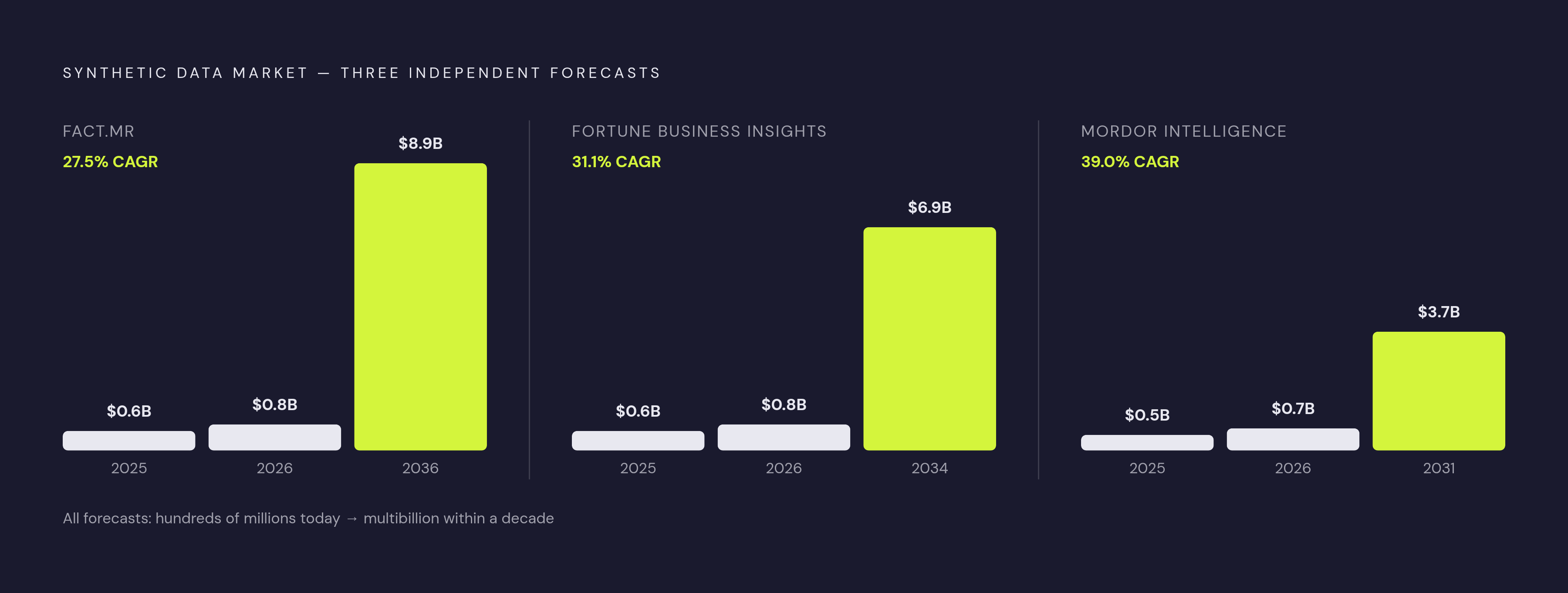
Depending on which analyst firm you ask, the synthetic data market looked a little different heading into 2026, but the shape of the story is the same everywhere you look. Fact.MR pegs the industrial vision segment specifically at USD 600.0 million in 2025, growing to USD 800.0 million in 2026, and reaching USD 8,900.0 million by 2036 at a 27.5% compound annual growth rate FactMR. Fortune Business Insights, looking at the broader all-vertical market, puts 2025 at USD 603.61 million, climbing to USD 791.34 million in 2026 and USD 6,905.32 million by 2034, at a 31.10% CAGR. Mordor Intelligence comes in lower on the baseline, USD 510 million in 2025 and USD 710 million in 2026, but projects USD 3.67 billion by 2031 on a steeper 38.96% CAGR.
None of these numbers agree exactly, and they shouldn't be expected to: they scope the market differently, weigh verticals differently, and use different baseline years Mordor Intelligence. What matters is that all three converge on the same directional story, a market in the low hundreds of millions today, growing at a rate that would be considered explosive in almost any other software category, heading toward a multibillion-dollar footprint within a decade Mordor Intelligence. That kind of consensus across independent analyst firms is itself a form of evidence. It says the market isn't reacting to a single vendor's marketing push, it's responding to a demand curve that appears across surveys built on different assumptions.
That demand has a clear source: new digital-twin deployments across manufacturing and mobility are creating appetite for physics-rich simulation, and synthetic data generation is the supply side of that equation, responding directly to the scarcity described above. NVIDIA's acquisition of Gretel in March 2025 makes the same point in a different register. When an infrastructure company that large decides synthetic data generation is worth owning outright rather than partnering around, that's a signal about where the industry believes the value sits over the next decade, not just this quarter.
The main generation methods and their uses
No single technique dominates the field. The active landscape, according to the CIRP review, includes generative adversarial networks, variational autoencoders, diffusion models, simulation and rendering-based approaches, SMOTE, and hybrid combinations of the above, each suited to a different piece of the problem.
For part recognition specifically, CAD-driven simulation and rendering tends to be the most direct route, because the geometry of the part is already known. A workflow described in a 2026 MDPI paper lays out the sequence: define a modeling strategy, build a parametric CAD model, auto-generate variants of that geometry, and use the result to prepare labeled training data for point-cloud-based segmentation. Pose, lighting, and camera angle can all be controlled deliberately, and labels come out automatically rather than requiring someone to draw a box or trace a mask by hand. This only works where a CAD model already exists. Legacy parts and brownfield equipment without a digital twin are simply excluded from this approach.
GANs and diffusion models solve a different problem. Their primary value in this space is generating rare defect data, synthesizing the failure modes that real production floors cannot supply in sufficient volume because failures are, again, the thing manufacturers are trying to prevent. But the CIRP review is candid about their limits here too, noting that these approaches "do not fully address the unique challenges of industrial defect detection, such as severe data imbalance, long-tail distributions, and the need for diverse, high-quality synthetic samples tailored to specific applications". They generate images well. They don't automatically solve the distributional problem that makes defect detection hard.
That's part of why hybrid approaches are gaining ground as the practical default. One method described in recent research combines CAD-based rendering, which gives geometric control, with domain randomization and compositing onto real manufacturing backgrounds, which gives appearance realism. The pipeline systematically varies part geometry, surface texture, and lighting, then composites the result onto real manufacturing backgrounds, preserving geometric precision while introducing real-world visual complexity. Treat these three approaches less as a ranked list and more as a decision map. Each answers a different question, and most serious pipelines end up combining more than one.
The sim-to-real gap: why synthetic training does not automatically transfer to real inspection
A model trained entirely on rendered images can perform beautifully on more rendered images and still stumble the first time it sees an actual camera feed from a factory floor. That's the sim-to-real gap: perfectly clean synthetic training data doesn't carry the lighting inconsistency, sensor noise, background clutter, and surface variation that real inspection environments produce as a matter of course.
The SIP-17 dataset, built specifically to make this gap testable rather than theoretical, illustrates just how tricky the problem is. It covers 17 objects across six industrial use cases, including both isolated parts and assembled ones, and researchers benchmarked five deep network models, a mix of supervised and self-supervised architectures, all trained purely on synthetic images and then tested against real ones. That test design, train blind to reality and then check the result against it, is the honest way to measure the gap rather than assume it away.
One gap in the research itself sits in the datasets themselves. Datasets like the one built by Horváth et al., covering ten objects including a bracket, a pipe clamp, and a handle, consist only of isolated objects sitting alone in a scene. That's a reasonable simplification for early benchmarking, but it may understate the alignment differences that occur constantly in real assembly-line quality inspection, where parts are rarely photographed in isolation. A bracket sitting by itself under studio lighting behaves nothing like the same bracket half-obscured inside a subassembly.
The severity of the gap isn't constant across conditions, either. It tends to widen most when synthetic renders skip surface texture realism, it shifts depending on whether the part is matte or reflective, and it's considerably harder to close for assembled configurations than for parts photographed alone. None of that makes synthetic training useless. It just means the gap needs to be measured honestly before anyone claims to have closed it.
Domain randomization and other methods for closing the sim-to-real gap
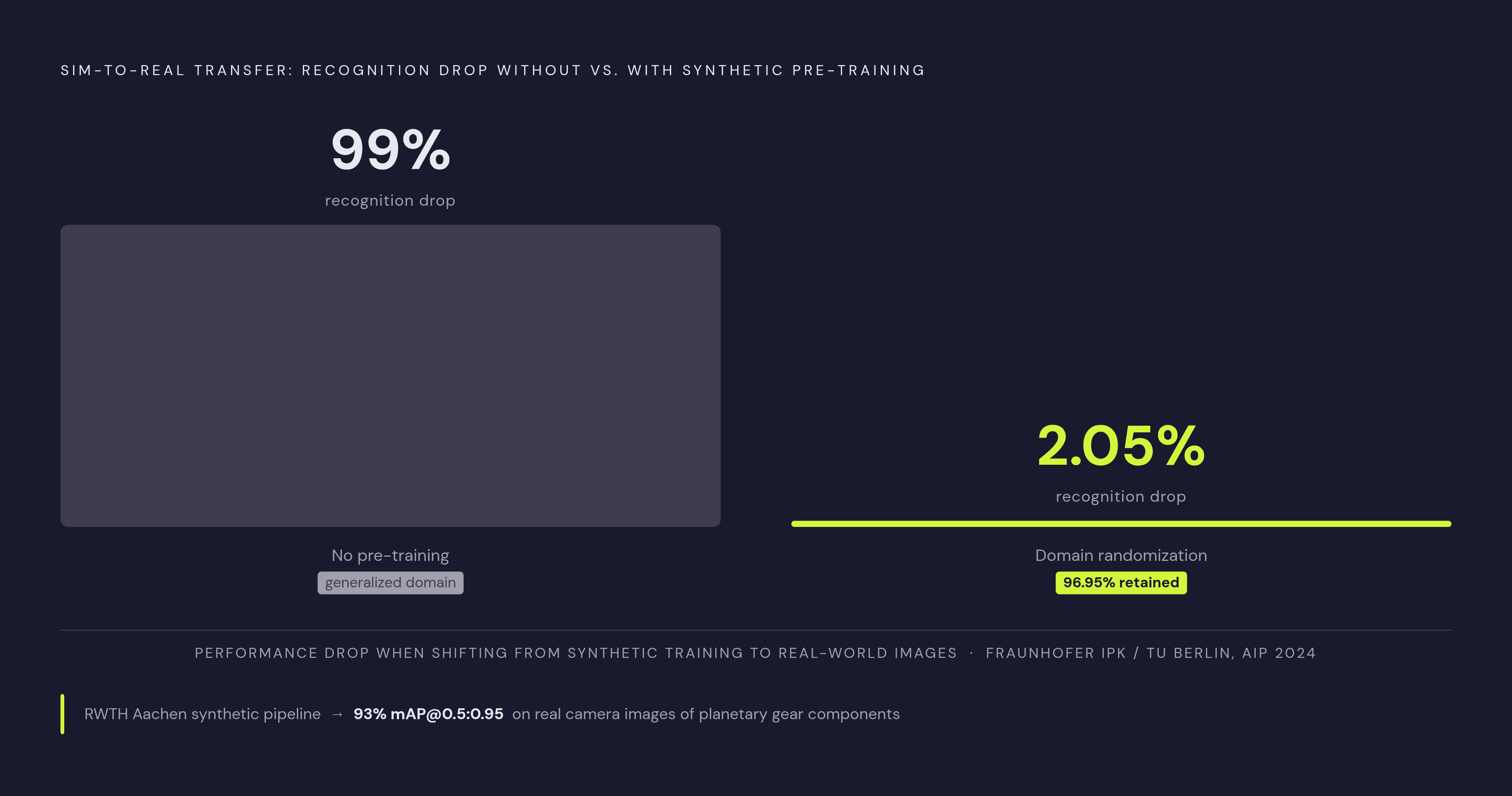
This is the number to lead with. A study from Fraunhofer IPK and the Technical University of Berlin, published in AIP Conference Proceedings in 2024, found that using synthetic-data pre-training, the drop in recognition rate when shifting to a generalized domain that included unknown part instances fell from 99% to 96.95%, a relative decline of just 2.05% NextMSC / ABB. That's the clearest evidence available that the sim-to-real gap is a solvable engineering problem in specific, tested conditions, not just an aspiration.
The underlying technique is domain randomization, a concept traced to Tobin et al., built on a deceptively simple idea: vary pose, camera parameters, and illumination so aggressively during training that any real-world image the model later encounters looks like just another sample from the same wide distribution, rather than something foreign to it. Push the synthetic variation far enough, and reality stops looking like an edge case.
Real background compositing works alongside domain randomization rather than in place of it. Instead of rendering an entire scene synthetically, the approach composites a synthetic part onto a photograph of an actual manufacturing environment, adding scene-level realism, cluttered backgrounds, real shadows, actual factory geometry, without giving up the pixel-accurate labels that come from knowing the part's synthetic geometry exactly. The hybrid pipeline referenced earlier works through this mechanism.
There's a concrete transfer benchmark worth citing alongside the Fraunhofer figure AIP Conference Proceedings NextMSC / ABB. A pipeline out of RWTH Aachen University, built around CAD-based scene generation for planetary gear system components, reported mAP@0.5:0.95 scores as high as 93% when the model trained on synthetic data was tested against real camera-captured images A Synthetic Data Pipeline for Supporting Manufacturing SMEs in Visual Assembly Control. That's a strong result, and it says something important about where these methods are heading. Still, none of this should be read as a claim that the gap disappears. Domain randomization cannot invent texture realism that was never modeled in the first place, and it does nothing for parts that have no CAD model to begin with. Some residual gap remains in nearly all published benchmarks in this space, and randomization cannot compensate for fundamentally absent texture realism or for parts without CAD models.
Applications of synthetic data in industrial part recognition today
Surface defect detection has become one of the most active research areas, and the pace of published work through 2025 makes that clear: Fully-Synthetic Training for Visual Quality Inspection in Automotive Production (CIRP 2025), Bounding Box-Guided Diffusion for Synthesizing Industrial Images and Segmentation Map (CVPRW 2025), structured guided diffusion models for industrial defect image generation (KBS 2025), and Photovoltaic Defect Image Generator with Boundary Alignment Smoothing Constraint for Domain Shift Mitigation (2025) all appeared within roughly the same year. The common thread across all of them is class imbalance, described in section one. Defects are rare by definition, so synthetic generation isn't a nice-to-have here, it's often the only practical way to build a training set that actually represents the failure modes a model needs to catch.
Semiconductor manufacturing has its own version of the same story. Scratch-type defects on wafers can trigger rejected dies and meaningful yield loss, and manual inspection simply cannot keep pace with modern fab throughput. A fully synthetic-data-driven inspection framework published in 2026 bridges virtual simulation and real-world deployment without requiring any annotated real-world training data at all, which is a notable claim given how expensive wafer-level annotation tends to be.
A framework tested and validated in a robot-assisted packaging case in the dairy industry, published by University of Patras researchers in Applied Sciences 2026, showed that a single synthetic data pipeline could support computer vision modules across multiple production steps rather than being built one-off for each step. For smaller manufacturers, that matters in a very specific way: low cost, effectively unlimited dataset size, and automatic labeling are resources that small manufacturers cannot afford to replicate through manual real-data collection.
Wear-and-tear detection has its own recent result. An approach called SynGen-Vision, published in September 2025, reported a mAP50 score of 0.87, outperforming the other approaches it was evaluated against, and its authors describe it as customizable and extendable to other wear-and-tear scenarios beyond the one it was tested on arXiv. Synthetic data is being applied today in robot-assisted assembly and packaging for SMEs. The RWTH Aachen University pipeline (arXiv:2509.13089) addresses the SME-specific barrier that image acquisition, annotation, and training costs are prohibitive, with synthetic CAD-based scene generation demonstrated as a time-saving pipeline.
Key tools and platforms practitioners are using to build synthetic data pipelines
NVIDIA's Omniverse and Isaac Sim platforms sit at the more industrial end of this landscape. They offer real-time ray tracing for photorealistic image generation with automatic ground-truth annotation attached, and they support multi-modal simulation, physics, sensors, and visualization together, through libraries including ovphysx and ovrtx, built on a shared scene substrate called ovstage. That positions the platform for production-grade digital twin work rather than one-off research datasets. A CAD-to-SimReady pipeline highlighted at SIGGRAPH 2026 added a Blender blueprint to the toolset, described as the most accessible entry point for teams trying to bridge traditional 3D content workflows with physical AI and digital twin work.
ABB has built its own commercial application on top of that infrastructure. RobotStudio HyperReality, announced in 2026 through a collaboration between ABB and NVIDIA that folds Omniverse libraries directly into RobotStudio, comes with vendor-reported figures that should be treated as vendor claims rather than independently verified benchmarks: up to an 80% reduction in setup and commissioning time, up to 40% lower operational costs, and up to a 50% acceleration in time-to-market for complex products NextMSC / ABB. Foxconn has been piloting the platform in consumer electronics assembly, reporting improved assembly precision and fewer debugging delays along the way.
At a smaller scale, Edge Impulse's integration with syntheticAIdata's Vision Datasets tool generates fully labeled synthetic images that simulate defects in manufactured products, with 3D-rendered datasets of common industrial components that import directly into Edge Impulse's training environment. One demonstrated result stands out: a model trained exclusively on synthetic images of plastic bottle caps went on to correctly detect faulty caps on real bottles, evidence that a synthetic-only starting point can get a defect detection system running before a single real factory image has been collected.
Open-source and academic pipelines round out the landscape and matter most for teams without a commercial simulation budget. The University of Patras framework mentioned earlier chains together 3D modeling, photorealistic rendering, automated labeling, and ML training tools into a single pipeline that's representative of accessible, non-commercial approaches viable for SMEs, and the RWTH Aachen pipeline follows a similar logic, building CAD-based scene generation without requiring proprietary simulation infrastructure.
The strengths and shortfalls of synthetic data
The strengths, at this point, should be plain. Labeling comes free: pixel-perfect segmentation masks, 6D pose annotations, and bounding boxes are generated automatically rather than drawn by hand. Dataset size becomes a parameter you set rather than a resource you have to go collect, so scale is no longer a constraint. Rare defects, the exact class of data that real production floors structurally cannot supply in volume, can be produced on demand. And models can be trained before a single real image exists, which matters enormously for new-part introductions where waiting for production data isn't an option.
The constraints deserve equally plain treatment, not a footnote. CAD dependency is a hard boundary: approaches built around simulation and rendering only work for parts that already have a digital model, and legacy or brownfield equipment without one is simply out of reach, a limit that no amount of clever tooling resolves. The sim-to-real gap, even after domain randomization and background compositing, tends to leave some residual performance drop in nearly every published benchmark, and the 96.95% figure from the Fraunhofer and TU Berlin study should be read as an achievable result under specific conditions, not a guaranteed outcome anyone can expect by default.
There's also a quieter problem in how this field checks its own work. A 2026 ScienceDirect analysis found that only 4 of 17 academic surveys on synthetic data generation included reproducibility artifacts, so most published validation results can't actually be independently verified by anyone trying to replicate them. That's a reason to weigh vendor claims and academic results with some skepticism, not a reason to dismiss the field. Leaning too heavily on synthetic data carries a risk of model collapse, a gradual decline in output quality when models are trained repeatedly on their own kind of data rather than on a healthy mix that includes the real thing. That's a genuine engineering concern, not an argument against synthetic data.
Put together, the evidence points toward one conclusion. Synthetic data is at its most powerful as a complement to real-world data, filling in the gaps that manufacturing environments structurally cannot fill on their own, not as a wholesale substitute for it.
How
Adopting synthetic data generation for part recognition starts with an honest inventory, not a purchase order. Does a CAD model already exist for the parts in question? If so, simulation and rendering pipelines are the most direct route, and tools ranging from NVIDIA Omniverse to open-source Blender-based workflows can turn that geometry into labeled training data without touching a production line.
From there, domain randomization and real-background compositing aren't optional extras, they're the mechanism that determines whether a model trained in simulation actually works on a factory floor. Budget for a validation phase against real captured images before trusting any synthetic-only model in production, and treat the residual sim-to-real gap as a number to measure, not a risk to assume away. Larger operations weighing commercial infrastructure have NVIDIA's Omniverse stack and ABB's RobotStudio HyperReality as documented, if vendor-reported, points of comparison. Either way, the evidence assembled across surface defect detection, semiconductor inspection, and assembly quality control points toward the same operating principle: synthetic data earns its place by filling exactly the gaps real data cannot, and it does that job best paired with real inspection data rather than standing in for it.
Sources
- Synthetic data generation in manufacturing: a review of methods, domains, and emerging trends - ScienceDirect
- A Synthetic Data Generation Framework for the Development of Computer Vision Applications in Manufacturing
- Generation of Synthetic Dataset for Part Segmentation Problems
- With synthetic data towards part recognition generalized beyond the training instances | AIP Conference Proceedings | AIP Publishing
- A Synthetic Data Pipeline for Supporting Manufacturing SMEs in Visual Assembly Control
- [2509.04894] SynGen-Vision: Synthetic Data Generation for training industrial vision models
- Industrial AI Growth Driven by Synthetic Data 2026
- Synthetic Data Generation for Industrial Vision Market, Global Market Analysis Report - 2036