3D Vision System Selection for Bin-Picking Applications
Match the right 3D sensor to avoid bin-picking failures before they halt your line.
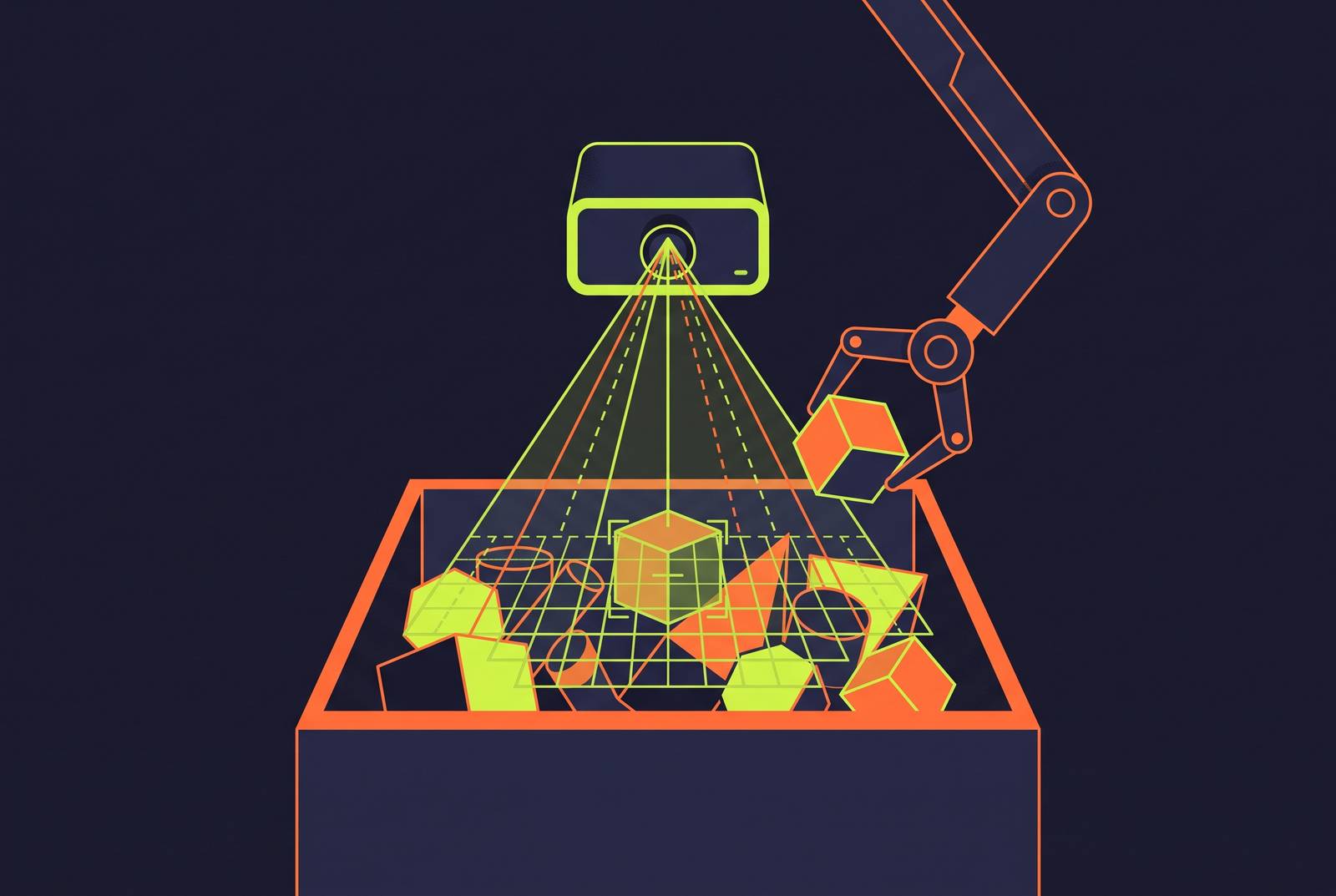
Bin-picking asks a robot to reach into a container full of loose parts, tell one part from the pile, and pull it out cleanly, with no fixture, no tray, no prior sorting to make the job easier. That sounds simple until you break down what "identify" actually requires. The task is commonly split into three flavors: structured, semi-structured, and unstructured. Structured means the parts sit in a known, repeatable layout. Unstructured means they've been dumped into a bin and left to settle however gravity took them, and it's this last case that sets the bar for what a vision system has to survive.
The hard part is perception. Parts stack on top of each other, so the sensor sees only the top layer and has to guess at what's buried underneath. A gripper needs a full six-degree-of-freedom pose for each candidate part, three numbers for position and three for rotation, and a flat 2D image simply doesn't carry that information. Reflective or dark or smooth-featureless surfaces confuse a lot of sensors. The bin itself, its floor, its walls, adds geometric constraints on how the gripper can approach without clipping the sides. And some parts are tangled together or bend under their own weight, which turns "find the part" into "find the part that isn't stuck to three other parts."
None of the downstream steps, grasp planning, motion planning, execution, mean anything if the vision system can't first hand over a usable point cloud, fast enough to keep the cell moving. Picking the wrong sensor causes the whole chain to fail before it starts because the eyes never gave it something to work with.
The four failure modes that a sensor must not introduce
Bin-picking failures sort into four categories, and each one traces back to a specific property of the sensor doing the looking.
Object recognition failure happens when the system can't detect a part at all: a reflective or transparent surface throws the signal, lighting shifts confuse the read, or parts are so tangled the sensor can't separate one from the next. Pose estimation failure is subtler and arguably more dangerous: the part gets detected, but its calculated position or orientation is off, usually because the point cloud is too sparse or the depth values are noisy, and the robot arrives at a spot in space where the part isn't. Constrained robot motion failure comes next: even a correctly estimated pose can be unreachable if the arm would collide with the bin wall or a neighboring part, which is often a symptom of a point cloud too thin to reveal a clear approach path. And grasping failure covers the cases where everything upstream worked, the gripper lands where it should, but the pick still fails: not enough friction, an entangled part that drags a neighbor along, or two parts gripped when only one was wanted.
Trace each of these back far enough and you land on a sensor spec: resolution, depth accuracy, how it handles glare, how fast it can capture a scene. Picking a sensor is a direct, preventive decision against a known list of ways the system can fail. It's a direct, preventive decision against a known list of ways the system can fail.
And when a failure can't be recovered automatically, the line stops. A person has to walk over, open the cell, and clear the fault by hand. That's the real cost of a sensor mismatch: not a single mispick, but a halted line and a supervisor pulled off other work. Even well-engineered bin-picking systems can struggle as a bin empties out and the remaining parts sit in awkward, sparse configurations, a state that can defeat automatic recovery regardless of the hardware involved. No sensor eliminates every failure. Some sensors eliminate far more of them than others.
Where each sensing technology breaks down
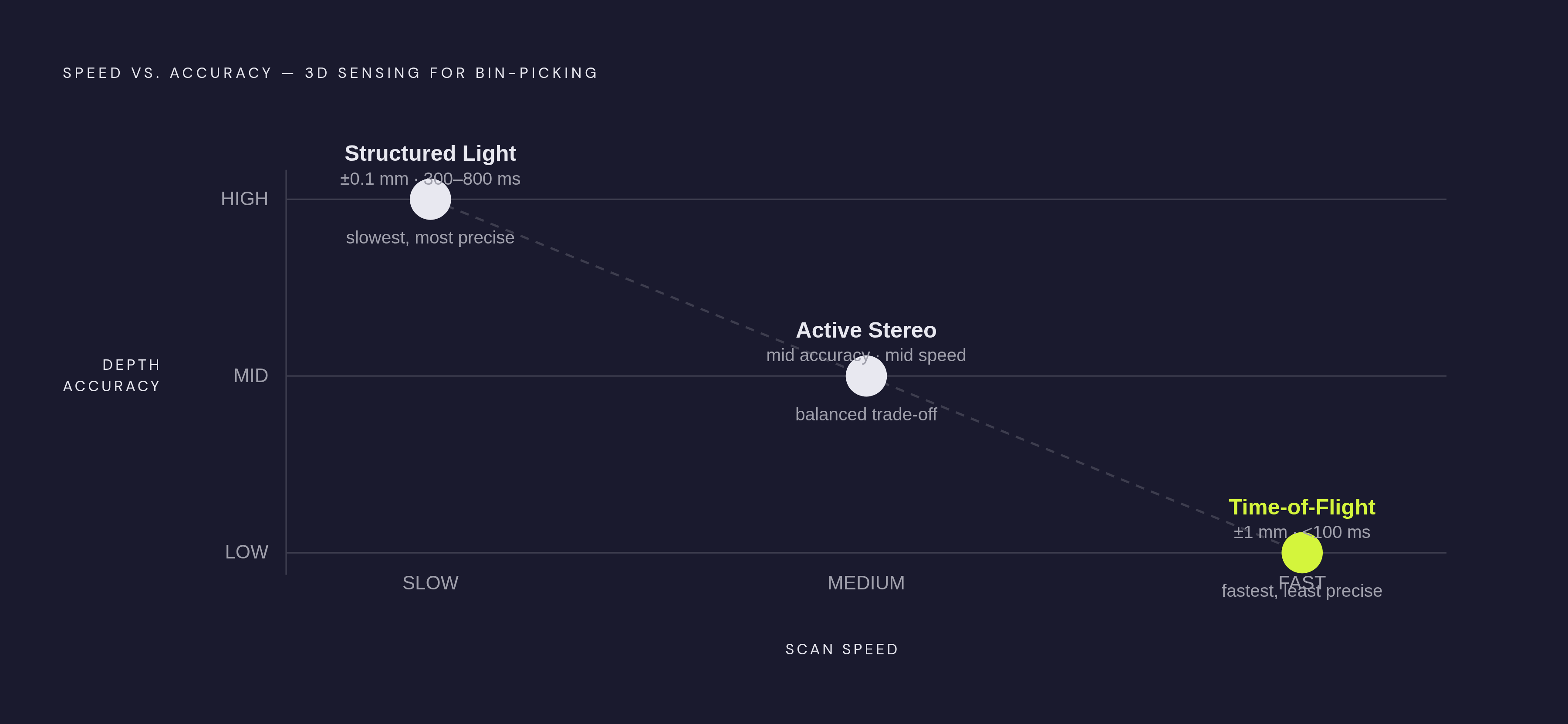
No single 3D sensing technology wins across every job. What fits depends on the part in front of the camera, the tolerance the application demands, and how many seconds the cycle time can spare.
Structured light works by projecting a known pattern onto the scene and calculating depth from how that pattern distorts across the surface, usually across a sequence of images rather than one. It produces the densest, most accurate point clouds of any of these methods, with accuracy around ±0.1 mm being typical, and its ability to capture high dynamic range lets it handle shiny or dark surfaces that trip up other sensors. A scan can take 300 to 800 milliseconds, the scene generally has to hold still while the multiple images are captured, and the compute load is heavier than the alternatives, so the cost is speed. That rules it out for parts in motion unless a buyer is willing to pay for extra engineering around it. Structured light earns its keep where tolerances are tight or surfaces are difficult, and where the cycle time has room to absorb a fraction of a second of dead time per scan.
Time-of-flight, or ToF, takes the opposite bet. It emits modulated infrared light and measures either the phase shift or the travel time of the return signal, producing depth from a single capture in under 100 milliseconds. That speed, combined with a wide field of view, a long working range, and a lower price tag, makes it well suited to real-time detection of parts that are moving, and to warehousing and logistics work generally. What it gives up is resolution: accuracy is around ±1 mm, which is fine for a heavy casting or a stamped bracket but not for anything with a small, tight-tolerance geometry.
Stereo vision comes in two forms. Passive stereo triangulates depth between two cameras using whatever ambient light is available, which keeps costs low but fails on blank, textureless metal, where the two cameras can't agree on which pixel in one frame matches which pixel in the other. Active stereo fixes that by adding a projector, often a laser throwing a random, pseudo-random pattern, that paints artificial texture onto the surface so the correspondence problem goes away. Active stereo has become a well-established choice in bin-picking precisely because it borrows the structured-light idea of projected texture but keeps the stereo algorithm's speed, trading away some point-cloud density in exchange for a faster, less compute-heavy scan. It is a reasonable balance of speed, cost, and accuracy for medium-sized parts that aren't pushing the limits of tolerance.
The part and environment variables that determine which technology fits
Surface finish drives a lot of this decision by itself. Shiny, polished, or dark parts favor structured light with HDR capture, since ToF and passive stereo tend to produce noisy or missing data wherever the surface throws back a specular reflection instead of a diffuse one. Matte, painted, or plastic parts are far more forgiving, and active stereo or ToF can handle them without trouble. Transparent parts remain a hard case across every technology on this list; that's not a sensor-selection problem so much as a materials problem, one that usually calls for polarization filters or a temporary coating rather than a different camera.
Part size and working distance matter just as much. Small, tight-tolerance components, machined fittings, connectors, anything where a tenth of a millimeter counts, need the accuracy that only structured light delivers. Large or bulky parts, castings, brackets, full totes, can tolerate ±1 mm without issue, which opens the door to ToF or active stereo. Photoneo's PhoXi 3D Scanner family, for instance, covers scanning ranges up to 2 meters, which matters for hand-eye configurations built around genuinely large parts.
Geometry plays its own role. Symmetric or simple shapes are forgiving: a lower-resolution sensor can still nail the pose because there's less ambiguity to resolve. Complex, asymmetric, or interlocked parts need a denser point cloud to pin down orientation with any confidence, which again points toward structured light. Deformable or interlocked parts are a genuinely harder problem no matter which sensor is watching; better data narrows the failure rate, but it doesn't erase the difficulty.
Then there's the matter of throughput, which sometimes overrides everything else. A structured-light scan running 300 to 800 milliseconds can become the bottleneck on a fast line, in which case ToF's sub-100-millisecond capture, or active stereo's middle ground, may be the only realistic option. On a slower cell, that same delay is a non-issue, and the accuracy structured light buys is worth every millisecond it costs.
How the major sensor platforms perform against these criteria
No vendor here is the right answer for everything. Each earns its spot by leaning hard into a specific slice of the framework above.
Zivid builds around structured light. Its Zivid 2+ line, the M60, M130, and L110, unveiled in June 2023, combines 5-megapixel 3D and 2D data in one capture, with different models covering different working volumes. Zivid states its point clouds land above 99% true-to-reality in position, dimension, and orientation, and eye-in-hand setups where the camera rides on the robot arm and scans from whatever angle gives the cleanest view are a natural fit for this level of point-cloud fidelity. In a deployment with CapSen Robotics, a Zivid Two camera brought combined image capture and object detection in under half a second, with a 4-second average full cycle. That makes Zivid a fit for reflective, tightly toleranced parts, where grasp precision affects how reliably the gripper picks the part, even though the acquisition is still slower than a time-of-flight camera by design.
Photoneo covers both ends of the speed-versus-precision trade. Its PhoXi 3D Scanner line spans scanning ranges from 16 centimeters up to 2 meters, serving both small-part and large-part hand-eye rigs. The PhoXi XL is a static, high-resolution scanner with a long track record among integrators. The more interesting product is MotionCam-3D, which captures sub-millimeter point clouds in under 300 milliseconds while the camera or the parts themselves are moving, something that structured light traditionally couldn't do without a stationary scene. One documented deployment paired a FANUC M-20iD/25 with a PhoXi XL mounted on a linear vertical axis that lowers as the bin empties, working alongside a custom vacuum gripper with four independently sensed Schmalz bellows cups. That cell ran a 7.2-second average cycle time (8 seconds at peak demand), hit a 99.4% first-attempt pick rate and 99.97% overall once retries were counted, paid for itself in 14 months on two shifts. Over its first two years it processed more than 1.8 million parts, against 6 recordable injuries per year on the manual operation before the system went in. That result shows up when the sensor's motion tolerance matches a genuinely demanding production environment.
Mech-Mind takes a different approach altogether: it sells the camera and the software stack together. The Mech-Eye camera feeds a proprietary AI pipeline that handles point-cloud generation, part detection, pose estimation, and grasp planning as one package. The AI trains on synthetically generated bin scenarios rather than part-specific geometry, so it's built to generalize to new parts without a long teaching cycle for each one. The trade-off is coupling: a team that wants to swap in a different camera or a different planning stack later will find the architecture less accommodating than an open system. Mech-Mind fits best for teams that want a shorter path to a working cell and are willing to trade some flexibility to get there.
Sources
- Practical Machine Vision for 3D Bin Picking Applications
- Bin picking & computer vision
- Robotic Bin Picking: 3D Vision & AI Guide (2026)
- qviro.com
- en.ids-imaging.com
- Overcoming Bin-Picking Challenges With KEYENCE Advanced Vision Systems | KEYENCE America
- 3D Technologies: Time-of-Flight Versus Stereo Vision
- amdmachines.com