Perception Failure Modes in High-Mix Low-Volume Manufacturing
Variety and speed that make HMLV valuable break vision systems in predictable ways.
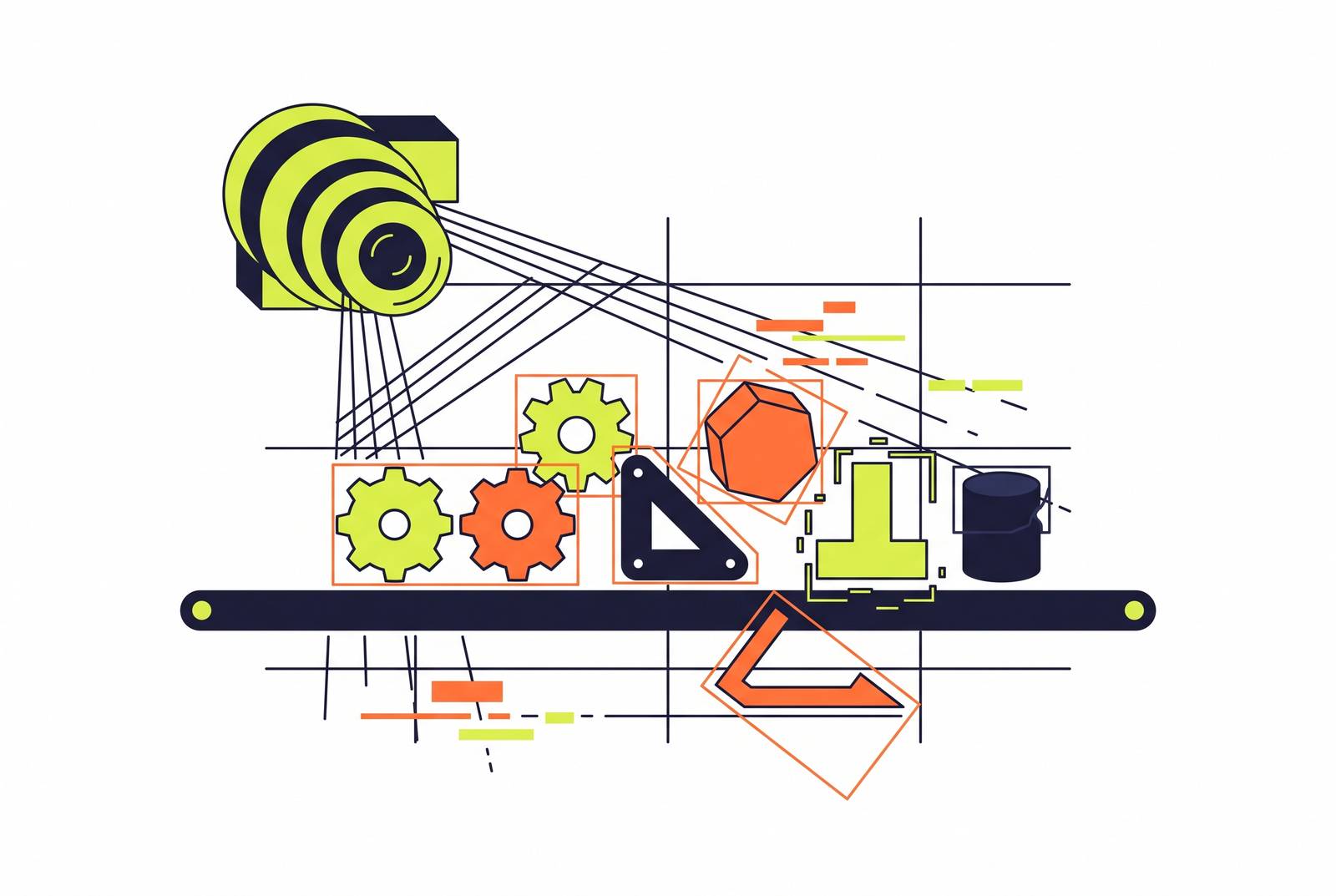
Perception failure in high-mix, low-volume manufacturing is a structural problem. It is a structural one: the same conditions that make HMLV commercially attractive, variety, speed, constant reconfiguration, are the conditions that break vision and ML systems in predictable, recurring ways. Understanding those failure modes by category gives manufacturers a way to diagnose where the perception stack actually breaks, instead of just hoping the next model release fixes it.
What makes HMLV structurally different from stable-production environments
HMLV manufacturing runs on two axes at once: a wide variety of products, often differing in material, tolerance, and geometry, made in small batches that can run under 500 parts. Production is pulled by individual customer orders rather than a forecast, so there is no long horizon to pre-configure or pre-train a system against. Aerospace components, specialty automotive parts and limited-edition models, medical devices, defense systems, and industrial equipment all run this way as a matter of course, not exception. The rhythm that defines the model is frequent changeovers, short product life cycles, and demand that moves around instead of holding steady.
Stable, high-volume production looks nothing like this. Changeovers are rare, geometries are standardized, and training data accumulates over months or years under consistent lighting and fixed fixturing. None of those conditions exist in HMLV by definition. The variety and responsiveness that make HMLV valuable to customers expose perception systems, cameras, models, sensors, to failure modes that a high-volume line never even encounters, let alone stress-tests. That gap is the subject of everything that follows.
Perception Failure in HMLV: A Structural Problem
Vision and machine learning have gotten good. Across more than 50 studies spanning automotive, aerospace, assembly, and general manufacturing, defect detection accuracy regularly clears 95%, with some systems approaching near-perfect scores under controlled conditions. If the story ended there, HMLV perception would be a solved problem waiting on deployment budgets.
It doesn't end there. Across two independently corroborating sources, 77% of AI manufacturing pilots never make it past prototype or pilot scale. Defect detection accuracy frequently exceeds 95%, with some systems reaching near-perfect scores in controlled environments. That is a deployment gap. It is a deployment gap, and deployment is where HMLV conditions live.
Stable production never forces a model to face data scarcity per SKU, domain shift at every changeover, novel geometry, or an unstructured workcell, because none of those are normal conditions on a line that runs the same part for a year. In HMLV, high variety of products produced in small batch quantities, sometimes fewer than 500 parts per run, are the normal condition. As Owczarek put it in Evertiq's 2026 coverage, "AI is never 100%. If you expect absolute certainty, it becomes hype". Accept probability instead, and it becomes an advantage. That reframing, from binary reliability to probabilistic tolerance, is the only frame that actually fits how HMLV perception behaves in practice.
Training-data scarcity and the cold-start problem at every new SKU introduction
A 2025 Dataspan industry analysis found that most manufacturers already run some form of AI vision for inspection, yet adoption at scale keeps stalling on accuracy and reliability problems that trace back to one thing: not enough data. And the shortage is self-inflicted in a strange way. The better a facility is at eliminating defects, the fewer defect examples it produces to train on, so operational excellence and training-data scarcity rise together.
In a stable-production plant, a new part launch means a temporary cold start: no defect history exists yet, and it takes months of running product to build one, even though the model is expected to perform from day one or close to it. In HMLV, that cold start never really ends. Products rotate in and out constantly, and a facility running a wide mix in a single shift hits a cold start at nearly every new introduction, not once a year. What is a launch problem elsewhere is a permanent operating condition here.
The obvious fallback, put a person on it, doesn't hold up either. In industries such as aerospace components, automotive specialty parts and limited-edition models, medical devices, defense systems, and industrial equipment, HMLV is standard. There is no reliable backstop waiting behind it.
Domain shift: how every changeover resets a perception model's operating assumptions
Data scarcity is one failure mode. Domain shift is a separate one, and it can take down a model that was trained on plenty of data, just not the data it is looking at now. In HMLV, the sources of shift stack up simultaneously rather than one at a time: camera optics, lighting, surface finish, part geometry, and product design can all change between one SKU and the next.
PCB automated optical inspection is a clean illustration. Systems built for board inspection routinely struggle with scarce labeled data alongside frequent domain shifts caused by variations in camera optics, illumination, and product design, and those limitations hinder development of accurate deep-learning models in manufacturing settings. The structural read on that is straightforward: a product changeover in HMLV isn't an occasional disruption to a model's assumptions, it is a domain shift event, and it happens on the default operating rhythm of the plant, not as an exception to it.
A high-volume line gets to run the same product for months or years, which gives a model time to settle into its environment and stabilize. HMLV never grants that window. The model is always mid-adjustment, because the conditions it was tuned for are always about to change again.
Occlusion and pose ambiguity in bin-picking and flexible assembly
Inspection is one job for perception. Grasping and assembly are another, and they fail differently. A robot has to localize a part and estimate its pose before it can pick it up, and occlusion, one part blocking the camera's view of another, is one of the most persistent problems in robot vision. When it happens, the robot either misses the target entirely or estimates the wrong orientation, and neither failure is subtle.
The consequence is physical. A misjudged grasp means a dropped part, a collision, or a part that gets damaged before it ever reaches the next station. Vision and force-torque sensing tend to fail at opposite moments: vision tracks pose and orientation well but can't tell much about actual contact once a part is occluded during insertion, while force-torque sensing reads contact richly but is nearly blind to the macroscopic positional error that just knocked the part out of alignment. HMLV multiplies the problem by making it constant. Parts show up in mixed orientations next to unfamiliar neighbors, so occlusion and pose ambiguity aren't separate challenges to solve one after another, they hit at the same time.
Research is moving on this. The xperception system, a zero-shot 6D pose estimation approach built on the FreeZe algorithm (whose successor, FreeZeV2.1, won the BOP Challenge 2024), is designed specifically for robustness against severe occlusion in tasks like bin picking, and it's aimed at industrial edge hardware rather than a lab rig. That said, an independent review of the paper found that its headline performance claims came from a live demo context, without controlled experiments or documented failure cases to back them up. Promising is the right word for it. Validated is not, at least not yet.
Environmental and sensor noise: how factory conditions degrade perception at the signal level
Before a model ever gets to make a decision, the signal reaching it has to be clean enough to decide anything from. Dust, inconsistent lighting, temperature swings, humidity, and the general unpredictability of a working factory floor all degrade that signal before an algorithm ever touches it.
Welding is a good concrete case. Arc brightness throws off enough visual noise to obscure the thing the camera is actually trying to see, and high reflectivity from variation in material surface and groove shape makes it hard for any camera to capture precise data, a recurring headache across HMLV job shops that handle a rotating mix of metal types and joint configurations. Transparent and specular materials cause a related but distinct problem: glass reflection and specular highlights obscure fine-grained defects and make continuous, reliable defect capture difficult, which matters most in HMLV because the same line may run transparent, metallic, and matte parts back to back in a single shift.
In stable production, the sensor rig gets tuned once for one material and one process and stays that way. In HMLV, the exact configuration that reads one SKU correctly can actively misread the next one, because nobody re-tunes lighting and optics between every job.
The interpretability gap: when a model flags a defect but cannot say what it is or why
Established AOI systems and unsupervised deep learning approaches are genuinely good at flagging that something is wrong. What they are not good at is saying what that something is, because their black-box design blocks the kind of semantic interpretability needed to classify a defect once it's been caught. A flag without a classification isn't nothing, but it isn't actionable either.
That gap creates a real bottleneck: manual labeling and expert-driven retraining every time a new defect type shows up, which costs both time and skilled attention. In regulated industries like medical devices and aerospace, this stops being a nice-to-have. Traceable, auditable decisions are a compliance requirement.
HMLV turns an occasional annoyance into a structural tax. In stable production, a genuinely novel defect type is rare enough to be a minor event. In HMLV, novel part geometries appear at every SKU introduction, so the retraining burden the interpretability gap creates isn't occasional, it's built into the operating rhythm. And the damage runs deeper than inspection throughput: if nobody can say what the defect actually is, nobody can fix the process step that caused it. The interpretability gap doesn't just slow down quality checks. It blocks the improvement loop that quality checks are supposed to feed.
The changeover reconfiguration failure: what happens to perception when the line switches products
Everything above converges at one moment: the changeover. HMLV lines have to handle divergence from the planned schedule and correctly tell different items apart on the fly, a requirement stable production simply doesn't have to solve. Traditional automated inspection needs heavy reprogramming for each new part, which makes it a poor fit for small batches, since every changeover can mean rebuilding perception parameters from scratch.
The physical side of this is just as heavy. Owczarek's account in Evertiq's coverage describes how moving a modular system into an existing line means rebuilding recalibration from the beginning, robots, testers, every fixed position, all of it. Workers face the same discontinuity from the other direction: training rarely keeps pace with the full range of products running through a HMLV line, and error rates spike hardest right at changeover, exactly when the setup is least familiar.
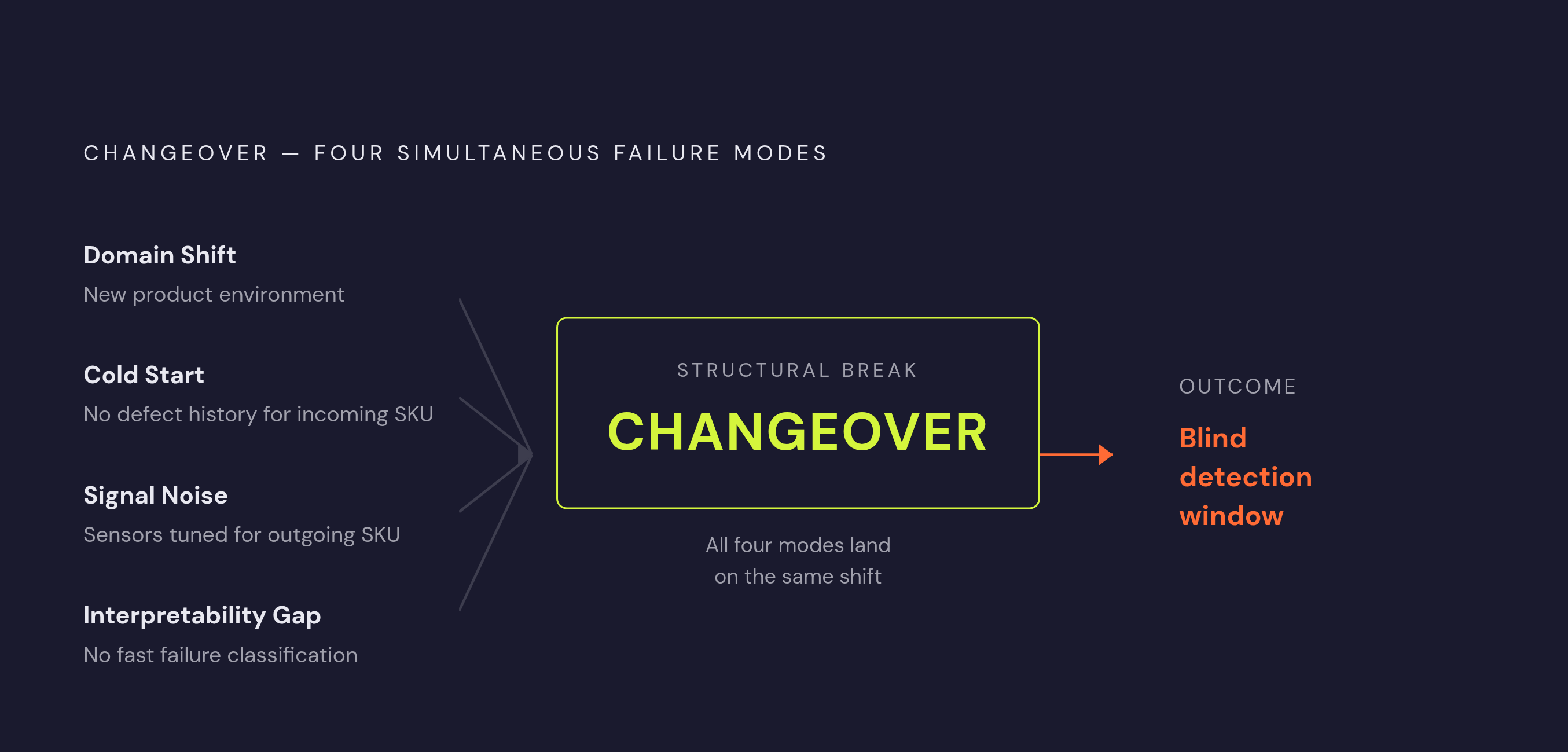
This is the moment where every failure mode covered so far stops being separate. At changeover, the model meets a new domain (domain shift), often with no defect history to draw on (cold start), sensors tuned for the outgoing SKU may now be misleading (signal noise), and if something does go wrong, there's no fast way to say what it is (the interpretability gap). None of these wait for their turn. They land together, on the same shift change. Changeover is the structural event this whole piece has been building toward.
Mitigation approaches that address the structural causes rather than the symptoms
The fixes that matter are the ones matched to a specific failure mode, not generic advice to "collect more data" or "retrain more often.""
For the cold-start and data-scarcity problem, synthetic data generation is doing real work. Generative augmentation increases data diversity and balances lopsided datasets, which speeds up deployment when real defect examples are still thin on the ground. A paper in Computer Graphics Forum from Mao and colleagues found that not all rendering choices matter equally: defect shape, material, lighting, and viewpoint affect how a downstream model behaves far more than simply generating more samples per pixel does, meaning design choices beat brute-force volume. A separate 2026 paper builds on that logic with an end-to-end generative pipeline for new product introduction, using masked textual inversion to separate defect shapes from surface backgrounds and produce realistic synthetic defects before any real labeled examples exist.
For domain shift specifically, the more promising work is in few-shot and foundation-model adaptation. A study out of LG CNS benchmarked three parameter-efficient fine-tuning strategies, Linear Probe, LoRA, and Visual Prompt Tuning, applied to CLIP-ViT-B/16 and DINOv2-S/14, aimed squarely at the scarce-labels-plus-frequent-domain-shift combination that AOI systems run into. A 2026 paper in the Journal of Intelligent Manufacturing proposes a distance-guided prototype network with explicit meta-learning, built to handle the way feature representation breaks down when defect scale varies across only a handful of training examples.
Using CAD data and assembly sequences, object recognition training can begin before physical production starts, and a quality model is automatically derived from the data and refined iteratively during production. This mitigation approach directly addresses the structural gap by allowing perception to be initialized at SKU introduction without waiting for physical defect examples to accumulate.
Sources
- Modular robotics – key to flexibility in high-mix manufacturing
- Machine Learning-Powered Vision for Robotic Inspection in Manufacturing: A Review
- Why Your Machine Vision System Breaks Every Time the Line Changes, and How to Fix It | Datature Blog
- Occlusion-resilient pose estimation of textureless components in cluttered environment and its implementation in robotic bin-picking | Intelligent Service Robotics | Springer Nature Link
- 11 reasons robots struggle to scale in high-mix manufacturing
- Adaptive robotic welding in high-mix, low-volume production: a closed-loop manufacturing framework, technology review, and deployment roadmap | The International Journal of Advanced Manufacturing Technology | Springer Nature Link