Why generalist robot arms struggle with mixed SKUs and irregular parts
Generalist robot arms falter when products vary, relying on humans for the work that matters most.
There is a gap between what robot arms promise and what factory floors actually look like, and it is not a minor discrepancy.
Walk through most modern fulfillment centers or light manufacturing facilities and you will notice something curious. The robot arms are impressive, precise, fast, right up until the moment the product mix changes. Then someone calls over a human. That human, often underpaid and underappreciated, does in three seconds what the six-figure automation system cannot do at all. Understanding why that happens tells you almost everything worth knowing about where industrial robotics actually stands today.
What "Generalist" Really Means
A generalist robot arm, in the broadest sense, is a multi-axis manipulator built to handle a wide range of tasks without being reconfigured from the ground up. One robot, many jobs. Deploy it in receiving today, kitting tomorrow, final inspection next week. The pitch is genuinely compelling, and I understand why procurement teams fall for it.
The problem is that "generalist" typically describes the arm's mechanical range of motion, not its perceptual or cognitive architecture. The arm can reach in many directions. What it cannot reliably do is understand what it is looking at.
When parts are uniform, this distinction is irrelevant. A robot picking the same injection-molded widget from the same tray orientation, eight hours a day, does not need to understand the object. It needs to execute a memorized motion with high repeatability. Generalist arms do this exceptionally well. Introduce variability, though, and that assumption collapses almost immediately.
Why Irregular Parts Are a Different Problem Class Entirely
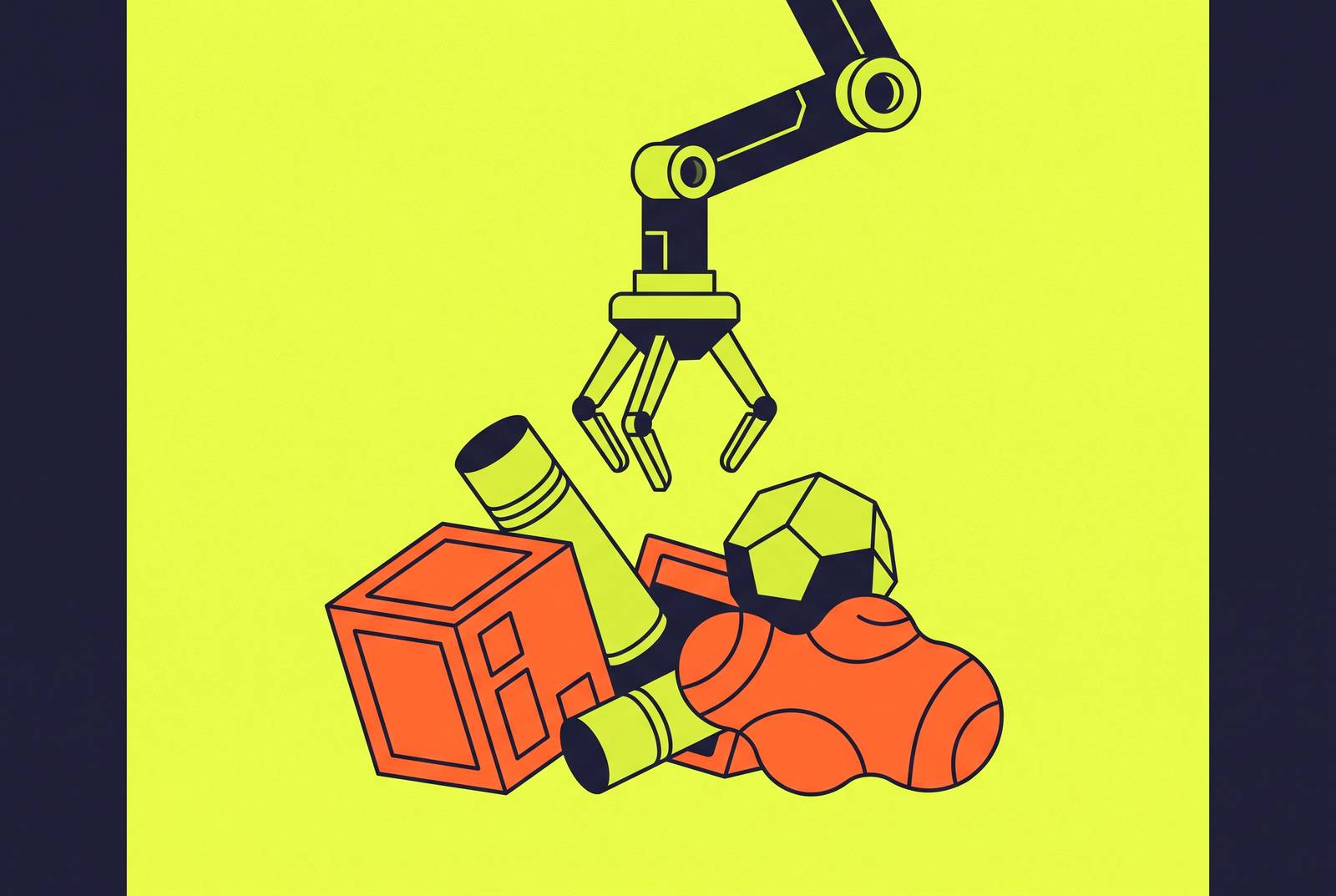
Think about what actually happens when you drop a bin of irregular parts in front of a robot. Twenty components, all oriented differently, all partially occluding each other, some reflective, some matte, a few damaged in ways nobody catalogued. The vision system must identify the object class, locate it in three-dimensional space, determine a viable grasp point, plan a collision-free path to that point, and then execute the grasp without disturbing neighboring parts or damaging the item itself.
Each of those steps is a compounding source of failure — like a row of dominoes where the first one does not even need to fall hard. A small error in pose estimation, the process of determining where exactly an object is and how it is oriented in space, propagates forward into a bad grasp attempt. A bad grasp attempt means a dropped part, a damaged part, or a robot arm collision that halts the entire line. I have stood on floors where the robot's overall throughput numbers looked clean on paper right up until you factored in recovery time after each failure event. That math gets ugly fast.
Humans handle this intuitively, and the neuroscience is instructive on why. The human hand and visual cortex form a continuous feedback loop that recalibrates during the grasp itself, adjusting grip force and finger placement in real time as new tactile information arrives. Current generalist robot systems, even sophisticated ones, close that loop more slowly and with less fidelity. The gap is narrowing. It has not closed.
The SKU Proliferation Problem
Mixed SKU environments compound these difficulties in a specific, underappreciated way. It is not just that individual parts are irregular. It is that the variety of irregular parts keeps expanding, often faster than anyone planned for at the time of deployment.
E-commerce and on-demand manufacturing have driven SKU counts to levels that were uncommon a generation ago. A single distribution center may handle tens of thousands of distinct product identifiers. Each one has different dimensions, different surface properties, different weight distributions, different fragility thresholds.
Training a robot to handle a new SKU is not a trivial exercise. Depending on the system's architecture, it requires new grasp planning data, updated vision model training, physical end-effector adjustments, or some combination of all three. In high-mix, low-volume environments, where the product mix changes frequently, that setup overhead can consume much of the efficiency gain that justified the robot investment in the first place. New part shows up, the robot has no referent for it, and the line stalls while someone figures out what to do next. That is not a fringe scenario. That is Tuesday.
Where Generalist Arms Actually Succeed
To be precise about the problem, it is worth naming where these systems genuinely work. High-volume, low-mix applications remain a strong fit. Palletizing uniform cases, welding identical assemblies, pick-and-place on a structured conveyor with controlled part presentation: these are tasks where the repeatability of a robot arm is a legitimate advantage over human labor. The ROI is real and the failure modes are manageable.
The failure is not the technology itself. It is the mismatch between the application's actual variability requirements and the system's capacity to handle that variability without constant human intervention or lengthy reprogramming cycles. Most sales processes do not surface that mismatch until after installation. By then, the contract is signed.
What Is Actually Closing the Gap
The companies doing the most interesting work here are not simply building better arms. The arm, at this point, is largely a solved problem. Six degrees of freedom, precise torque control, reliable repeatability: that is available commodity hardware. The differentiation lies in perception, grasp planning, and adaptive learning.
Vision systems trained on large, diverse datasets of real-world objects perform meaningfully better on novel parts than systems trained in controlled laboratory conditions. Force-torque sensing at the wrist gives the robot feedback during contact, allowing it to detect a poor grasp before fully committing to it, which matters enormously in fragile-goods environments. Software architectures that allow a robot to generalize from previously seen objects to new ones, rather than requiring a complete training run for each new SKU, fundamentally change the economics of deployment in high-mix environments.
Covariant, now operating within ABB's ecosystem, has put particular emphasis on the AI layer for piece-picking in irregular-part environments, with a foundation model approach that lets the system transfer knowledge across object categories rather than learning each SKU in isolation. Machina Labs has pursued adaptive feedback through material forming. Sanctuary AI is attacking the cognition problem from the humanoid direction. The approaches differ, but the underlying recognition is consistent: the arm's kinematics are not the bottleneck. Making sense of a messy, unpredictable physical world, fast enough to be economically useful, is the bottleneck.
No single system has fully solved this at production scale across all part types and industries. Anyone who tells you otherwise is selling you a controlled demonstration.
The Questions That Actually Matter at Deployment
If you are evaluating robot arms for a mixed-SKU or irregular-part environment, payload capacity and reach are not the specifications that should occupy most of your attention. Those numbers are largely comparable across serious vendors and they will not tell you much about the environment you are actually operating in.
The questions that matter are more specific. How does the system handle a part it has never seen before? What is the retraining process when a new SKU enters the facility, and what does that cost in time and labor? What does the failure mode look like when the vision system is uncertain: does the robot halt, attempt the grasp anyway, or escalate to a human? What does utilization actually look like during the first ninety days, not in the vendor's demo facility, but in a production environment comparable to yours?
The vendors who can answer those questions with evidence from real deployments are the ones building systems that will hold up where most facilities actually operate. The rest are selling you a version of the factory floor that does not exist, and the humans picking up the slack will tell you so, if you bother to ask them.