Monocular Depth Estimation for Industrial Inspection Cameras
Single-camera depth can rank defects, but gauging needs scale.
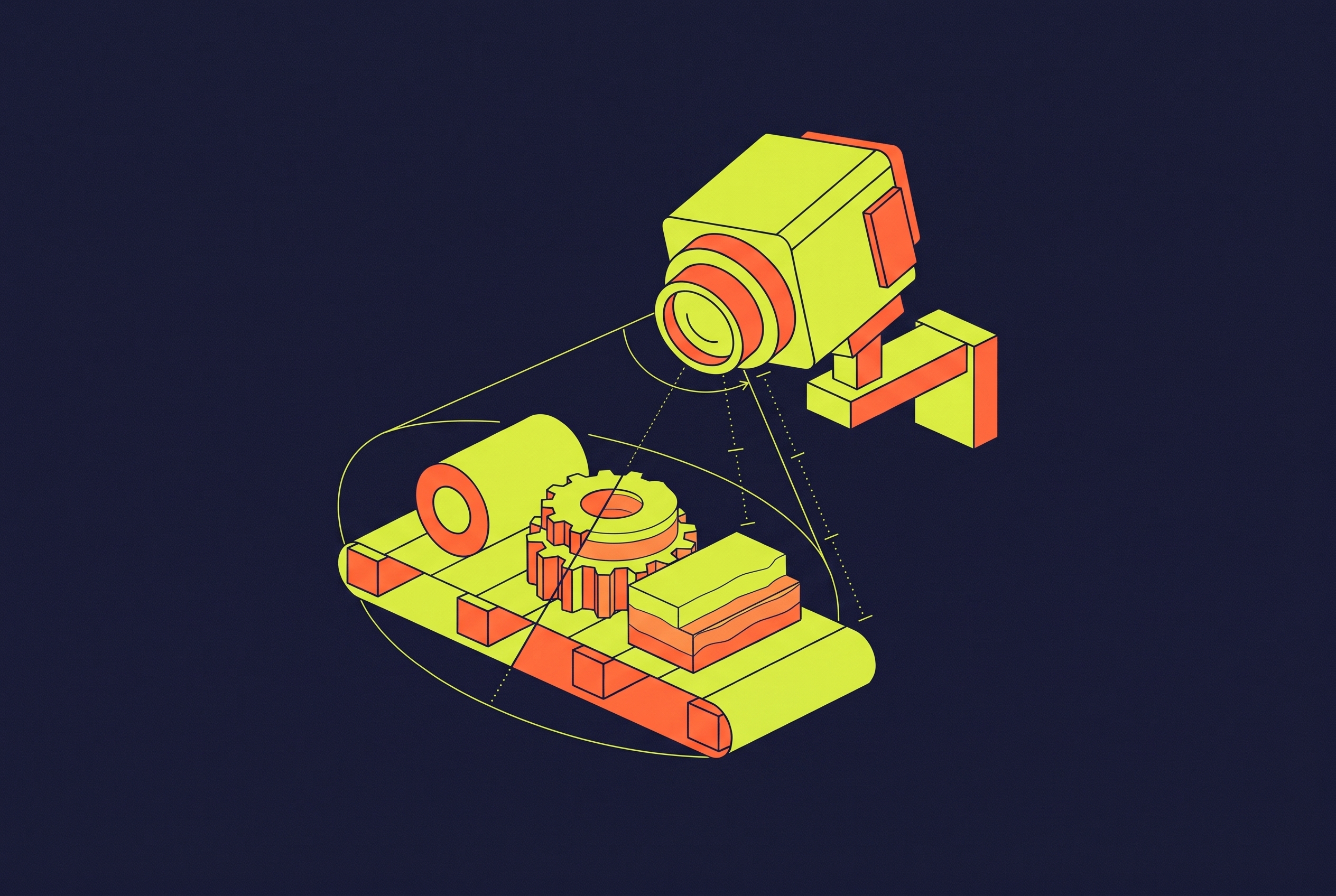
Monocular depth estimation gives industrial inspection cameras a practical path to 3D spatial awareness from a single RGB image, without stereo rigs or LiDAR. Its usefulness depends on a clear distinction between estimating spatial order and measuring physical dimensions. Matching that distinction to the inspection task, available compute, and calibration conditions turns a promising depth map into a deployable inspection tool.
Why industrial inspection cameras need depth information and what has prevented single-camera solutions until recently
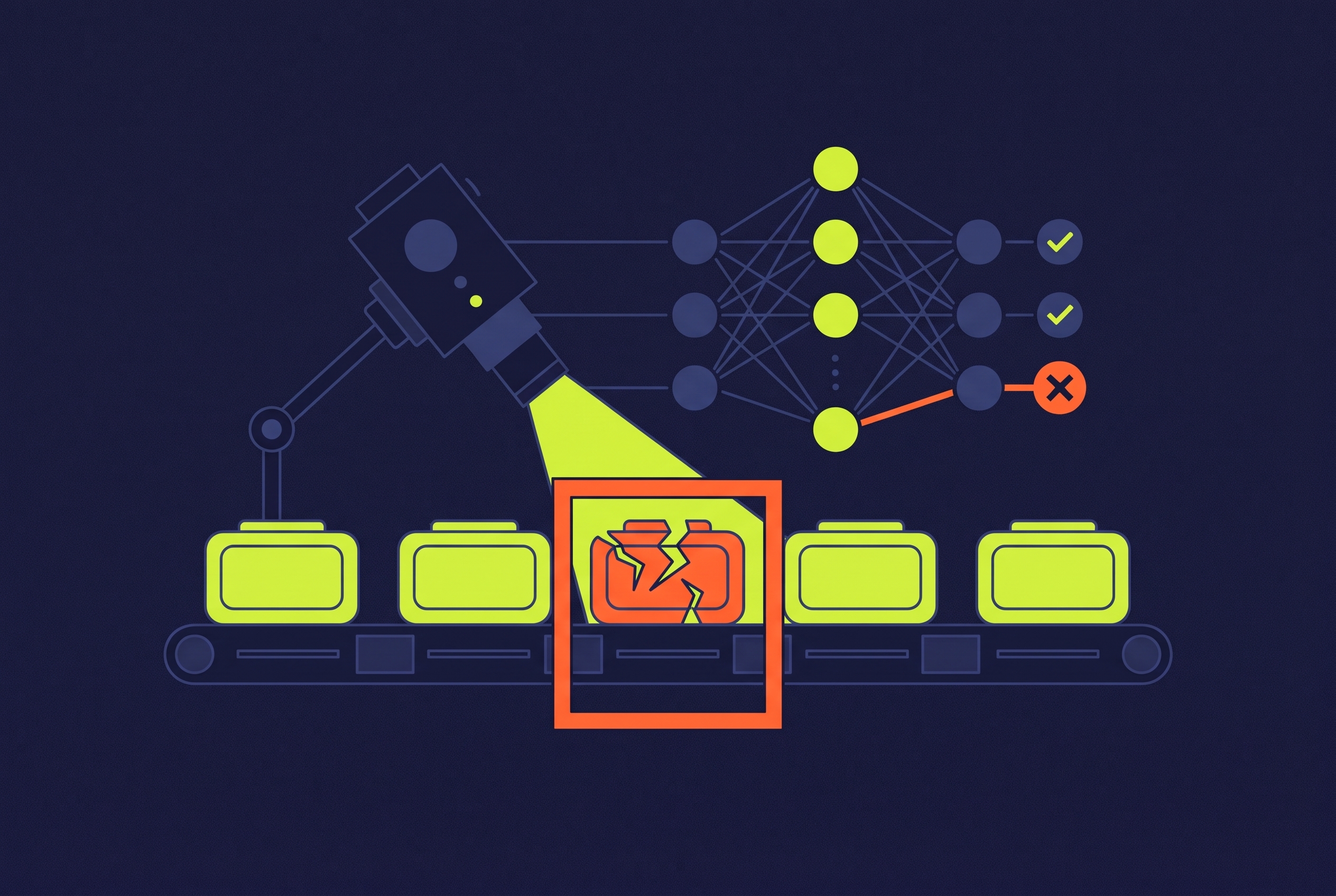
Industrial inspection depends on geometry that a flat image cannot directly supply, including surface topology, dimensions, and defect depth. Projection from a three-dimensional scene removes that information. Zhao et al.’s weld defect study in Sensors, 2026, identifies complex ambient lighting, oil contamination, and low-contrast surface textures as sources of high false alarm rates in 2D optical inspection. Judging a surface defect by how it looks alone can therefore be unreliable. Depth offers another way to distinguish its geometry from the surrounding image.
High-precision 3D laser scanning is costly and demands stringent installation and calibration, limiting its use in small and medium-sized enterprises and across large production lines. Structured-light sensors and LiDAR are at the high end, while stereo needs two synchronised cameras and precise baseline geometry. Monocular depth estimation, or MDE, provides a third path by predicting geometry from one RGB image. The practical attraction is retrofitting existing single-lens cameras.
What monocular depth estimation actually computes: the two output types and what separates them
MDE produces a per-pixel depth map from a single RGB frame, but those values can represent two different kinds of output. Relative depth estimates geometry up to an unknown shift and scale, providing near-to-far ordering. Metric depth instead predicts values at a physical scale. Ultralytics YOLO26 documentation, 2026, describes metric output in which each pixel holds an estimated distance in meters from the camera to the corresponding surface point. The distinction determines what an inspection system can conclude.
Relative depth gives up scale to generalise across domains. Metric depth retains scale, but its predictions depend heavily on camera parameters and the distribution of its training data. Neither formulation recovers information that the image directly records, because the projection has already destroyed depth information. Both must infer it from monocular cues and learned priors. Vision-transformer architectures now dominate both branches, with foundation models such as the Depth Anything family, UniDepth, and Metric3D using large and diverse training datasets to improve cross-domain generalisation.
Scale ambiguity: the specific failure mode that limits MDE in dimensional inspection tasks
Scale ambiguity is a structural constraint. A relative depth map may put surfaces in the right order but lack the scale needed to measure how far apart they are. That makes it insufficient for dimensional gauging, gap measurement, or reject thresholds expressed in physical units. The weld study explicitly states that mapping predictions to absolute physical dimensions is not strictly required in its framework. That is a defensible boundary for defect classification, but it does not establish dimensional measurement capability.
Metric output does not remove every scale-related difficulty either. The values in metric output depend on camera parameters, and differences between the depth distributions used in training and those seen in deployment can make losses unstable during conventional fine-tuning. A model producing distances in meters can therefore remain poorly suited to a particular camera and scene. The output unit is not an accuracy guarantee. Moving from defect classification to comparison with a tight engineering tolerance makes this distinction consequential.
A separate limitation concerns where the model is accurate. Standard MDE commonly uses a uniform pixel-wise objective that does not distinguish an inspection target from its background. Du et al.’s FocusDepth study, arXiv, 2026, shows that even when depth is good across the full image, target-local geometry can be unreliable under region-aware evaluation. Disrupting prompt-geometry correspondence increased AbsRel by up to 13.8% in the study. A small weld bead or surface crack can therefore need more attention than an image-wide score suggests.
What metric models and intrinsic-free architectures do to close the scale gap in practice
Recent architectures address scale by using camera intrinsics or by inferring camera geometry jointly with depth. Metric3D v2 and Depth Anything 3 Metric-L need the camera’s focal length to scale canonical model output into metric depth. This provides a route from learned geometry to physical units. It does not make residual error negligible, however, and both retain meaningful AbsRel error on embedded hardware common to industrial deployments. Tight-tolerance gauging is still hard even when scale is addressed.
Intrinsic-free architectures take a different route through the same problem. UniDepth V2 infers camera geometry on its own, though known camera parameters can still improve its results. These approaches narrow the scale gap, but how well they work still depends on the camera and scene conditions. A team also cannot count on conventional fine-tuning with a small dataset of its own to produce stable metric output.
How inspection use cases map onto the relative-versus-metric choice
For defect classification, surface anomaly ranking, free-space detection, and obstacle proximity, spatial ordering can be enough without physical measurement. The weld study uses classification of normal versus missed welds without needing absolute dimensions. Relative depth is therefore not merely a lower-quality substitute for metric depth. It answers a different question, and its ability to generalise across domains can be useful when that question requires ordering alone.
Dimensional gauging, gap measurement, absolute-size reject thresholds, and process monitoring against engineering tolerances require real-world units. Those tasks need metric depth or measurements from another source. Midwinter et al.’s civil infrastructure work in Structural Health Monitoring, 2025–2026, applies MDE to defect quantification and finds that pre-tuned vision transformers greatly outperform fully convolutional neural network-based methods. The approach also reduces data collection effort and cost compared with traditional RGB-D dataset collection. That result supports the value of learned depth for inspection without making relative output sufficient for every quantification task.
For practitioners, the decision rule follows the required output. Monocular depth fits installed-camera deployments where ranking is enough, while stereo fits situations where a machine acts on real units. LiDAR is appropriate where range and darkness rule cameras out. Learned shape priors can support depth estimation under glare or with transparent objects where structured-light sensing fails, giving MDE a role even when other depth hardware is present.
Compute and speed realities for edge deployment: what current hardware can sustain
Edge deployment imposes a substantial speed-accuracy trade-off before pipeline integration begins. On Jetson AGX Orin, Depth Anything 3 Metric-L runs far faster than Depth Pro at similar accuracy, making model choice consequential for real-time operation. Yet even the best metric models still have meaningful AbsRel error. MoGe-2-L, UniDepth V2-B, and Metric3D v2-L have much lower error under oracle-scale evaluation, but this needs per-image scale correction that is unavailable in zero-shot deployment.
Depth Anything V2 inference times vary widely across Small, Base, Large, and Giant models, allowing selection against power and latency budgets. Larger models are not automatically the practical choice. Low-power industrial PCs, embedded devices, and cost-capped camera nodes face power and cost limits as well as accuracy requirements. The architecture must work within those limits, even if a benchmark result comes from conditions the deployment cannot sustain.
YOLO26-Depth produces metric-scale output on a log scale without a hard distance limit, spanning scenes from a few centimetres to very long range within one model family. Its native depth task shares the export path used for detection, segmentation, and pose, including ONNX, TensorRT, CoreML, NCNN, LiteRT, and OpenVINO. This reduces the second-framework integration cost of combining detection and depth. Even with support for a broad range and easier export, teams still need to check accuracy and latency where the model will run.
Why cross-paper accuracy comparisons — and vendor claims — are unreliable, and what to benchmark instead
Published accuracy figures are not a common deployment specification. Evaluation remains insufficiently standardised, so comparisons across papers and vendors can combine unlike conditions. Oracle-scale evaluation uses per-image correction and reports substantially lower error than zero-shot conditions, with the distinction not always disclosed in abstracts or headline claims. The comparison is incomplete unless the scale treatment is understood.
Dataset differences create another source of uncertainty. Standard indoor and outdoor benchmarks such as NYU Depth V2 and KITTI do not capture the full domain shift to industrial scenes. A model leading on NYU Depth V2 may not outperform a smaller, faster model on a welding line or an infrastructure inspection task. Full-image scores also leave uncertainty about the small foreground regions on which an inspection decision depends. Benchmark standing alone cannot resolve either problem.
The practical response is evaluation on the target environment. Teams should run candidate models on held-out frames from that environment before committing to a deployment architecture. That comparison needs to match the relative or metric task and use the scale information that will be available when the system runs. It also needs to distinguish useful target geometry from good average image performance.
Deployment integration: calibration, pipeline structure, and the cases where MDE complements rather than replaces other sensors
Successful deployment depends on calibration and pipeline structure as much as model choice. Teams should audit camera metadata before selecting a model family, since metric approaches benefit from true focal length and other known intrinsics. Intrinsic-free models reduce dependence on supplied parameters but do not make those parameters irrelevant. Target-domain fine-tuning can improve results, but the scale and distribution issues described above make metric adaptation harder. Calibration requirements belong in the architecture decision.
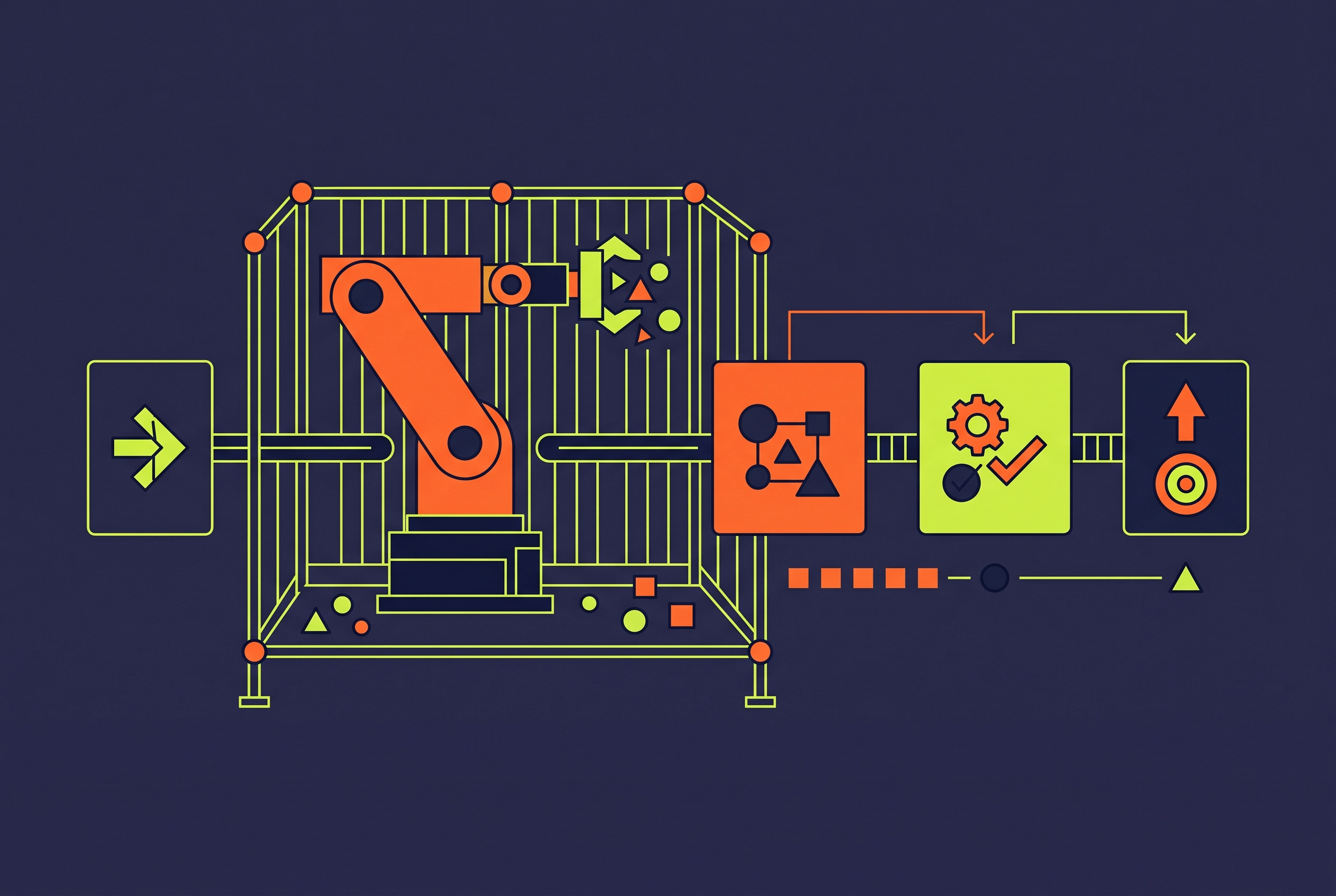
The inspection region also needs an explicit role. FocusDepth uses box or text prompts to prioritise foreground accuracy and boundary fidelity by combining Segment Anything Model 3 spatial selectivity with the Depth Anything family. This addresses the uniform-objective limitation where a small or low-contrast target sits against a complex background. It remains a relative depth framework, however, rather than a solution to absolute dimensional measurement. Better attention to the target and recovery of physical scale are separate requirements.
YOLO26 keeps both tasks within one package, one installation, and one export path, reducing maintenance overhead on production lines. It does not combine them into one forward pass. Depth has its own checkpoint and returns a depth map rather than detection boxes or segmentation masks, so the combined workflow still runs two models.
For tight-tolerance gauging, MDE can serve as a first-pass geometric filter alongside precision measurement. That filter can reduce the volume of parts routed to higher-cost structured-light or contact measurement. Learned shape priors also make MDE a useful fallback or parallel channel when glare or transparent surfaces defeat structured light, while worker and equipment proximity monitoring can benefit from spatial ordering. These roles establish a practical scope for single-camera depth.
Sources
- Focusable Monocular Depth Estimation
Provided the FocusDepth findings on target-local depth reliability and prompt-guided foreground accuracy.
- Industrial Weld Defect Detection Based on Monocular Depth Estimation and Dual-Attention Point Cloud Network - PMC
Supplied the weld defect study's findings on 2D inspection false alarms and why absolute dimensions were not required for classification.
- Survey on Monocular Metric Depth Estimation
Covered metric depth models, their reliance on camera intrinsics, oracle-scale versus zero-shot evaluation, and edge speed-accuracy trade-offs.
- Industrial Weld Defect Detection Based on Monocular Depth Estimation and Dual-Attention Point Cloud Network
Published version of the weld defect study, source for the lighting, oil contamination, and low-contrast texture limits of 2D inspection.